Team Career Plan B · August 13, 2026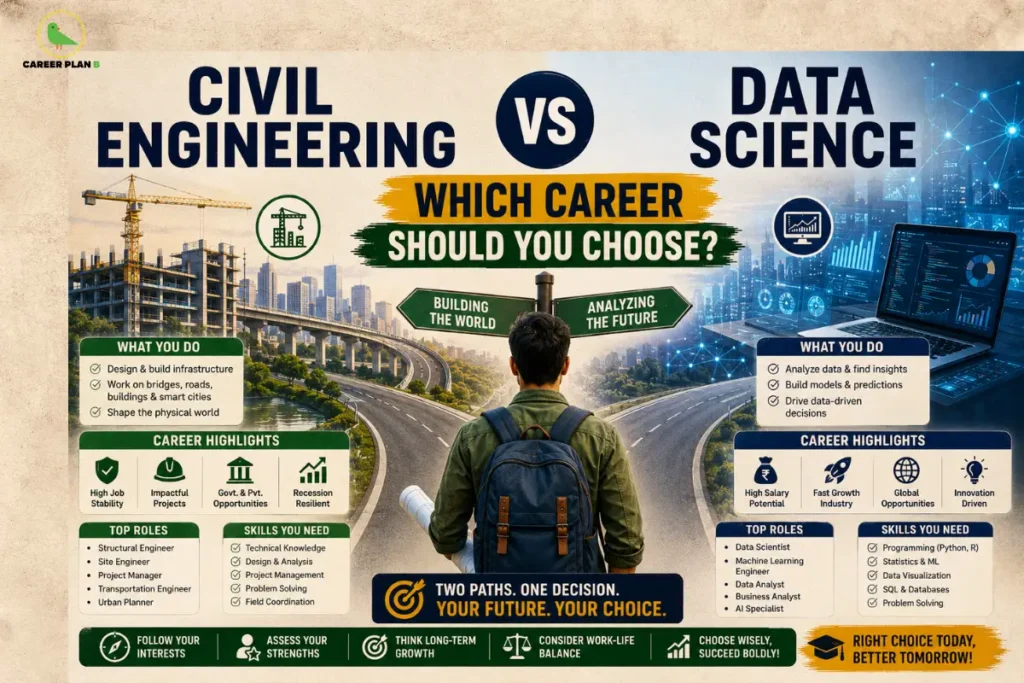
Introduction
Two careers. Two completely different worlds. One builds flyovers, dams, and smart cities. The other builds algorithms, prediction models, and data pipelines. And right now, thousands of students across India are stuck at the same crossroads civil vs data science unsure which direction to take.
It is a genuinely difficult choice. Civil engineering is time-tested, stable, and backed by massive government investment. Data science is fast-growing, high-paying, and increasingly relevant across every industry. Both promise strong futures. But they demand very different personalities, skill sets, and long-term commitments.
This blog breaks down both careers side by side: what they involve, what they pay, where they are headed, and most importantly, how to figure out which one is the right fit for you.
What Does a Civil Engineer Actually Do?
A civil engineering career is built around designing, constructing, and maintaining the physical infrastructure that society depends on: roads, bridges, buildings, water supply systems, airports, and urban planning projects.
On any given day, a civil engineer might be:
- Preparing structural designs and construction drawings
- Supervising on-site construction and quality checks
- Conducting soil and material testing
- Working with government bodies on infrastructure tenders
- Managing timelines, budgets, and contractor teams
Who Is Civil Engineering Best Suited For?
Civil engineering is a strong fit if you enjoy working with physical, tangible outcomes. If you like being on-site, solving real-world construction problems, and contributing to projects that visibly change landscapes and communities, this career rewards that temperament deeply.
What Does a Data Scientist Actually Do?
A career in data science revolves around collecting, processing, and analysing large volumes of data to generate insights and build predictive models that help organisations make smarter decisions.
A data scientist’s typical responsibilities include:
- Cleaning and organising raw datasets
- Building machine learning models and statistical analyses
- Visualising data trends for business or research teams
- Writing code in Python, R, or SQL
- Translating complex data findings into actionable recommendations
Who Is Data Science Best Suited For?
Data science suits those who enjoy working with numbers, patterns, and logic and who are comfortable spending long hours in front of a screen. If you are naturally curious about why things happen and enjoy finding answers in data, this field can be deeply satisfying.
Civil vs Data Science: A Direct Comparison
Here is an honest, side-by-side engineering career comparison to help you see both paths clearly:
| Parameter | Civil Engineering | Data Science |
|---|---|---|
| Core Education | B.Tech Civil Engineering | B.Tech (Any Stream) + Data Skills / M.Tech / Bootcamp |
| Primary Skills | Structural Design, Site Management, GIS | Python, Machine Learning, Statistics, SQL, Data Visualization |
| Work Environment | Office + Field (Outdoor Exposure) | Primarily Desk-Based and Remote-Friendly |
| Entry-Level Salary (India) | ₹4–7 LPA | ₹5–9 LPA |
| Senior-Level Salary (India) | ₹18 LPA+ | ₹25–40 LPA+ |
| Job Market (India) | Stable, Government + Private | Competitive but Rapidly Expanding |
| Growth Trajectory | Steady, Project-Based | Fast, Skill-Based |
| Government Job Scope | Very High (NHAI, PWD, UPSC ESE) | Moderate (Growing in Public Sector Data Roles) |
Career in Data Science Scope and Reality
The career in the data science space in India is genuinely booming. According to the U.S. Bureau of Labour Statistics, data science roles are projected to grow by 36% through 2033 far faster than most other professions. India is mirroring this trend with rapid demand from tech, banking, healthcare, and e-commerce sectors.
However, the reality is also competitive. Entry into quality data science roles requires the following:
- Strong foundation in mathematics and statistics
- Proficiency in Python or R
- Understanding of machine learning algorithms
- Hands-on experience through projects or internships
For learning data science through government-supported platforms, explore:
- NPTEL (National Programme on Technology Enhanced Learning)
- MeitY’s Digital Skill initiatives: Visit the Ministry of Electronics and Information Technology for government-backed digital skilling programmes
- National Skill Development Corporation (NSDC): Offers skilling programmes including data analytics
Civil Engineering Career Scope and Reality
India’s civil engineering career landscape is backed by one of the largest public infrastructure investments in the world. The National Infrastructure Pipeline (NIP) has allocated over ₹111 lakh crore for infrastructure projects through 2025, spanning roads, railways, urban development, and housing.
This means consistent demand for civil engineers across both government and private sectors.
Key government recruiters and official portals:
- National Highways Authority of India (NHAI)
- Ministry of Road Transport and Highways (MoRTH)
- UPSC Engineering Services Examination (ESE/IES): The premier exam for government civil engineering roles
- GATE for M.Tech admissions
- AICTE for approved civil engineering programmes
Civil engineering offers strong job security, clear career progression, and the satisfaction of contributing to nation-building projects.
Can a Civil Engineer Switch to Data Science?
This is one of the most searched questions in the civil engineering vs data science debate, and the answer is a clear yes, but with effort.
Switching from civil to data science is increasingly common. Civil engineers bring valuable strengths to the data world:
- Strong analytical and problem-solving mindset
- Experience with large-scale project data
- Familiarity with GIS, which intersects powerfully with spatial data science
What you will need to add:
- Python or R programming skills
- Statistics and machine learning fundamentals
- Portfolio projects demonstrating data science skills
- Relevant certification or a postgraduate programme
The intersection of data science for engineers with civil domains like smart city analytics, traffic prediction models, and structural health monitoring is an emerging niche that civil engineers are uniquely positioned to occupy.
Have Any Doubts?
How to Decide 5 Questions to Ask Yourself
Still unsure about the best career choice for students between these two paths? Work through these five honest questions:
- Do you prefer working outdoors or at a desk? Civil engineers spend significant time on-site. Data scientists work almost entirely at a computer.
- Are you drawn to physical outcomes or digital insights? Do you want to see a bridge you designed or a model you built predicting customer behaviour?
- How strong is your interest in coding and mathematics? Data science demands consistent comfort with both.
- Are you looking for government job stability or private sector growth? Civil engineering has deeper government job roots; data science thrives in the private and startup ecosystem.
- What does your 10-year vision look like? Picture yourself at 35. Which work environment excites you more?
There are no right or wrong answers. The goal is honest self-reflection.
How Career Plan B Helps
Choosing between civil and data science is not just about comparing salaries or job numbers; it is about understanding your own strengths, interests, and long-term fit. Career Plan B helps you do exactly that. Their Psycheintel Career Assessment Tests are designed to identify your natural aptitude and working style, giving you a data-backed answer to this very question. Their personalised career counselling helps you explore both paths honestly, while career roadmapping ensures that whichever direction you choose, you have a clear, actionable plan to get there. For students considering M.Tech or data science certifications, their admission and academic profile guidance can help you target the right institutions and programmes.
For Latest Information
Frequently Asked Questions (FAQs)
- Is data science better than civil engineering in terms of salary?
In the short- to mid-term, data science roles in the private sector tend to offer higher salaries, especially at the senior level. However, civil engineering offers strong government pay scales, job security, and pension benefits that data science roles in the private sector typically do not.
- Can a civil engineering student learn data science?
Yes. Many civil engineers have successfully transitioned to data science roles. The analytical foundation of civil engineering is a genuine advantage. Adding Python, statistics, and machine learning skills through platforms like NPTEL or postgraduate programmes makes the switch achievable.
- Which career has more job security in India?
Civil engineering traditionally offers stronger job security, especially through government recruitment via UPSC ESE and state PSCs. Data science job security depends more on skill relevance and continuous upskilling in a fast-changing field.
- What is the best stage to make this decision?
Ideally before or during your undergraduate years, so you can align your electives, projects, and internships accordingly. However, a switch is possible even after graduation with the right guidance and skilling plan.
Conclusion
The civil vs data science debate does not have a universal winner. Civil engineering offers nation-building impact, strong government opportunities, and a stable career path. Data science offers rapid growth, high earning potential, and the flexibility to work across industries.
The best career is not the most popular one on LinkedIn or the one your relatives recommend at family gatherings. It is the one that aligns with how your mind works, what kind of work energises you, and where you want to be in ten years.
If you are still unsure, do not guess; get assessed. Visit Career Plan B to take a career assessment and speak with an expert who can help you make this decision with confidence.