Team Career Plan B · August 13, 2026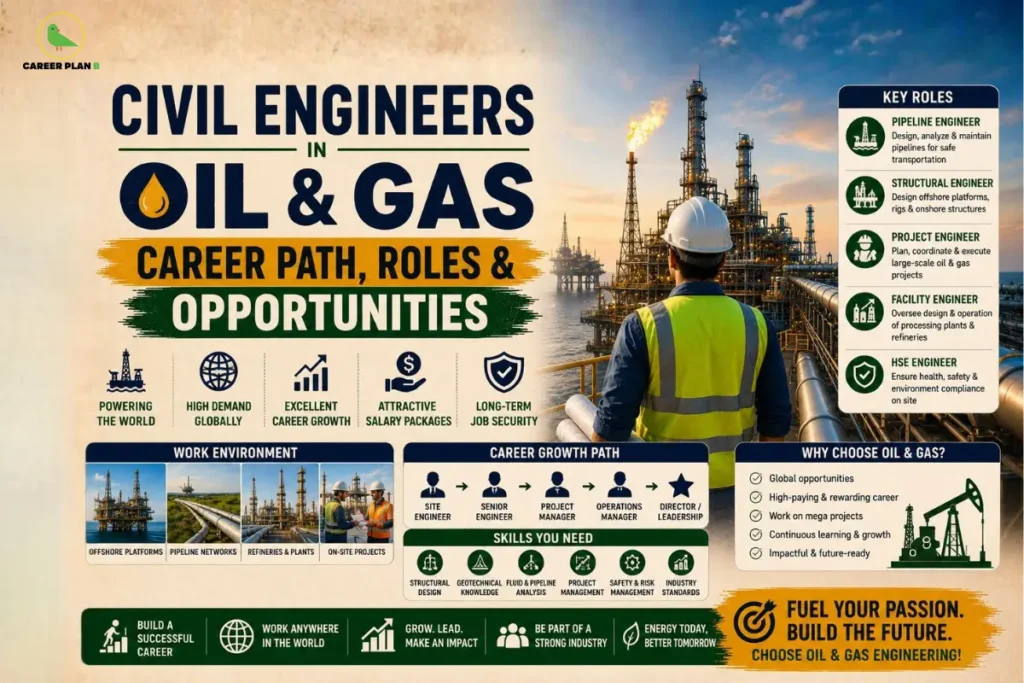
Introduction
When most people picture the oil and gas industry, they think of petroleum engineers, drilling rigs, and offshore platforms. Civil engineers rarely come to mind. Yet the truth is that without civil engineers in oil & gas, none of those rigs, refineries, pipelines, or processing plants would ever get built.
Every oil refinery needs a structurally sound facility. The pipeline needs precise geotechnical planning and route engineering. Every offshore platform needs a foundation designed to withstand extreme marine conditions. Every storage terminal needs civil infrastructure connecting it to ports, roads, and rail. That is all civil engineering, and it represents one of the most lucrative, globally mobile, and underexplored career paths available to civil engineering graduates today.
Yet most students never consider it. This blog changes that. Here is a complete breakdown of the career path for civil engineers in oil & gas from roles and education to employers, salary, and how to get started.
Why Does the Oil & Gas Sector Need Civil Engineers?
The oil and gas sector is fundamentally an infrastructure-heavy industry. Before a single barrel of oil is extracted or refined, an enormous amount of civil engineering work must happen: site preparation, structural design, road and port access, pipeline routing, environmental assessments, and facility construction.
Civil engineering in the energy sector underpins every stage of the oil and gas value chain:
- Upstream: Site development, drilling pad construction, access roads in remote terrain
- Midstream: Pipeline infrastructure design, pump stations, river crossings
- Downstream: Refinery civil works, storage tank foundations, port and jetty construction
India’s oil and gas sector is expected to attract investments of over $100 billion by 2030, according to the Ministry of Petroleum and Natural Gas. That scale of investment means continuous, large-scale civil engineering demand.
Civil Engineering vs Petroleum Engineering in This Sector
Petroleum engineers focus on extraction, reservoir management, and drilling. Civil engineers focus on the physical infrastructure that supports those operations. Both are essential; they just work at different layers of the same project.
Key Roles for Civil Engineers in Oil & Gas
The oil and gas engineering career options for civil engineers are more varied than most people realise. Here are the primary roles:
1. Pipeline Infrastructure Engineer
A pipeline infrastructure engineer designs and oversees the construction of oil and gas transmission pipelines. This includes route surveys, soil analysis, pipe foundation design, and compliance with safety standards. It is one of the most in-demand civil roles in the sector.
2. Offshore Civil Engineer
An offshore civil engineer works on the design and construction of offshore platforms, subsea foundations, and marine structures. This role demands expertise in marine geotechnics, wave load analysis, and corrosion-resistant structural design.
3. Structural Engineer Refineries and Processing Plants
A structural engineer oil and gas specialist designs the load-bearing frameworks of refineries, LNG terminals, and petrochemical plants. These structures must meet stringent safety, fire resistance, and blast-load standards.
4. Site and Construction Manager
Oversees on-ground execution of civil works at oil and gas facilities, managing contractors, timelines, budgets, and quality control across complex, multi-disciplinary projects.
5. Geotechnical Engineer
Conducts soil investigations and foundation design for drilling sites, pipelines, and heavy industrial facilities, particularly in challenging terrains like deserts, riverbeds, and coastal zones.
6. Oil and Gas Project Management
Senior civil engineers often move into oil and gas project management roles, overseeing entire project lifecycles from feasibility through commissioning, coordinating civil, mechanical, and electrical workstreams simultaneously.
Educational Path and Specialisations
The entry point for a petroleum industry job for a civil engineer’s career is a B.Tech or B.E. in civil engineering. From there, targeted specialisation significantly improves your prospects in this sector.
Recommended M.Tech. Specialisations
- M.Tech in Structural Engineering for refinery and platform design roles
- M.Tech in Geotechnical Engineering for pipeline and foundation-heavy roles
- M.Tech in Environmental Engineering for HSE and impact assessment roles
Key Certifications
- PMP (Project Management Professional): Globally recognised for project management roles in oil and gas
- NEBOSH International General Certificate: The industry standard for Health, Safety, and Environment (HSE) compliance
- OPITO Certifications: Mandatory for offshore roles.
Official Academic Resources
- AICTE for approved engineering programmes
- UGC for recognised universities
- GATE for M.Tech admissions at IITs and NITs
- Oil India Limited Training and Development programmes
Skills Required to Succeed
Technical Skills
A strong civil engineering career in the energy sector requires a specific blend of core civil and industry-specific skills:
- Structural analysis using STAAD Pro, ANSYS, or SAP2000
- Pipeline design and stress analysis fundamentals
- AutoCAD and plant design software like PDMS or E3D
- Geotechnical investigation and foundation engineering
- Environmental Impact Assessment (EIA) methodology
- Knowledge of ASME, API, and IS codes relevant to oil and gas structures
- Understanding of HSE management systems and HAZOP studies
Soft Skills That Matter in This Industry
The oil and gas environment is high-stakes and high-pressure. These soft skills are equally critical:
- Strong risk assessment and decision-making under pressure
- Ability to manage multidisciplinary teams across remote project sites
- Clear technical documentation and reporting
- Adaptability to extreme work environments: deserts, offshore platforms, Arctic conditions
- Cross-cultural communication for international projects
Have Any Doubts?
Top Employers and Salary Outlook
Government Sector
India’s public sector oil and gas companies are among the largest employers of civil engineers in the country:
- Oil and Natural Gas Corporation (ONGC)
- Oil India Limited (OIL)
- Hindustan Petroleum Corporation Limited (HPCL)
- Bharat Petroleum Corporation Limited (BPCL)
- GAIL (India) Limited
- Ministry of Petroleum and Natural Gas for sector-wide policy and recruitment context
Private and International Sector
Top private and multinational employers for petroleum industry jobs for civil engineers include L&T Hydrocarbon Engineering, Reliance Industries, Technip Energies, McDermott, Bechtel, Shell, ExxonMobil, and Halliburton.
Salary Overview
| Level | India (Per Annum) | Abroad (Per Annum) |
|---|---|---|
| Entry Level | ₹5–8 LPA | $60,000–$80,000 |
| Mid-Level | ₹12–20 LPA | $90,000–$120,000 |
| Senior Level | ₹25 LPA+ | $140,000+ |
Challenges Unique to This Sector
Every career has trade-offs. Here is what the oil and gas engineering career path genuinely demands:
- Remote and offshore postings: Many projects are located in deserts, deep forests, or offshore locations far from urban centres; extended site stays are common
- Strict HSE compliance: Oil and gas is one of the highest-risk industrial environments. Non-compliance with safety standards has serious professional and legal consequences
- Volatile industry cycles: The sector is sensitive to global oil prices. Downturns can slow hiring or lead to project cancellations. financial planning matters in this career
- Extreme working conditions: Whether it is the heat of a Middle Eastern refinery or the cold of an Arctic pipeline project, physical and mental resilience is genuinely required
- Continuous upskilling: New materials, digital construction technologies, and evolving environmental regulations mean you must keep learning throughout your career
Being aware of these realities early helps you prepare with the right mindset and skills before entering the field.
How Career Plan B Helps
If you are a civil engineering student or professional wondering whether the oil and gas engineering career path is the right fit for your strengths and personality, Career Plan B can help you find that answer with confidence. Their PsycheIntel Career Assessment Tests evaluate your aptitude, working style, and sector fit, giving you a clear, personalised picture of whether roles like offshore civil engineer or oil and gas project management align with who you are. Their Career Roadmapping service helps you plan the exact steps, the right M.Tech specialisation, certifications, and entry strategy to build a strong foundation in this sector. For students targeting postgraduate admissions, their admission and academic profile guidance ensures you present the strongest possible application.
For Latest Information
Frequently Asked Questions (FAQs)
- Can a civil engineer work in the oil and gas industry?
Absolutely. Civil engineers are among the most actively recruited professionals in the oil and gas sector. From pipeline infrastructure to offshore platforms and refinery construction, civil engineering expertise is essential at every stage of oil and gas project development.
- Which certifications are most valuable for civil engineers in this sector?
NEBOSH International General Certificate for HSE roles, PMP for project management positions, and OPITO certifications for offshore work are the most recognised. Technical software proficiency in STAAD Pro and pipeline design tools is equally important.
- What government companies hire civil engineers in oil & gas in India?
ONGC, Oil India Limited, HPCL, BPCL, and GAIL are the primary public sector employers. Recruitment is typically through campus placements, GATE scores, and company-specific written tests and interviews.
- Is oil & gas a stable career given fluctuating oil prices?
The sector does go through cycles tied to global oil prices. However, civil engineers in oil and gas tend to have more stability than petroleum or drilling engineers because infrastructure construction and maintenance continue even during market downturns. Diversifying skills to include renewable energy infrastructure further improves long-term career resilience.
Conclusion
The oil and gas industry is one of the most technically demanding, globally connected, and financially rewarding sectors that civil engineers in oil & gas can enter. From designing the foundations of offshore platforms to managing billion-dollar refinery construction projects, the scope is vast and the impact is real.
If you have the technical foundation, the appetite for challenging environments, and the drive to work on projects that literally fuel the world, this career path deserves serious consideration.
Not sure if it is the right fit for you? Visit Career Plan B to take a career assessment, speak with an expert counsellor, and get a personalised roadmap that brings clarity to your next step.
The world still runs on energy, and energy infrastructure runs on civil engineering.