Team6 · November 2, 2026
Introduction
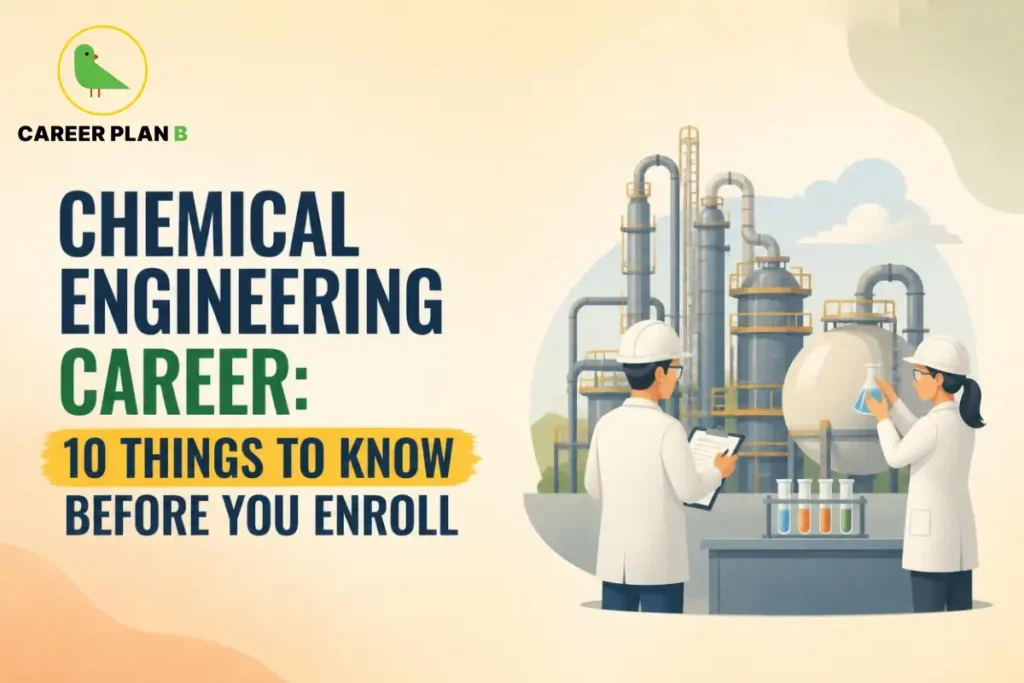
Imagine turning crude oil into fuel, developing life-saving medicines, or designing systems that purify drinking water for millions. That is exactly what a chemical engineering career can look like. Yet every year, thousands of students enroll in chemical engineering courses without truly understanding what they are signing up for.
Chemical engineering is one of the most versatile and intellectually demanding branches of engineering. It sits at the intersection of chemistry, physics, biology, and mathematics. Before you commit four years of your life (and a significant financial investment) to this field, there are some essential things you need to know.
This blog breaks down everything from what chemical engineers actually do to the skills you need, the scope of the field, and the common mistakes students make before enrolling.
What Does a Chemical Engineer Actually Do?
This is where most students go wrong. They assume chemical engineering is just “advanced chemistry”. It is not.
Chemical engineers design, optimize, and manage processes that convert raw materials into valuable products at a large, industrial scale. The keyword here is process engineering. You are not working in a lab coat running small experiments. You are designing entire production systems, managing safety protocols, and solving large-scale industrial problems.
Industries Where Chemical Engineers Work:
- Oil & Gas – refining petroleum into fuel
- Pharmaceuticals – manufacturing medicines and vaccines
- Food & Beverage – processing and preserving food products
- Petrochemicals & Plastics – producing polymers and synthetic materials
- Environmental Engineering – managing waste treatment and pollution control
- Semiconductors & Electronics – fabricating microchips and electronic components
According to the U.S. Bureau of Labour Statistics (bls.gov), chemical engineers work across nearly every manufacturing sector, making it one of the most cross-functional engineering disciplines.
Is a Chemical Engineering Course the Right Fit for You?
Before looking at colleges or chemical engineering admission processes, ask yourself an honest question: Are you genuinely interested in how things work at a molecular and industrial level?
A chemical engineering course typically covers:
- Thermodynamics – energy transfer in industrial systems
- Fluid Mechanics – movement of liquids and gases through pipelines
- Heat and Mass Transfer – how heat and materials move in processes
- Chemical Reaction Engineering – designing reactors for chemical processes
- Process Control – maintaining stability in large-scale systems
If subjects like physics, mathematics, and physical chemistry excite you, this field will feel like a natural fit. If you are drawn to pure laboratory chemistry or want to work as a research chemist, a B.Sc. in Chemistry might serve you better.
Key Chemical Engineering Skills You Will Need
Success in a career in chemical engineering is not just about academic knowledge. Employers look for a mix of technical expertise and professional competencies.
Technical Skills:
- Process simulation software (HYSYS, ASPEN, MATLAB)
- Understanding of thermodynamics and reaction kinetics
- Knowledge of safety regulations and HAZOP studies
- Proficiency in process design and plant layout
Soft Skills:
- Problem-solving – industrial problems are rarely straightforward
- Attention to detail – errors in a chemical plant can be costly or dangerous
- Communication – you will work in multidisciplinary teams
- Analytical thinking – interpreting data and drawing practical conclusions
Building strong chemical engineering skills during your undergraduate years through internships, lab work, and industry projects significantly improves your employability after graduation.
What Is the Scope of Chemical Engineering?
The chemical engineering scope is broader than most students realize. A degree in chemical engineering does not lock you into one industry. It opens doors across sectors.
Career Paths After Graduation:
| Role | Industry |
|---|---|
| Process Engineer | Oil & Gas, Petrochemicals |
| Production Engineer | Pharmaceuticals, FMCG |
| Quality Control Engineer | Food, Chemicals |
| Environmental Engineer | Waste Management, Consulting |
| Research & Development | Biotech, Materials Science |
| Plant Safety Officer | Manufacturing |
Higher Studies Options:
- M.Tech / M.S. in Chemical, Petroleum, or Environmental Engineering
- MBA in Operations or Supply Chain Management
- Ph.D. for research and academia
In India, students can qualify for postgraduate programmes through GATE (Graduate Aptitude Test in Engineering).
For global opportunities, chemical engineers are in high demand in countries like the USA, Canada, Germany, and the UAE, particularly in energy, pharma, and environmental sectors.
Have Any Doubts?
What to Expect During Chemical Engineering Admission
Getting into a reputed chemical engineering programme in India requires serious preparation.
For undergraduate admission, most students appear for the following:
- JEE Main and JEE Advanced for IITs and NITs
- State-level engineering entrance exams (MHT-CET, KCET, etc.)
Seat allotment for centrally funded institutions (IITs, NITs, and IIITs) is managed through the Joint Seat Allocation Authority (JoSAA). The official portal is josaa.nic.in.
For private universities, check individual institute portals and ensure they are AICTE-approved. You can verify approval status on the AICTE official website at aicte-india.org.
Common Mistakes Students Make Before Enrolling
Many students end up regretting their choice not because chemical engineering is bad, but because they entered it for the wrong reasons. Here are the most common pitfalls:
- Choosing it for salary alone – While the pay is competitive, the early years can be demanding. Passion matters.
- Confusing it with pure chemistry – The two disciplines are fundamentally different in approach and career outcomes.
- Ignoring specializations – Chemical engineering has sub-fields like polymer engineering, biochemical engineering, and petroleum engineering. Knowing which excites you helps in choosing the right electives and internships.
- Not researching the college’s industry connections – Placement opportunities and internship tie-ups vary significantly between institutions.
- Skipping internships – Practical exposure during your degree is not optional; it is essential.
How Career Plan B Helps
Choosing the right engineering branch is a critical decision that shapes your entire future. Career Plan B offers personalized career counselling, psychometric and career assessment tests, and structured career roadmapping to help you evaluate whether a chemical engineering career truly aligns with your strengths, interests, and long-term goals. Their PsycheIntel assessments and admission guidance take the guesswork out of one of life’s biggest choices.
For Latest Information
Frequently Asked Questions (FAQs)
1. What is the average salary in a chemical engineering career?
In India, entry-level chemical engineers earn between ₹3.5 to ₹6 LPA. With experience and specialization, salaries can rise to ₹12 – ₹20 LPA or more, especially in oil & gas and pharmaceuticals.
2. Is chemical engineering harder than other engineering branches?
It has a steep learning curve due to its combination of chemistry, physics, and mathematics. However, students who enjoy problem-solving and applied sciences generally adapt well.
3. What do chemical engineers do on a day-to-day basis?
Most chemical engineers work on process design, troubleshooting plant operations, quality control, safety audits, and coordinating with cross-functional teams.
4. Can I switch to IT or data science after a chemical engineering course?
Yes. Many chemical engineers transition into data science, process simulation software roles, or management consulting. The analytical foundation from chemical engineering transfers well.
5. Which are the top colleges for chemical engineering in India?
IIT Bombay, IIT Madras, IIT Delhi, IIT Kharagpur, and NIT Trichy consistently rank among the best for chemical engineering programmes. Admission is via JEE Advanced and JoSAA counselling.
6. Is GATE necessary for a chemical engineering career in the public sector?
Yes. For PSU jobs (ONGC, IOCL, and BPCL) and M.Tech admissions in IITs/NITs, a strong GATE score is essential.
Conclusion
A chemical engineering career is rich with opportunity, but it demands the right mindset, strong fundamentals, and a clear sense of purpose. Before you fill out that chemical engineering admission form, take time to reflect on your interests, research the chemical engineering scope, and understand what the course truly demands of you.
The students who thrive in this field are not necessarily the ones who scored the highest in JEE. They are the ones who are genuinely curious about how things work and motivated to solve real-world problems at scale.
Do your research, seek guidance where needed, and make a choice that aligns with both your passion and your long-term goals.
Not sure which path is right for you? Visit Career Plan B today and take a career assessment to discover the field that truly matches your strengths and aspirations.