Team6 · November 2, 2026
Introduction
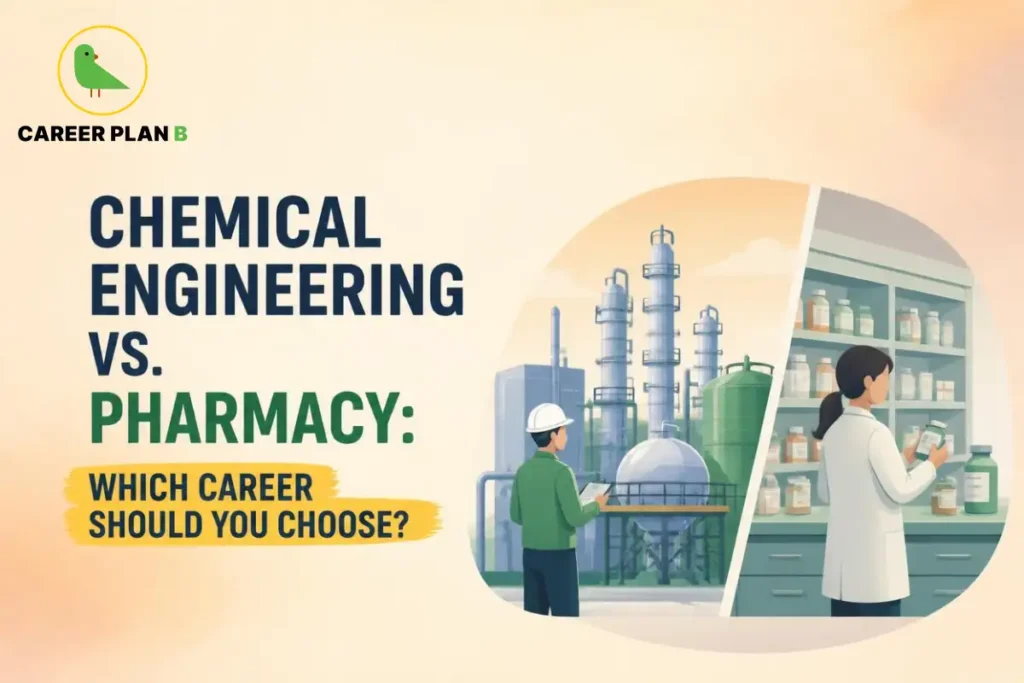
You have cleared Class 12 with PCB or PCM. The world tells you that medicine, engineering, and pharmacy are your “safe” options. But somewhere between entrance exam prep and college brochures, you find yourself stuck at a crossroads: chemical engineering vs pharmacy.
Both fields are rooted in chemistry. Both offer strong career prospects. And both can lead to well-paying, respected professions. Yet they are fundamentally different in what you study, where you work, and what kind of problems you solve every day.
This blog breaks down the chemical engineering vs pharmacy debate in a clear, honest way, comparing scope, salary, skills, career paths, and who each field is truly best suited for. By the end, you will have a clearer picture of which direction aligns with your strengths and goals.
What Is Chemical Engineering?
Chemical engineering is a branch of engineering that focuses on designing, optimising, and managing large-scale industrial processes. Chemical engineers work on converting raw materials crude oil, natural gas, minerals, and biomass into useful products like fuel, medicines, plastics, and food ingredients.
Core Subjects in Chemical Engineering:
- Thermodynamics and Heat Transfer
- Fluid Mechanics and Process Engineering
- Chemical Reaction Engineering
- Mass Transfer Operations
- Process Control and Plant Design
Chemical engineers work across industries including oil and gas, pharmaceuticals, food processing, environmental engineering, and semiconductor manufacturing. It is an engineering discipline at heart, heavy on mathematics, physics, and applied problem-solving.
What Is Pharmacy?
Pharmacy is a healthcare science focused on the preparation, dispensing, and safe use of medicines. A pharmacy degree, whether B.Pharm, M.Pharm, or Pharm.D, trains you to understand how drugs work in the human body, how they are formulated, and how they interact with biological systems.
Core Subjects in Pharmacy:
- Pharmacology and Pharmacognosy
- Pharmaceutical Chemistry
- Drug Formulation and Dosage Design
- Clinical Pharmacy and Therapeutics
- Pharmaceutical Jurisprudence (Drug Laws)
Pharmacy professionals work in hospitals, retail pharmacies, pharmaceutical companies, drug regulatory agencies, and research institutions. It sits firmly at the intersection of chemistry, biology, and healthcare.
The Pharmacy Council of India (PCI) is the statutory body that regulates pharmacy education in India. You can verify college approvals and course standards on their official website at pci.nic.in.
Chemical Engineering vs Pharmacy: Head-to-Head Comparison
Here is a side-by-side look at both fields to help you make a more informed decision:
| Parameter | Chemical Engineering | Pharmacy (B.Pharm) |
|---|---|---|
| Duration | 4 years (B.Tech) | 4 years (B.Pharm) |
| Eligibility | Class 12 with PCM | Class 12 with PCB or PCM |
| Entrance Exams | JEE Main / JEE Advanced / State CETs | NEET (for some states) / GPAT (PG) |
| Key Subjects | Maths, Physics, Chemistry | Biology, Chemistry, Pharmacology |
| Primary Focus | Industrial processes and systems | Drug development and patient care |
| Top Employers | ONGC, IOCL, Reliance, TATA Chemicals | Sun Pharma, Cipla, Dr. Reddy’s, Hospitals |
| Average Starting Salary (India) | ₹3.5 – ₹6 LPA | ₹2.5 – ₹4.5 LPA |
| Higher Studies | M.Tech, MBA, MS, Ph.D | M.Pharm, Pharm.D, MBA, Ph.D |
| Global Demand | High (Oil, Pharma, Environment) | High (Clinical, Research, Regulatory) |
For chemical engineering admissions, seat allotment through centrally funded institutions is managed by the Joint Seat Allocation Authority (JoSAA) official portal at josaa.nic.in. For engineering colleges, AICTE approval can be verified at aicte-india.org.
Which Has Better Scope: Chemical Engineering or Pharmacy?
Chemical Engineering Scope
The chemical engineering scope in India and globally is exceptionally broad. Chemical engineers are employed in core industries like petroleum refining, speciality chemicals, and agrochemicals and increasingly in renewable energy and environmental engineering.
Globally, the U.S. Bureau of Labour Statistics (bls.gov) projects steady demand for chemical engineers, particularly in biotech, environmental services, and advanced manufacturing.
In India, PSUs like ONGC, BPCL, IOCL, and GAIL actively recruit chemical engineers through GATE scores. This makes pharmaceutical engineering and process design roles particularly attractive for students who enjoy large-scale industrial work.
Pharmacy Career Scope in India
A pharmacy career in India has expanded significantly beyond the traditional role of a pharmacist behind a counter. Today, pharmacy graduates work in:
- Drug regulatory affairs
- Clinical research and trials
- Pharmaceutical sales and marketing
- Hospital pharmacy and patient counselling
- Quality assurance and control in pharma companies
For postgraduate pharmacy, the GPAT (Graduate Pharmacy Aptitude Test) conducted by NTA opens doors to M.Pharm. admissions in top institutions including NIPERs (National Institutes of Pharmaceutical Education and Research). Official information is available at niper.gov.in.
Career Options: What Can You Do After Each Degree?
After Chemical Engineering:
- Process / Production Engineer
- Plant Safety Engineer
- Environmental Engineer
- Research & Development Scientist
- Petroleum Engineer
- Quality Control Engineer
- Data Analyst (process industries)
After B.Pharm:
- Hospital or Retail Pharmacist
- Drug Regulatory Affairs Specialist
- Clinical Research Associate
- Medical Representative
- Pharmaceutical Formulation Scientist
- Quality Assurance Manager
Both fields also offer strong MBA opportunities in operations, supply chain, healthcare management, and pharma management, making career transitions across sectors very achievable.
Have Any Doubts?
Who Should Choose Chemical Engineering?
You are likely a strong fit for a chemical engineering career if you:
- Enjoy mathematics, physics, and applied problem-solving
- Are fascinated by industrial systems, manufacturing, and large-scale processes
- Want to work in core engineering sectors like oil, gas, energy, or chemicals
- Prefer process-oriented thinking over patient-facing roles
- Have a PCM background and a strong JEE preparation foundation
Who Should Choose Pharmacy?
A pharmacy career in India is likely your calling if you:
- Have a PCB background and a genuine interest in how medicines work
- Are drawn to healthcare, patient wellbeing, and drug science
- Want to work in clinical, regulatory, or research environments
- Are interested in biology and human physiology alongside chemistry
- See yourself contributing directly to public health outcomes
How Career Plan B Helps
Choosing between chemical engineering vs pharmacy is not just about marks or job salaries; it is about understanding your own strengths, interests, and long-term vision. Career Plan B offers personalised career counselling for science students, along with PsycheIntel career assessment tests and structured career roadmapping to help you identify which path genuinely suits your aptitude and personality. Their admission and academic profile guidance also helps you target the right colleges and entrance exams with confidence.
For Latest Information
Frequently Asked Questions (FAQs)
1. Which is better, chemical engineering or pharmacy, for salary?
Chemical engineering typically offers a higher starting salary (₹3.5–₹6 LPA) compared to pharmacy (₹2.5–₹4.5 LPA) at the entry level. However, pharmacy professionals in clinical research, regulatory affairs, or abroad can earn significantly more with experience.
2. Can a chemical engineer work in the pharmaceutical industry?
Absolutely. Pharmaceutical engineering is a major area where chemical engineers are in high demand, particularly in drug manufacturing, process design, and quality control. Many chemical engineers build successful careers in pharma companies.
3. Is NEET required for pharmacy admission?
NEET is required for pharmacy admissions in some states in India. However, many universities conduct their own entrance tests or admit students on the basis of Class 12 merit. Always check the specific institution’s requirements.
4. Which field is better for studying abroad: chemical engineering or pharmacy?
Both have strong global demand. Chemical engineering is particularly valued in the USA, Canada, Germany, and the UAE in the energy and manufacturing sectors. Pharmacy and clinical research are in demand across the USA, UK, and Australia.
5. What higher studies options are available after B.Pharm?
After B.Pharm, you can pursue M.Pharm, Pharm.D (post-baccalaureate), MBA in pharmaceutical management, or a Ph.D. in pharmaceutical sciences. GPAT scores are essential for M.Pharm admissions in government colleges and NIPERs.
6. Can a PCB student get into chemical engineering?
In most Indian universities, chemical engineering requires PCM (Physics, Chemistry, and Mathematics) at Class 12. PCB students typically need to have mathematics as an additional subject to be eligible for engineering admissions.
Conclusion
The chemical engineering vs pharmacy debate does not have a universal winner. The right answer depends entirely on you, your academic background, your interests, and the kind of work you want to do every day for the next several decades.
If you love working with industrial systems, processes, and large-scale manufacturing, chemical engineering is your arena. If you are passionate about medicines, healthcare, and contributing to patient wellbeing, pharmacy is where you belong.
Take the time to reflect honestly, seek proper guidance, and make a decision backed by self-awareness, not just peer pressure or perceived prestige.
Not sure which path is right for you? Visit Career Plan B today and take a career assessment to discover the field that truly matches your strengths and aspirations.