Team6 · November 2, 2026
Introduction
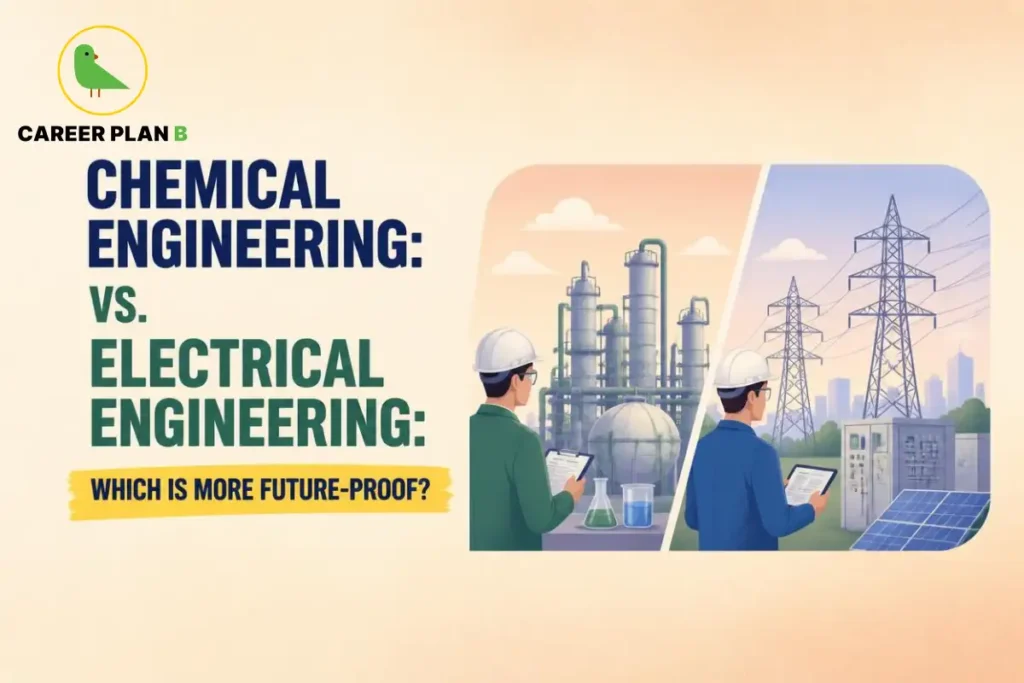
Every year, hundreds of thousands of PCM students across India face the same high-stakes question after their Class 12 results: which engineering branch should I choose? Among the many comparisons that students and parents debate, chemical vs. electrical engineering is one of the most common and one of the most genuinely difficult to answer.
Both are core engineering disciplines with strong industrial foundations. Both offer competitive salaries, PSU opportunities, and pathways to higher studies abroad. Yet they are fundamentally different in what you study, where you work, and how your career evolves over time.
More importantly, in a world being reshaped by clean energy, artificial intelligence, advanced manufacturing, and sustainability mandates, the question is not just which field pays more today; it is which field remains relevant, in-demand, and impactful over the next two to three decades.
This blog breaks down the chemical vs electrical engineering debate comprehensively, comparing career scope, future trends, salary expectations, job roles, and who each field is genuinely best suited for so you can make a well-informed, future-proof career decision.
What Is Chemical Engineering?
Chemical engineering is a branch of engineering that applies chemistry, physics, mathematics, and biology to design and optimise large-scale industrial processes. Chemical engineers convert raw materials into useful products, fuels, medicines, plastics, food ingredients, and speciality chemicals safely and efficiently.
Core Subjects in Chemical Engineering:
- Thermodynamics and Heat Transfer
- Fluid Mechanics and Process Engineering
- Chemical Reaction Engineering
- Mass Transfer and Separation Processes
- Process Control and Plant Safety
Chemical engineers work across oil and gas, pharmaceuticals, food processing, speciality chemicals, and environmental engineering and increasingly in biofuels and green hydrogen production.
What Is Electrical Engineering?
Electrical engineering focuses on the study, design, and application of electrical systems from power generation and distribution to electronics, communication systems, and control engineering. It is one of the broadest engineering disciplines, with applications ranging from household wiring to satellite communications.
Core Subjects in Electrical Engineering:
- Circuit Theory and Electromagnetics
- Power Systems and Machines
- Control Systems and Automation
- Electronics and Signal Processing
- Renewable Energy Systems and Smart Grids
Electrical engineers work across power utilities, telecommunications, electronics manufacturing, electric vehicles, renewable energy, defence, and, increasingly, artificial intelligence hardware and semiconductor design.
Chemical vs Electrical Engineering: Head-to-Head Comparison
Here is a side-by-side comparison to help you evaluate chemical vs. electrical engineering across the most important parameters:
| Parameter | Chemical Engineering | Electrical Engineering |
|---|---|---|
| Core Focus | Industrial process design and optimisation | Electrical systems, power, and electronics |
| Key Subjects | Thermodynamics, reaction engineering, fluid mechanics | Circuit theory, power systems, control engineering |
| Top PSU Recruiters | ONGC, IOCL, BPCL, GAIL, HPCL | NTPC, BHEL, POWERGRID, NHPC, PGCIL |
| Private Sector | Reliance, Sun Pharma, Cipla, UPL | Siemens, ABB, Tata Power, L&T, Samsung |
| Entry Salary (India) | ₹3.5 – ₹6 LPA | ₹3.5 – ₹6.5 LPA |
| Higher Studies | M.Tech, MS, MBA, Ph.D | M.Tech, MS, MBA, Ph.D |
| Global Demand | Oil, pharma, environmental sectors | EVs, renewable energy, semiconductors, AI |
| Emerging Sectors | Biofuels, green hydrogen, green chemistry | Smart grids, EV charging, AI chips, IoT |
Which Has Better Career Scope in India?
Chemical Engineering Career Scope
The chemical engineering career scope in India remains robust across multiple sectors. Core industries like oil refining, pharmaceuticals, fertilisers, and speciality chemicals provide stable, well-paying employment for chemical engineering graduates.
Public sector opportunities are particularly strong. PSUs like ONGC, IOCL, BPCL, HPCL, and GAIL actively recruit chemical engineers through GATE scores. These roles offer job security, competitive salaries, and excellent benefits.
The Ministry of Petroleum and Natural Gas oversees India’s energy and petrochemical sector. India’s expanding refining capacity and growing speciality chemicals sector ensure consistent demand for chemical engineers well into the future.
Additionally, chemical engineers are increasingly finding opportunities in:
- Biofuels and biorefinery operations under India’s National Biofuel Policy
- Green hydrogen production supported by the National Green Hydrogen Mission
- Environmental compliance and sustainability consulting
Electrical Engineering Future in India
The electrical engineering future in India is equally strong and, in some emerging sectors, arguably accelerating faster than most other engineering disciplines.
Key growth areas include:
- Renewable Energy: India aims to achieve 500 GW of renewable energy capacity by 2030 under its National Electricity Plan. The Ministry of New and Renewable Energy (MNRE).
- Electric Vehicles: India’s FAME (Faster Adoption and Manufacturing of Hybrid and Electric Vehicles) scheme is driving massive EV infrastructure investment.
- Smart Grid Development: The Ministry of Power is investing in smart grid modernisation across India.
- Semiconductor Manufacturing: India’s semiconductor mission aims to build domestic chip manufacturing capacity, creating new electrical engineering job opportunities in electronics design and fabrication
Future Trends: Which Field Is Growing Faster?
This is the heart of the chemical vs. electrical engineering debate, and the honest answer is that both fields are growing, but in different directions.
Chemical Engineering Trends:
- Green Chemistry and Sustainable Manufacturing: Regulations and consumer pressure are pushing industries to adopt cleaner, less wasteful processes, a space where chemical engineers lead
- Biofuels and Bio-based Materials: India’s ethanol blending programme and biorefinery investments are creating new career pathways
- Green Hydrogen: Chemical engineers are central to hydrogen production, purification, and storage system design
- Carbon Capture and Storage: As industries face carbon tax and emission reduction mandates, chemical engineers will design the systems that capture and utilise CO₂
Electrical Engineering Trends:
- Electric Vehicles and Charging Infrastructure: The EV revolution requires electrical engineers for battery management systems, motor drives, and charging network design
- AI Hardware and Semiconductor Design: The global AI boom is creating unprecedented demand for electrical engineers in chip design, embedded systems, and hardware acceleration
- Smart Grids and Energy Storage: Modernising India’s electricity grid requires electrical engineers who can integrate renewable sources, battery storage, and demand-response systems
- Drones, Robotics, and IoT: Automation and connected devices are creating entirely new application areas for electrical engineering graduates
In terms of sheer volume of emerging opportunities, electrical engineering may have a slight edge in the short term due to the explosive growth of EVs, AI hardware, and renewable energy. However, chemical engineering offers deep, irreplaceable expertise in sectors that are not going away: energy, pharmaceuticals, food, and sustainability.
Have Any Doubts?
Who Should Choose Chemical Engineering?
Considering future-proof engineering careers in India, chemical engineering is likely your best fit if you:
- Are genuinely fascinated by industrial processes, manufacturing systems, and large-scale chemistry
- Enjoy thermodynamics, applied mathematics, and physical chemistry
- Want to work in sectors like oil and gas, pharmaceuticals, specialty chemicals, or environmental engineering
- Are interested in sustainability, green chemistry, or biofuel technology
- Prefer a career with deep technical specialisation and strong PSU opportunities
Who Should Choose Electrical Engineering?
Electrical engineering is the stronger fit if you:
- Are excited by electronics, power systems, automation, and emerging technologies
- Enjoy circuit design, signal processing, and control systems
- Want to work in EVs, renewable energy, AI hardware, or telecommunications
- Are interested in software-hardware integration and embedded systems
- See yourself building the digital and energy infrastructure of the future
How Career Plan B Helps
Choosing between chemical vs. electrical engineering goes beyond comparing salary charts and job listings; it requires a deep understanding of your own strengths, aptitude, and long-term vision. Career Plan B offers personalised career counselling for engineering aspirants, PsycheIntel career assessment tests that evaluate your technical aptitude and personality fit for specific engineering disciplines, and structured career roadmapping to help you build a clear path forward. Whether you are at the stage of choosing your branch or planning your GATE and higher studies strategy, Career Plan B’s admission and academic profile guidance ensures you make a decision backed by data and self-awareness, not just peer pressure or perceived prestige.
For Latest Information
Frequently Asked Questions (FAQs)
1. Which has a better salary, chemical or electrical engineering?
At the entry level, both fields offer comparable salaries in the range of ₹3.5 – ₹6.5 LPA in India. With experience, chemical engineers in PSUs and the oil and gas sector can earn significantly more, while electrical engineers in EV companies, semiconductor firms, and AI hardware companies also command premium salaries, particularly in global markets. The chemical engineering vs electrical engineering salary gap narrows significantly with specialisation and experience.
2. Which engineering branch is better for PSU jobs?
Both branches have strong PSU recruitment pathways through GATE. Chemical engineers are recruited by ONGC, IOCL, BPCL, HPCL, and GAIL. Electrical engineers are recruited by NTPC, BHEL, POWERGRID, NHPC, and DVC. The choice depends on which sector interests you more.
3. Which is better for studying abroad, chemical or electrical engineering?
Both have strong global demand. Chemical engineering is valued in the USA, Germany, Canada, and the UAE in the energy and pharmaceutical sectors. Electrical engineering has strong global demand in the USA, Germany, South Korea, and Japan, particularly in semiconductors, EVs, and renewable energy.
4. Can a chemical engineer work in the renewable energy sector?
Absolutely. Chemical engineers play a critical role in renewable energy, particularly in biofuels, green hydrogen production, battery electrolyte development, and solar panel manufacturing processes. The best engineering branch for career growth in clean energy depends on whether your interest lies in process chemistry or electrical systems.
5. Is electrical engineering getting replaced by computer science?
Not at all. While computer science focuses on software, electrical engineering deals with hardware, power systems, and physical devices. The growth of EVs, AI chips, IoT, and renewable energy is actually increasing demand for electrical engineers, not reducing it.
Conclusion
The chemical vs. electrical engineering debate does not have a single right answer because the best choice depends entirely on your interests, strengths, and the kind of problems you want to solve over the course of your career.
Chemical engineering offers deep expertise in processes that power industries. The world simply cannot function without energy, medicines, food, and materials. Electrical engineering offers breadth and momentum, riding the wave of EVs, AI, renewable energy, and digital infrastructure.
Both are genuinely future-proof engineering careers in India when chosen for the right reasons. The question is not which field is objectively better; it is which field is better for you.
Take the time to understand your own aptitude, seek proper guidance, and make a decision that aligns with both your passion and your long-term goals.
Not sure which engineering branch is the right fit for you? Visit Career Plan B today and take a personalised career assessment to discover your ideal engineering path.