Team Career Plan B · November 2, 2026
Introduction
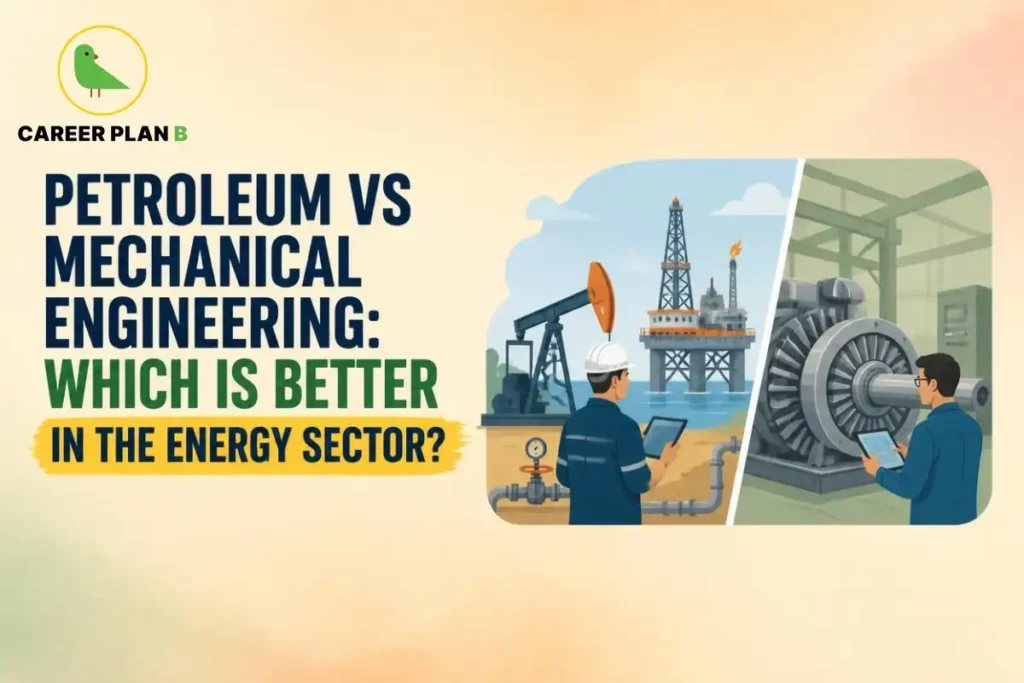
India’s energy sector is one of the largest and fastest-growing in the world and it needs engineers. But when aspirants ask about petroleum vs mechanical engineering, the answer is rarely straightforward.
Both branches feed directly into the energy sector. Both open doors to top PSUs, high-paying private roles, and international opportunities. The difference lies in how they fit into the energy ecosystem and how that ecosystem is changing.
This blog breaks down petroleum vs mechanical engineering across career scope, salary, PSU access, and future growth so you can choose the branch that truly fits your ambitions in the energy sector.
What Does a Petroleum Engineer Do in the Energy Sector?
Petroleum engineering sits at the heart of the upstream oil and gas engineering roles finding hydrocarbon reserves, designing wells, and managing the extraction of oil and natural gas from underground reservoirs.
In the energy sector, petroleum engineers work on:
- Reservoir evaluation and modelling
- Drilling programme design
- Well completion and production optimisation
- Enhanced oil recovery projects
- Offshore and deepwater field operations
The primary employers for petroleum engineers in India are ONGC and Oil India Limited, along with multinational oilfield service firms operating in Indian and international basins.
Core Roles in Petroleum Engineering
- Reservoir Engineer
- Drilling Engineer
- Production Engineer
- Well Intervention Engineer
- Subsurface Data Analyst
What Does a Mechanical Engineer Do in the Energy Sector?
Mechanical engineering in the energy sector is far broader. Mechanical engineers design, build, maintain, and optimise the machines and systems that generate, transmit, and use energy from thermal power plants to gas compressors, wind turbines, and hydrogen fuel systems.
In energy-related roles, mechanical engineers work on:
- Turbine and compressor design and maintenance
- Pipeline systems and pressure vessels
- Power plant operations and maintenance
- Rotating equipment in refineries and gas plants
- Renewable energy systems including wind and solar infrastructure
Major energy sector employers for mechanical engineers include BHEL, NTPC, IOCL, GAIL, HPCL, and Power Grid Corporation of India.
Core Roles for Mechanical Engineers in Energy
- Rotating Equipment Engineer
- Turbine Maintenance Engineer
- Pipeline Integrity Engineer
- Plant Operations Engineer
- Renewable Energy Systems Engineer
Head-to-Head Petroleum vs Mechanical in the Energy Sector
| Parameter | Petroleum Engineering | Mechanical Engineering |
|---|---|---|
| Industry Reach | Narrow; Primarily Oil and Gas | Very Broad; Power, Refining, Renewables, Manufacturing |
| PSU Access | ONGC, Oil India | BHEL, NTPC, IOCL, GAIL, HPCL, PGCIL, and More |
| GATE Paper | PE (Petroleum Engineering) | ME (Mechanical Engineering) |
| International Demand | High in the Middle East and Southeast Asia | Moderate Across Energy and Manufacturing Sectors |
| Skill Transferability | Low; Niche to Oil and Gas | High; Applicable Across Multiple Energy Industries |
| Future Adaptability | Moderate; Tied to the Fossil Fuel Sector | High; Growing Role in Renewables and Green Energy |
This energy sector engineering careers India comparison shows that mechanical engineering offers more flexibility, while petroleum engineering offers deeper specialisation in oil and gas.
Salary Comparison Who Earns More?
Mechanical vs petroleum engineer salary varies significantly depending on the sector, location, and employer.
PSU Salaries
Petroleum engineers recruited by ONGC and Oil India typically start at ₹14–20 LPA including perks at the E1 grade. Mechanical engineers in PSUs like BHEL, NTPC, and GAIL start at ₹8–14 LPA, though pay scales and benefits vary by organisation.
Private Sector
In the domestic private sector, mechanical engineers working in refineries, power plants, and EPC companies earn ₹5–10 LPA at entry level with strong mid-career growth. Petroleum engineers in private oil and gas firms start at similar levels but grow faster if they move into international markets.
International Market
Oil and gas jobs for mechanical engineers in the Middle East are plentiful rotating equipment and pipeline roles are always in demand. Petroleum engineers working in Saudi Arabia, UAE, and Kuwait can earn ₹35–70 LPA depending on seniority and employer.
Verdict: Petroleum pays more early on in oil and gas roles. Mechanical offers more consistent earning growth across a broader range of energy jobs.
Have Any Doubts?
PSU and Government Jobs Which Branch Has More Options?
For most Indian engineering aspirants, PSU recruitment through GATE is a primary goal. Here is how both branches compare.
GATE Mechanical Engineering (ME)
- One of the highest-appearing GATE papers competition is intense
- PSUs recruiting through GATE ME: BHEL, NTPC, IOCL, GAIL, HPCL, PGCIL, BPCL, BARC, DRDO, and many more
- Widest PSU recruitment base of any engineering branch
- M.Tech seats available across all IITs and most NITs
GATE Petroleum Engineering (PE)
- Niche paper with significantly fewer aspirants
- PSUs recruiting through GATE PE: ONGC and Oil India
- M.Tech seats at IIT (ISM) Dhanbad, IIT Bombay, and IIT Kharagpur
- Lower competition but fewer total openings
If GATE mechanical engineering PSU jobs are your priority, mechanical engineering wins on volume. Petroleum engineering wins on niche value within the upstream oil and gas sector.
Future Scope Energy Transition and Both Branches
India’s energy future involves both hydrocarbons and renewables and both branches have a role to play, though differently.
The Ministry of Petroleum and Natural Gas has confirmed that India’s hydrocarbon demand will continue to grow well into the 2040s. Refinery expansions, city gas distribution networks, and LNG infrastructure are all creating new petroleum engineering career in India openings over the next decade.
At the same time, the Ministry of New and Renewable Energy has set ambitious targets for solar, wind, and green hydrogen capacity. Mechanical engineers are central to building and maintaining this infrastructure from wind turbine assembly to hydrogen compression systems and thermal management in solar plants.
Mechanical engineering in the energy sector is uniquely positioned to grow in both directions fossil fuel and renewable making it more adaptable to where India’s energy mix is heading. Petroleum engineering remains strong for the next two to three decades but carries more long-term uncertainty.
How Career Plan B Helps
Choosing between petroleum and mechanical engineering in the energy sector is not just about industry trends it is about where your aptitude and interests truly lie. Career Plan B offers personalised career counselling, PsycheIntel assessments, GATE strategy guidance, and admission support to help you identify the branch and career path that matches your strengths and long-term goals.
For Latest Information
Frequently Asked Questions
- Which is better for the energy sector petroleum or mechanical engineering?
Both are valuable in the energy sector. Petroleum engineering is best for upstream oil and gas roles, while mechanical engineering covers a far wider range of energy industries including power, refining, and renewables.
- Can a mechanical engineer work in the oil and gas sector?
Yes. Mechanical engineers are widely hired in refineries, gas processing plants, and pipeline companies for rotating equipment, plant maintenance, and operations roles.
- Which branch has more PSU job opportunities through GATE?
Mechanical engineering has significantly more PSU recruitment options through GATE ME, including BHEL, NTPC, GAIL, IOCL, HPCL, PGCIL, BARC, and DRDO.
- What is the future of petroleum engineering in India?
Petroleum engineering career in India remains strong for at least the next 25 years based on India’s projected hydrocarbon demand, with new opportunities in refining, LNG, and city gas distribution.
- Is mechanical engineering good for renewable energy jobs?
Yes. Mechanical engineers play a key role in wind energy, solar thermal systems, green hydrogen production, and energy storage infrastructure all of which are growing rapidly in India.
Conclusion
The petroleum vs mechanical engineering question in the energy sector does not have one right answer it has the right answer for you.
If you want to go deep into oil and gas, build expertise in reservoir and drilling systems, and are open to international postings, petroleum engineering is a focused and rewarding path. If you want a broader career with more industries to choose from, stronger PSU options, and the flexibility to grow into renewables, mechanical engineering gives you more room.
India’s energy sector needs both kinds of engineers. The question is which role you see yourself in.
Start with clarity visit Career Plan B to find the path that fits you best.