Team5 · September 18, 2026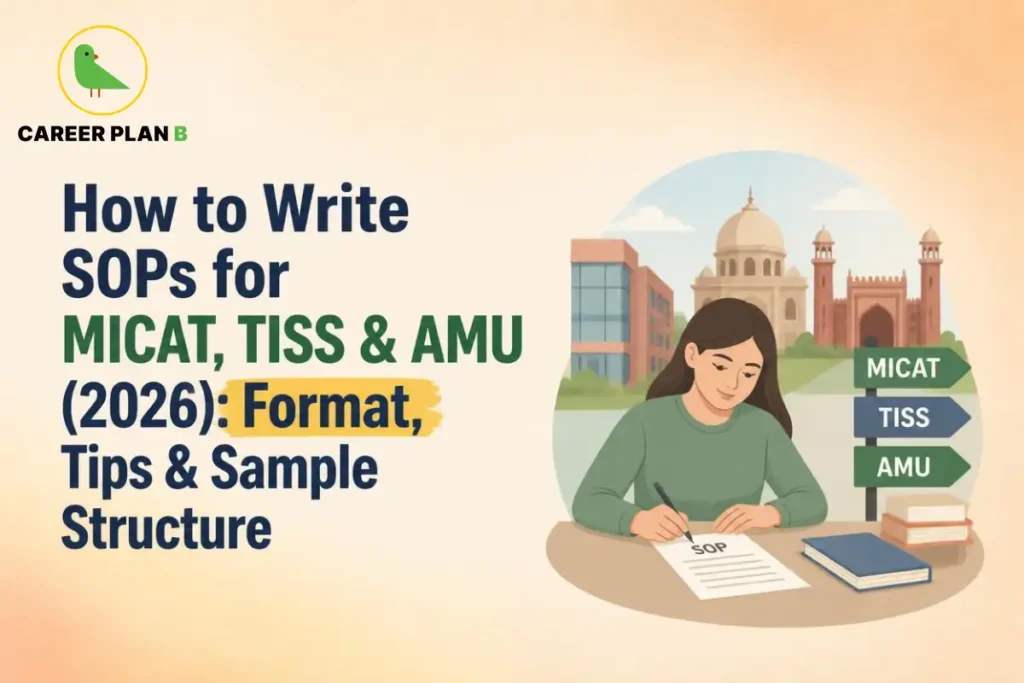
Introduction
Writing a Statement of Purpose for MICAT, TISS, and AMU means understanding something that most SOP guides skip entirely: these three institutes don’t all ask for a conventional SOP document.
What they do ask for, whether through a Personal Interview, an Online Assessment, an Extempore Reflection Test, or a creative essay, demands exactly the same clarity about who you are, why this programme, and where you’re heading. Your ability to articulate purpose is what’s actually being tested, regardless of the format it takes.
This guide breaks down what each institute’s admission process specifically requires in 2026 and how to build an SOP-quality narrative for each one.
What MICAT Actually Tests Instead of an SOP
MICA Ahmedabad does not request a formal SOP document from applicants. Its admission process runs in three stages:
CAT or XAT score, followed by MICAT’s own written exam, and then Group Exercise (GE) and Personal Interview (PI). The MICAT written component includes a Psychometric Test, Divergent and Convergent Thinking, and a Verbal Ability section, but the stage where your personal narrative gets its most direct outing is the PI.
MICAT runs twice each year, in December (MICAT-I) and February (MICAT-II), with the better score counted for evaluation. Admissions for the 2026 intake are now closed, per MICA’s official portal at (MICAT), but understanding this cycle’s format helps you prepare for 2027.
For PI preparation, your MICAT narrative should answer a key question: why marketing and communication? Generic MBA PIs may not always explore this question in detail. MICA attracts candidates interested in brand management, marketing strategy, and creative leadership rather than general management. Interview panels often explore these specific career interests.
A strong PI narrative for MICA should cover three areas. First, explain what genuinely attracted you to marketing instead of finance or consulting. Next, discuss a specific campaign, brand, or creative problem that you have studied or explored in depth. Finally, explain why MICA’s curriculum and culture suit your career goals better than a general management programme.
What TISS Actually Requires: OA, ERT, and PI
TISS Mumbai’s management admissions follow a well-structured multi-stage process for 2026. The primary route is CAT 2025 score for MA HRM and LR, where shortlisting gives 97 percent weight to CAT score and 3 percent for gender diversity. Once shortlisted, candidates appear for an Online Assessment (OA), sometimes accompanied by an Extempore Reflection Test (ERT), followed by a Personal Interview.
The total course fee for TISS’s MA HRM and LR is ₹2.35 lakh for the full programme, making it one of the most affordable management programmes in the country. The TISS MBA 2026 final merit list was released on April 20, 2026, with subsequent lists on May 5 and May 12.(TISS)
Since TISS does not require a standalone SOP, your statement of purpose largely comes through your PI performance. TISS evaluates motivation for the social sector, leadership potential, and suitability for an HR-focused management career. Interview panels explore these areas during the selection process.
A strong TISS PI narrative should show that you understand human resource management beyond its basic job description. Include a specific example of how you have encountered or considered people management, labour rights, or organisational challenges. Also explain why TISS’s blend of social sensitivity and management education fits your career goals.
Read More:- How to Write SOPs for MBA Admission: SPJAT, MICAT, VITBEE & NIPER
What AMU’s Admission Process Requires
AMU’s MBA admission runs through its own AMU Common Admission Test (AMU-CAT), conducted at Aligarh, Kolkata, and Kozhikode. After the merit list is released, shortlisted candidates appear for a Group Discussion and Personal Interview. There is no formal SOP document required at any stage of the AMU MBA admission process.
AMU MBA fees for 2026-27 are ₹32,600 to ₹77,000 for the entire course, with an annual fee of ₹16,300 to ₹38,500. Popular specializations include Hospital Administration, Agri-business, Islamic Banking and Finance, Financial Management, and International Business. Applications for the AMU 2026-27 session are processed online at AU MBA.
Your GD and PI at AMU are effectively your statement of purpose delivered verbally. The PI panel evaluates academic background, career intention, and subject knowledge in your preferred specialization. Candidates targeting Hospital Administration should be ready to discuss health sector trends, healthcare quality challenges, and why hospital management specifically interests them, not just management broadly.
For Personalized Guidance
How to Build Your Core SOP Narrative Across All Three
Even though none of these three institutes request a formal SOP document, the thinking that goes into a well-written SOP directly improves your PI performance at all three. Build your narrative around four questions before any interview.
- What specific experience or realisation led you toward this field rather than another
- What have you done between that realisation and today that reflects genuine interest, whether through coursework, extracurriculars, reading, or professional exposure
- What specifically about this institute’s programme, faculty, or culture aligns with what you’re trying to learn
- Where do you want to be professionally in five to eight years, and how does this programme bridge where you are now to that goal
Generic answers to any of these four questions will cost you in the PI round at all three institutes. Specific, honest, well-reasoned answers to all four will consistently outperform candidates with stronger entrance scores but weaker self-awareness.
How Career Plan B Helps
Translating your genuine story into a compelling interview narrative for MICAT, TISS, or AMU requires both self-knowledge and strategic communication, two things that benefit from structured guidance.
Career Plan B offers personalised career counselling, Psycheintel assessment tests, and admission profile guidance</b> to help you build and articulate a strong personal narrative.
Our career roadmapping turns your background into a coherent, interview-ready statement of purpose.
Get In Touch With Us
Frequently Asked Questions
Q1 Does MICA require a formal SOP document for MICAT admission?
No, MICA’s admission process uses a written test, Group Exercise, and Personal Interview. No standalone SOP document is required.
Q2 Does TISS require an SOP for its HRM programme?
No, TISS selects candidates through CAT or CUET PG scores, followed by an Online Assessment and Personal Interview, with no separate SOP submission.
Q3 Does AMU MBA admission involve an SOP?
No, AMU’s MBA process runs through AMU-CAT, a merit list, and a GD and PI round without a formal SOP document.
Q4 How should I prepare my “purpose” narrative if there’s no formal SOP?
Build your narrative around the four questions in this guide and rehearse specific, detailed answers to all four before any PI round.
Q5 Can the same SOP-style narrative work across all three institutes?
The core story can be the same, but the “why this institute” and specialization-specific sections must be customised for MICA, TISS, and AMU separately.
Conclusion
Writing SOPs for MICAT, TISS, and AMU means building a clear and well-developed personal narrative. This narrative should work in both a written essay and a live interview. None of these three institutes formally require a standalone SOP document in their current admission process. Instead, candidates need to explain their purpose clearly during the GE-PI, Online Assessment, and GD rounds.
Start with the four-question framework in this guide well before your interview dates. Strong performance in MICA, TISS, and AMU selection rounds depends on more than memorising impressive opening lines. Candidates should understand why they want to join the institute. They should also explain their goals clearly and show genuine interest in what the specific institute offers.