Team6 · September 22, 2026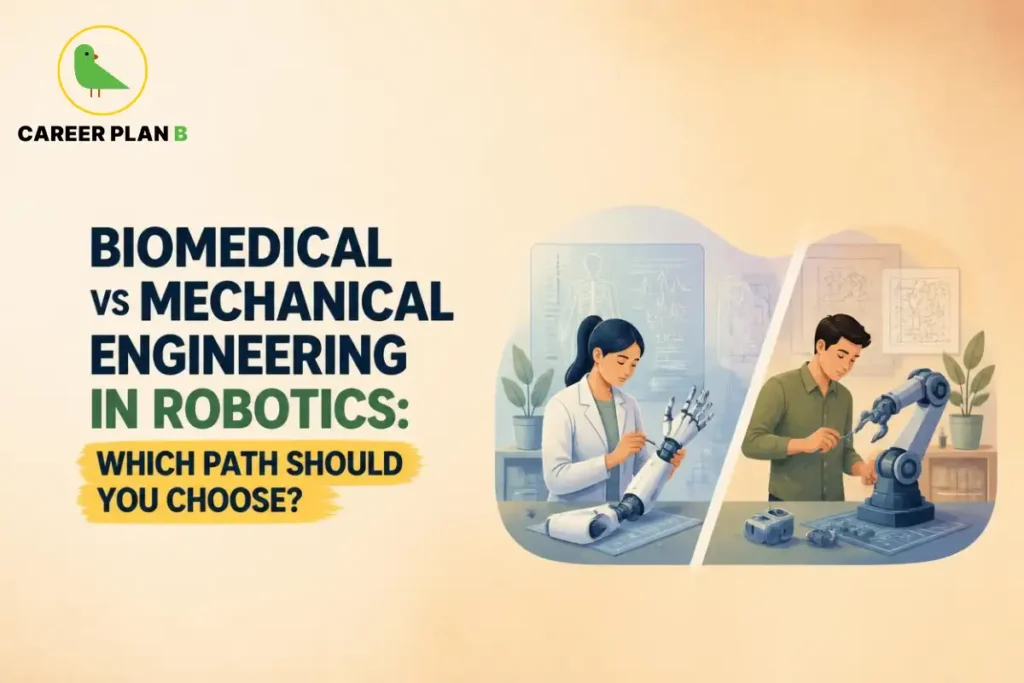
Introduction
‘Robotics’ is one word, but the engineers behind it come from very different worlds.Walk into a hospital where a robotic arm is assisting a surgeon in a minimally invasive procedure, and you will find biomedical engineers who designed the system to interact safely with the human body. Walk into an automobile manufacturing plant where robotic arms are assembling car frames with millimetre precision, and you will find mechanical engineers who designed the mechanisms, actuators, and motion systems that make it possible.
Biomedical vs mechanical engineering in robotics is a comparison that matters deeply for engineering students in India who are drawn to robotics but unsure which academic path takes them there most effectively. Both disciplines contribute to robotics but in fundamentally different ways, serving different industries, solving different problems, and building different kinds of expertise.
In this blog, we break down exactly how biomedical and mechanical engineers fit into the robotics world, what roles they occupy, what they earn, and most importantly, which path is the right fit for you based on what you want to build and who you want to serve.
What Is the Core Difference Between Biomedical and Mechanical Engineering in Robotics?
Before comparing careers and salaries, it is important to understand what actually separates these two engineering disciplines when applied to robotics.
Mechanical Engineering in Robotics focuses on the physical design and mechanics of robotic systems: the structure, kinematics, actuators, materials, and motion control that make a robot move. Mechanical engineers think about forces, tolerances, energy efficiency, and durability. Their robots are built to operate in factories, warehouses, defence systems, aerospace environments, and general-purpose automation settings.
Biomedical Engineering in Robotics focuses on robots that interact directly with the human body: surgical robots, rehabilitation exoskeletons, prosthetic limbs, and assistive devices for people with disabilities. Biomedical engineers think about biocompatibility, patient safety, human anatomy, clinical regulatory compliance, and how a robotic system affects biological tissue and human physiology.
The biomedical engineering robotics scope is therefore a specialised subset of the broader robotics field deeper in its human-centred focus, more regulated in its development process, and increasingly in demand as healthcare systems around the world adopt robotic technology at scale.
Both paths are valid and valuable. The difference lies entirely in which application domain excites you more: general robotics and industrial automation or human-centred medical robotics.
Where Do Mechanical Engineers Fit in the Robotics World?
Mechanical engineers are the backbone of the traditional robotics industry. Their training in mechanics, thermodynamics, materials science, manufacturing processes, and control systems gives them the foundational skills to design and build robotic systems across the widest possible range of applications.
In robotics, mechanical engineers work in:
- Industrial automation designing robotic arms and automated production lines for automotive, electronics, and consumer goods manufacturing
- Defence robotics building unmanned ground vehicles, bomb-disposal robots, and remote warfare systems
- Aerospace robotics developing robotic systems for satellite assembly, spacecraft maintenance, and planetary exploration
- Agricultural robotics designing automated harvesting, seeding, and crop monitoring systems
- Logistics and warehousing building autonomous mobile robots for warehouse fulfilment and supply chain automation
Key employers for mechanical engineers in robotics in India include DRDO for defence robotics and ISRO for space robotics, two of the most prestigious government research destinations for engineering graduates in India.
Can Mechanical Engineers Work in Medical Robotics?
Yes, and many do. However, crossing into medical robotics as a mechanical engineer typically requires additional knowledge in biomedical sciences, human anatomy, medical device regulations, and clinical environments. A mechanical engineer in medical robotics in India who has pursued an M.Tech. in Biomedical Engineering or Mechatronics or who has worked in MedTech companies and developed domain expertise on the job is genuinely competitive for roles in surgical robot mechanical design, exoskeleton structural engineering, and medical device R&D.
The bridge is possible, but it requires intentional upskilling. Mechanical engineers who assume their robotics skills automatically transfer to the medical domain without any additional learning often find the regulatory and clinical context more demanding than expected.
Where Do Biomedical Engineers Fit in the Robotics World?
Biomedical engineers enter the robotics world through a specific and increasingly important doorway: the intersection of robotics and human healthcare. Their training in human physiology, biomechanics, medical device design, and clinical engineering gives them a perspective that pure mechanical or electronics engineers simply do not have.
In robotics, biomedical engineers work in:
- Surgical robotics designing and validating robotic systems that assist surgeons in minimally invasive procedures
- Rehabilitation robotics developing exoskeletons and robotic therapy devices that help stroke and spinal injury patients regain motor function
- Prosthetics and orthotics building smart prosthetic limbs that interface with the human nervous and musculoskeletal system
- Assistive robotics: designing devices that support elderly and disabled individuals in daily life activities
- Neuroprosthetics: developing brain-computer interfaces that allow robotic systems to be controlled directly by neural signals
Key employers for biomedical engineers in robotics include AIIMS for clinical and rehabilitation robotics research, DRDO for defence medical robotics, and a growing ecosystem of health-tech startups and MedTech MNCs operating in India.
What Makes Biomedical Robotics Unique?
The defining characteristic of biomedical robotics is that it involves direct interaction with the human body and that changes everything about how these systems are designed, tested, and approved for use.
A biomedical robotic device must be
- Biocompatible materials that contact the body must not cause toxic or immunological reactions
- Clinically safe failure modes must be designed to be safe for the patient, not just the operator
- Regulatory compliant: all robotic medical devices in India must be approved by CDSCO under the Medical Devices Rules 2017 before they can be used in clinical settings
This regulatory dimension navigating CDSCO approval processes and international standards like ISO 13485 for medical device quality management is something biomedical engineers are specifically trained to understand. It gives them a significant advantage over mechanical engineers trying to enter the medical robotics space without additional training, and it is central to a surgical robotics career for engineers in the Indian pathway.
Head-to-Head Comparison: Biomedical vs Mechanical in Robotics
| Factor | Biomedical Engineering | Mechanical Engineering |
|---|---|---|
| Application Domain | Medical, rehabilitation, assistive robotics | Industrial, defence, aerospace, general robotics |
| Core Skills | Biomechanics, physiology, medical device design, clinical engineering | Mechanics, kinematics, materials, manufacturing, control systems |
| Key Employers | AIIMS, DRDO MedTech, health-tech startups, MedTech MNCs | DRDO, ISRO, automotive MNCs, manufacturing firms |
| Entry Salary India | ₹3 – ₹5.5 LPA | ₹3.5 – ₹6 LPA |
| Regulatory Context | CDSCO medical device regulations | General industrial standards |
| Higher Study Options | M.Tech. Biomedical / Biomechatronics, MS in Neural Engineering | M.Tech. Robotics / Mechatronics, MS in Robotics |
| Growth Path | MedTech R&D, clinical robotics, neuroprosthetics research | Automation engineering, robotics product development |
The honest analysis of this robotics engineering career comparison India-wide is this: mechanical engineering gives you a broader entry into the robotics industry overall because the industrial robotics market is larger and more established. Biomedical engineering gives you a deeper and more specialised entry into the medical robotics niche, which is smaller today but growing significantly faster.
Do you want to build robots that move products or robots that move people toward recovery?
That question, more than any salary figure or seat availability statistic, is the one that should guide your choice.
Career Paths and Roles Side by Side
| Role | Biomedical Engineering | Mechanical Engineering |
|---|---|---|
| Surgical Robotics Engineer | Possible with additional MedTech training | Primary career path |
| Rehabilitation Robotics Researcher | Primary career path | Possible with biomechanics upskilling |
| Industrial Robotics Engineer | Limited | Primary career path |
| Defence Robotics Engineer | Possible (DRDO MedTech) | Primary career path |
| Exoskeleton Design Engineer | Primary career path | Possible with biomedical knowledge |
| AI Robotics Engineer | Both with AI upskilling | Both with AI upskilling |
| Neuroprosthetics Researcher | Primary career path | Limited |
| Aerospace Robotics Engineer | Limited | Primary career path |
The biomedical robotics vs mechanical robotics career India landscape shows that while mechanical engineers have a wider entry into robotics overall, biomedical engineers have a stronger claim on the most human-centred and clinically meaningful robotics roles roles that are growing fastest in the current global MedTech investment environment.
Both disciplines can target emerging roles in AI robotics and human-robot interaction design with appropriate upskilling. The Government of India’s ‘Make in India‘ initiative has identified medical devices, including robotic surgical systems, as a priority manufacturing sector, which is creating new domestic opportunities for both mechanical and biomedical engineers in medical robotics development and production.
The Department of Science and Technology also funds interdisciplinary robotics research projects at IITs that bring mechanical and biomedical engineers together, creating collaborative research opportunities that reward engineers from both backgrounds.
Salary Comparison: Biomedical vs Mechanical in Robotics
The biomedical vs mechanical salary in robotics India comparison is closer than most students expect. Here is an honest breakdown:
| Career Stage | Mechanical Robotics (LPA) | Biomedical Robotics (LPA) |
|---|---|---|
| Fresher (0–2 years) | ₹3.5 – ₹6 | ₹3 – ₹5.5 |
| Mid-Level (3–6 years) | ₹8 – ₹16 | ₹8 – ₹15 |
| Senior / Specialist (7+ years) | ₹18 – ₹30 | ₹18 – ₹28 |
| Abroad USA (Annual) | $85,000 – $120,000 | $85,000 – $120,000 |
At the fresher level, mechanical robotics roles offer a marginally higher starting salary in India partly because the industrial robotics job market is larger and more established. However, by mid-level and senior stages, the salary trajectories converge. Biomedical robotics professionals working with global MedTech companies or in clinical AI robotics roles often earn at the top of the range, particularly when their work involves regulatory affairs, clinical validation, or AI-driven surgical systems, where the talent pool is smaller and the demand is growing.
The most important insight from this salary comparison is this: the salary difference between the two paths is not the right basis for choosing between them. The real difference is in what you spend your career building and who benefits from your work.
Have Any Doubts?
Which Is Better for Robotics: Biomedical or Mechanical Engineering?
This is the question every student reading this blog wants answered, and the honest answer is that neither is objectively better. The right choice depends entirely on what kind of engineer you want to be.
Choose Mechanical Engineering if:
- You are drawn to the breadth of robotics: industrial, aerospace, defence, and general automation
- You want the widest possible entry into the robotics job market from day one
- You are interested in manufacturing, automotive, or large-scale automation systems
- You prefer a well-established career path with a large number of employers
Choose Biomedical Engineering if:
- You are specifically excited about robots that interact with the human body
- You want to work in surgical robotics, rehabilitation technology, or assistive devices
- You are comfortable with the additional regulatory and clinical dimensions of medical-device development
- You are interested in research, health-tech entrepreneurship, or working at the intersection of medicine and engineering
Thinking about which engineering is better for robotics in India without knowing your own interests and strengths is the wrong starting point. Both paths lead to meaningful, well-paying, technically challenging robotics careers. The question is which version of that career gives you the most satisfaction.
Can you switch paths? Yes. Mechanical engineers can pursue an M.Tech. in Biomedical Engineering to move into MedTech robotics. Biomedical engineers can pursue an M.Tech. in Robotics or Mechatronics to broaden their industrial robotics exposure. Both paths also benefit significantly from learning common robotics tools such as ROS (Robot Operating System), Python, embedded systems programming, and AI and machine learning regardless of which discipline you start from.
Can You Combine Both? Bridge Paths Worth Knowing
One of the most underexplored opportunities in Indian engineering education is the deliberate combination of mechanical and biomedical robotics knowledge, and it is a combination that the job market is beginning to actively reward.
Here are the most practical bridge paths available:
- M.Tech in Biomedical Engineering for Mechanical Graduates: Several IITs and NITs admit mechanical engineering graduates into M.Tech Biomedical programs, providing the clinical and regulatory knowledge needed to transition into MedTech robotics roles
- M.Tech in Robotics or Mechatronics for Biomedical Graduates provides mechanical systems depth and exposure to industrial robotics, broadening career options beyond the medical domain
- Joint and Interdisciplinary Research Programmes at IITs: IIT Bombay, IIT Delhi, IIT Madras, and IIT Kanpur all run interdisciplinary research initiatives that bring mechanical and biomedical engineers together on robotics projects. AICTE provides the regulatory framework for these programs and maintains a list of approved institutions offering them
- Short-term Upskilling: Regardless of which degree you hold, learning ROS (the standard robotics software platform), medical device regulatory affairs under CDSCO, biomechanics fundamentals, and AI for robotics will significantly strengthen your profile for roles that sit at the intersection of both disciplines
The engineers who will lead the next generation of robotic healthcare systems in India will be the ones who refused to stay entirely inside one disciplinary boundary.
How Career Plan B Helps
Choosing between biomedical and mechanical engineering for a robotics career is not just an academic decision; it is a decision about what kind of problems you want to spend your career solving and what kind of impact you want to have. Career Plan B offers the PsycheIntel career assessment to help engineering students identify whether human-centred medical robotics or broad industrial robotics aligns better with their aptitude, personality, and long-term ambitions. With personalised career counselling and academic roadmapping, Career Plan B helps you navigate the choice between biomedical and mechanical specialisations, identify the right M.Tech or upskilling path, and build a profile that makes you genuinely competitive in the robotics career market, whether you are targeting DRDO, a health-tech startup, or an MS in robotics abroad.
Get In Touch With Us
Frequently Asked Questions
1. Is biomedical engineering better than mechanical engineering for robotics?
Neither is universally better. Mechanical engineering gives you broader access to the overall robotics job market, including industrial, defence, and aerospace robotics. Biomedical engineering gives you deeper and more specialised access to medical robotics, surgical systems, rehabilitation robotics, and prosthetics. The right choice depends on whether you want to build robots for general applications or robots that interact directly with the human body in clinical settings.
2. Can a mechanical engineer work in surgical robotics in India?
Yes, but it typically requires additional training. A mechanical engineer in the medical robotics India pathway usually involves an M.Tech in Biomedical Engineering or Mechatronics, or on-the-job experience in a MedTech company. Understanding CDSCO medical device regulations and human anatomy is essential for surgical robotics roles knowledge that mechanical engineering programmes do not typically provide by default.
3. What is the salary difference between biomedical and mechanical engineers in robotics?
The biomedical vs mechanical salary in robotics in India gap is small. Mechanical robotics freshers earn approximately ₹3.5–6 LPA, while biomedical robotics freshers earn ₹3–5.5 LPA. At mid- and senior levels, salaries are broadly comparable, ranging from ₹8–16 LPA and ₹18–30 LPA, respectively. Abroad, both fields offer $85,000–$120,000 annually for experienced professionals, depending on specialisation and employer.
4. Which IITs offer robotics programs for biomedical and mechanical engineers?
IIT Bombay, IIT Delhi, IIT Madras, IIT Kanpur, and IIT Kharagpur all offer M.Tech programmes in Robotics, Mechatronics, or Biomedical Engineering that are accessible to graduates from both mechanical and biomedical engineering backgrounds. AICTE maintains updated listings of approved programmes. DST also funds interdisciplinary robotics research projects at several IITs that welcome engineers from both disciplines.
Conclusion
Biomedical vs mechanical engineering in robotics is not a competition; it is a choice between two genuinely powerful ways of contributing to one of the most exciting fields in modern engineering. Mechanical engineering gives you the breadth to work across the full robotics landscape from factory floors to space missions. Biomedical engineering gives you the depth to work at the most human-centred frontier of robotics, where engineering meets medicine and the stakes are as high as a patient’s life.
The best robotics engineers of the next decade will be those who go deep enough in their own discipline to be genuinely expert and curious enough about the other to collaborate effectively across both.
If you are an engineering student trying to figure out which path in robotics aligns with your strengths, your interests, and your long-term career goals, do not leave that decision to chance. Visit Career Plan B and take the PsycheIntel career assessment today. A clear career plan built around who you actually are will always outperform a choice made on assumptions alone.
Robotics does not belong to one engineering discipline; it belongs to the engineer who is willing to go deep enough in theirs.