Team Career Plan B · September 22, 2026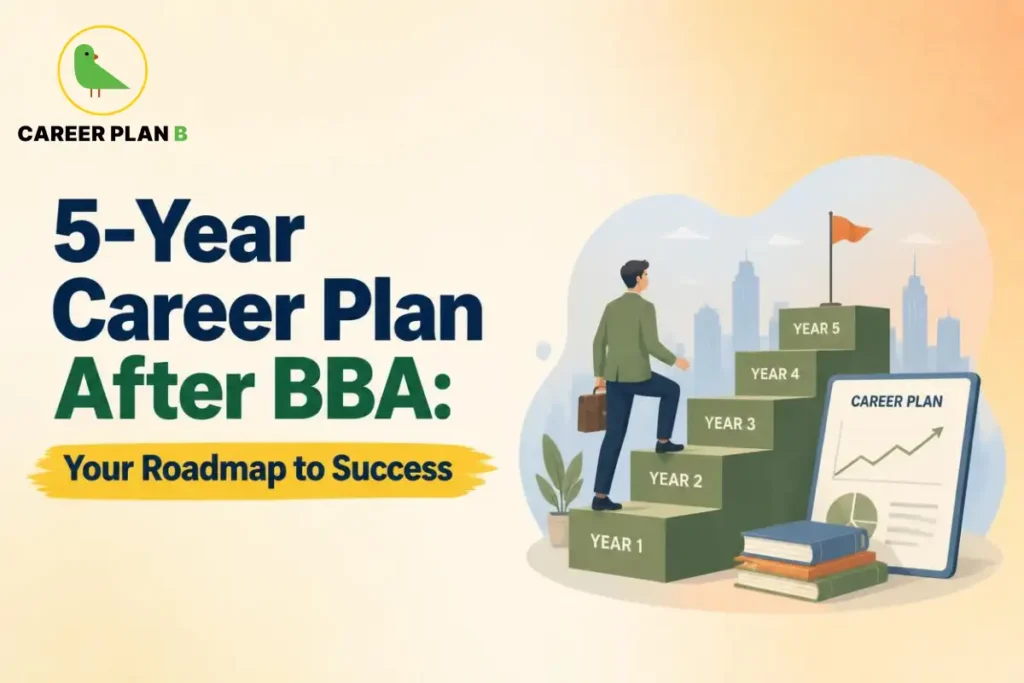
Introduction
Did you know that 40% of BBA graduates struggle with career direction in their first year?
You’ve completed your Bachelor of Business Administration—congratulations! But now comes the real challenge: figuring out what’s next. Your BBA degree opens doors, but without a clear career roadmap after BBA, you might wander through opportunities without a real direction.
This guide gives you a step-by-step 5-year career plan that turns your business degree into concrete career success. Whether you’re interested in finance, HR, operations, or entrepreneurship, we’ll map out exactly what you should focus on during each phase of your early career.
Why a 5-Year Plan Matters for BBA Graduates
Think of your first five years after graduation as the foundation of your professional house. You’re not just getting a job—you’re building expertise, networks, and credibility.
Here’s why this matters:
- Entry-level jobs after BBA are just the beginning. Your decisions now shape whether you become a team leader or mid-level manager by year five.
- A structured career progression strategy helps you develop the right skills at the right time.
- You’ll know whether to pursue further education (like an MBA) or gain hands-on experience first.
- You’ll build confidence and clarity instead of feeling lost in the corporate world.
Year 1-2: Building Your Foundation
What “Entry-Level Jobs After BBA” Really Mean
Your first two years aren’t about landing a dream job—they’re about landing the right starter role. Look for positions like:
- Associate/Executive (HR, Finance, Operations)
- Business Analyst
- Management Trainee programs
- Sales Executive
Key focus: Learn the business fundamentals, understand your industry, and prove you can execute tasks reliably.
BBA Skill Development in Year 1-2
Don’t just do your job—develop skills deliberately:
- Excel & data analysis – Master spreadsheets and basic reporting
- Communication – Present ideas clearly to seniors and peers
- Problem-solving – Take ownership of small problems and solve them
- Industry knowledge – Read industry reports, understand market trends
- Networking – Build genuine relationships with mentors and peers
Pro tip: Find a mentor in your organization. This single relationship can accelerate your learning by months.
Year 3-4: Strategic Growth & Specialization
When to Consider “BBA Career Options” More Deeply
By year three, you’ve seen enough to know your real interests. Now it’s time to specialize.
Ask yourself:
- Do I love working with people (HR path)?
- Am I data-driven (Finance/Analytics path)?
- Do I prefer project management and operations?
- Am I drawn to sales and business development?
Building Your Career Growth Strategy
Year 3 milestones:
- Move into a role with more responsibility (Senior Associate, Team Lead, Project Coordinator)
- Lead a small team or project
- Develop one deep skill (financial modeling, recruitment strategy, supply chain optimization)
Year 4 focuses:
- Take on strategic projects, not just operational tasks
- Consider certifications relevant to your field (CFA, ACCA, SHRM, PMP)
- Evaluate: Do I need an MBA now, or should I wait?
For Personalized Guidance
Year 5: Leadership & Future Planning
The MBA vs. Work Experience Question
By year five, you’re at a crossroads. Should you pursue an MBA vs. work experience?
Choose MBA if:
- Your target role requires it (consulting, top finance roles)
- You want to switch industries
- You’re aiming for positions requiring specialized knowledge
Choose to stay and work if:
- You’re on a clear path to leadership
- Your company offers executive development programs
- You want to deepen expertise in your current field first
Building Your Long-Term Career Progression
In year five, you should be:
- Managing a team or significant projects
- Recognized as an expert in your area
- Clear on your next 5-year goal (senior management, specialize deeper, or switch paths)
- Actively mentoring junior staff
How Career Plan B Helps
Feeling overwhelmed about planning your career trajectory?
Career Plan B’s personalized career counseling helps BBA graduates like you build a realistic 5-year roadmap tailored to your strengths.
Our career assessment tests (Psycheintel) identify your ideal role and industry fit, while our career roadmapping service breaks down specific milestones for each year.
Whether you’re deciding on MBA timing or developing specialized skills, our experts guide you through every decision point.
Get In Touch With Us
Frequently Asked Questions
1. What if I choose the wrong first job?
Answer: Your first job teaches you what you don’t want—that’s valuable. Most people change roles within 1-2 years. Focus on learning, not perfection.
2. Should I take an MBA immediately after BBA?
Answer: Most experts recommend 2-3 years of work experience first. You’ll understand business better and get more from your MBA.
3. What’s the average salary progression for BBA graduates?
Answer: Entry-level typically ranges ₹2-4 LPA. By year 5, expect ₹6-10+ LPA depending on industry, performance, and company.
4. How do I develop leadership skills early?
Answer: Volunteer for team lead roles, mentor interns, take ownership of projects, and seek feedback actively.
5. Which industry offers the best BBA career options?
Answer: Finance, tech, consulting, and FMCG offer strong growth. Choose based on your interests, not just salary.
6. Should I switch companies to grow faster?
Answer: Sometimes yes—changing jobs every 2-3 years can boost salary by 15-25%. But ensure you’re learning, not just chasing money.
Start Building Your Career Roadmap Today
Your 5-year career plan after BBA isn’t set in stone—it’s flexible. The economy changes, companies evolve, and your interests shift. But having a clear direction? That’s everything.
Here’s your action plan starting today:
- Audit your current role – Does it align with year 1-2 of this roadmap?
- Identify one skill to develop – Commit to mastering it in the next quarter
- Find a mentor – Someone 5-10 years ahead of you in your desired path
- Review this plan annually – Adjust based on what you’ve learned
Your BBA degree is a ticket to opportunity. But the real success comes from intentional planning and consistent effort. Start your roadmap now, stay flexible, and watch your career grow.
What’s your first career move? Reach out to Career Plan B for personalized guidance on your unique path.