Team6 · September 23, 2026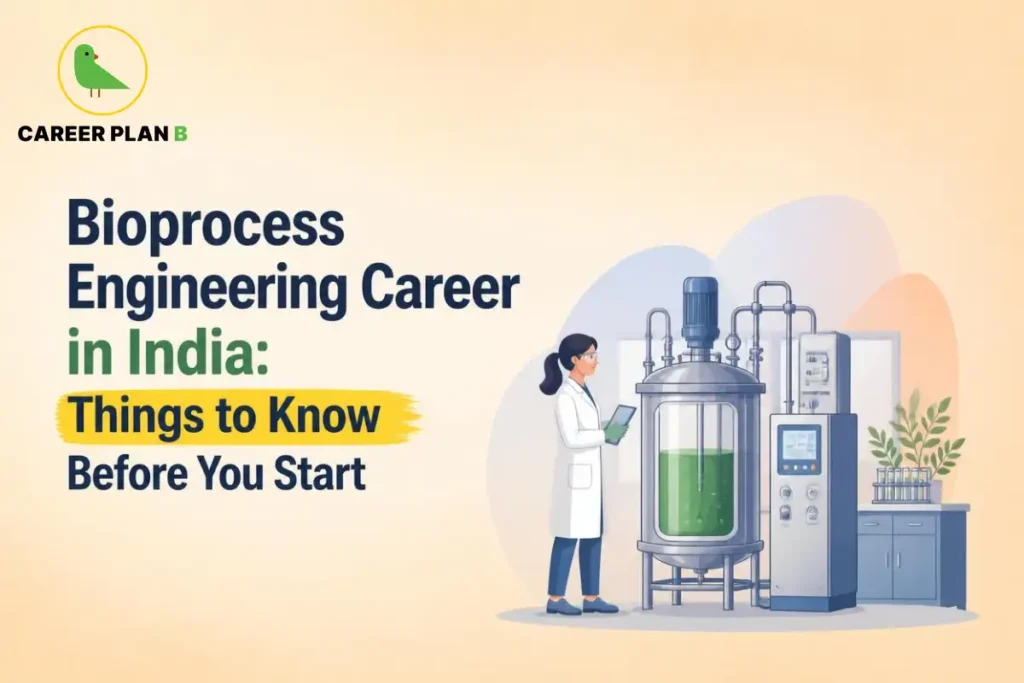
Introduction
Every time you receive a vaccine, take an antibiotic, or drink a glass of packaged juice, you are benefiting from the work of a bioprocess engineer. These professionals sit behind some of the most essential products in human health and nutrition, yet their field rarely gets the attention it deserves compared to flashier branches like genetic engineering or bioinformatics.
A bioprocess engineering career in India is one of the most underrated paths in the life sciences space. It combines the rigour of chemical engineering with the complexity of living biological systems, making it intellectually demanding, industrially essential, and increasingly well-compensated. But it is also a field that students often enter without fully understanding what they are signing up for.
This blog is a complete pre-entry guide. Whether you are a Class 12 student shortlisting engineering branches, a B.Tech biotechnology student considering a postgraduate specialisation, or a chemical engineering student exploring life sciences convergence, here is everything you need to know before pursuing a bioprocess engineering career in India.
What Is Bioprocess Engineering Exactly?
At its core, what bioprocess engineering is is a question about how living systems (bacteria, yeast, fungi, mammalian cells, or enzymes) can be used to manufacture useful products at scale. Bioprocess engineering is the science and engineering discipline that makes that manufacturing possible, reliable, and economically viable.
Think of it this way. A microbiologist might discover that a particular bacterium produces a valuable antibiotic. A bioprocess engineer’s job is to figure out how to grow that bacterium in a 10,000-litre tank, extract the antibiotic efficiently, purify it to pharmaceutical-grade standards, and ensure the entire process can be repeated consistently every single time.
The field sits directly at the intersection of biotechnology and chemical engineering. It draws from microbiology, biochemistry, fluid dynamics, thermodynamics, and process control, all applied to biological systems. Key areas within bioprocess engineering include:
- Bioreactor design and operation: the vessels in which biological processes are carried out
- Fermentation technology using microorganisms to produce chemicals, medicines, and food ingredients
- Cell culture technology: growing mammalian or insect cells for vaccine and biopharmaceutical production
- Downstream processing: the purification and recovery of the final product after fermentation or cell culture
- Process scale-up: translating a process that works in a 2-litre lab flask to a 20,000-litre industrial reactor
A common point of confusion is the difference between bioprocess engineering and biochemical engineering. In practice, the two terms are often used interchangeably. Biochemical engineering tends to emphasise the chemical engineering fundamentals, while bioprocess engineering places slightly more emphasis on the biological system being engineered. Most university programmes and industry job descriptions use them as equivalent terms.
What Do Bioprocess Engineers Actually Do?
One of the most important things to understand before entering this field is what a typical working day actually looks like because it is quite different from what many biology students imagine.
Bioprocess engineers work at the interface of the laboratory and the production floor. They are neither pure researchers nor pure manufacturers; they bridge both worlds. Their responsibilities generally fall into two broad categories:
Upstream Processing: Upstream processing jobs involve everything that happens before the product is made designing and optimising the conditions under which the biological system grows and produces. This includes:
- Selecting and developing the right microbial strain or cell line
- Designing growth media and culture conditions
- Operating and monitoring bioreactors
- Controlling variables like pH, temperature, dissolved oxygen, and agitation
- Troubleshooting fermentation failures or inconsistent yields
Downstream Processing: Downstream processing jobs involve recovering and purifying the product after it has been produced. This includes:
- Centrifugation and filtration to separate cells from the product
- Chromatography to purify proteins or other biomolecules
- Formulation and packaging of the final product
- Ensuring the product meets regulatory quality standards
Beyond these two pillars, bioprocess engineers also work in process validation, quality assurance, regulatory affairs, and technology transfer, particularly in pharmaceutical manufacturing biotech environments where Good Manufacturing Practice, or GMP, compliance is mandatory.
Industries that employ bioprocess engineers in India include:
- Pharmaceutical and biopharmaceutical companies producing vaccines, insulin, monoclonal antibodies, and biosimilars
- Food and beverage companies producing fermented foods, flavour compounds, organic acids, and enzymes
- Biofuel companiesusing microbial fermentation to produce ethanol and other biofuels
- Wastewater treatmentusing biological processes to treat industrial effluents
- Agricultural biotechproducing biopesticides and biofertilizers through fermentation
Key Subjects and Skills You Will Study
If you are considering a bioprocess engineering career in India, understanding what the academic programme demands is essential. This is not a field where biology alone will carry you. The coursework is genuinely engineering-heavy.
Core Subjects:
- Microbiology and cell biology: understanding the organisms you are working with
- Biochemistry: the chemistry of biological molecules and metabolic pathways
- Chemical engineering fundamentals: mass transfer, heat transfer, fluid mechanics, thermodynamics
- Bioreactor design and analysis: the engineering principles behind culture vessel design and operation
- Fermentation technology, both submerged and solid-state fermentation processes
- Downstream processing and bioseparations: chromatography, membrane filtration, crystallisation
- Process control and instrumentation: monitoring and automating biological processes
- Bioprocess economics and scale-up understanding the commercial realities of production
Technical Skills Employers Look For:
- Familiarity with process simulation software such as SuperPro Designer or Aspen Plus
- Hands-on experience with bioreactor operation, even at lab scale
- Understanding of GMP and regulatory documentation practices
- Proficiency in analytical tools: HPLC, spectrophotometry, mass spectrometry basics
- Data analysis using Excel, Python, or MATLAB for process optimisation
Soft Skills:
- A process optimisation mindset always looking for ways to improve yield, reduce cost, or increase consistency
- Meticulous documentation discipline, which is non-negotiable in regulated pharmaceutical environments
- Comfort working in interdisciplinary teams with microbiologists, chemical engineers, and regulatory specialists
- Problem-solving under production pressure
If your strengths lie more in mathematics, engineering problem-solving, and systems thinking than in purely biological or clinical work, bioprocess engineering will suit you well.
Top Colleges Offering Bioprocess Engineering in India
Bioprocess engineering colleges in India include a range of institutions offering this specialisation at both undergraduate and postgraduate levels. Here are the most reputed options:
IITs (Indian Institutes of Technology):
- IIT Delhi’s Department of Biochemical Engineering and Biotechnology offers one of India’s most respected B.Tech and M.Tech programmes
- IIT Bombay offers M.Tech in Chemical Engineering with bioprocess specialisation options
- IIT Kharagpur’s strong biochemical engineering programme within the Department of Biotechnology
- IIT GuwahatiDepartment of Biosciences and Bioengineering with bioprocess focus
NITs and Central Universities:
- NIT Warangal and NIT Rourkela offer B.Tech. in Biotechnology with bioprocess components
- Jawaharlal Nehru University MSc and PhD programmes in Biotechnology with fermentation and bioprocess research
Private Institutions:
- BITS Pilani’s strong industry-linked programme combining chemical and biological engineering
- Manipal Academy of Higher Education offers Biomedical and Bioprocess Engineering programmes
Regulatory Verification:
- B.Tech programmes are regulated by AICTE. Always verify college approval before applying
- PG programmes fall under UGC for university-affiliated institutions
What to Look For When Evaluating a Programme:
- Access to working bioreactor facilities in the laboratory
- Industry collaborations and internship pipelines with pharma or biotech companies
- Faculty with active research in fermentation, cell culture, or bioprocess optimisation
- Placement records in core bioprocess or pharmaceutical manufacturing roles
Have Any Doubts?
Career Paths After Bioprocess Engineering
One of the strongest arguments for pursuing a bioprocess engineering career in India is the breadth of career directions it opens up.
Core Industry Roles:
- Bioprocess engineers design and optimise production processes in pharma or biotech companies
- Fermentation Scientists specialise in developing and scaling microbial fermentation processes
- Validation engineers ensure that manufacturing processes consistently meet defined quality standards, a critical GMP requirement
- QA/QC Specialist oversees quality assurance and control in pharmaceutical manufacturing biotech environments
- A technology transfer specialist manages the transfer of processes from R&D to full-scale manufacturing
Research Pathway: Students interested in research can pursue PhD programmes or apply for funded fellowships:
- CSIR Junior Research Fellowship (JRF), one of India’s most competitive science fellowships
- DBT-JRF Programme specifically for biotechnology graduates seeking research careers
- DRDO funds defence-related bioprocess and fermentation research
Emerging Areas:
- Biopharmaceuticals and biosimilars: India is positioning itself as a global biosimilar manufacturing hub, creating strong demand for upstream and downstream processing expertise
- Biofuels and green chemistry: fermentation-based production of sustainable fuels and chemicals
- Cultivated meat and alternative proteins: an early-stage but rapidly growing sector globally
Government Sector: Public sector units like Bharat Immunologicals and Biologicals Corporation (BIBCOL) and Hindustan Antibiotics Limited hire bioprocess professionals for vaccine and antibiotic manufacturing. CSIR institutes, including CSIR-IMTECH and CSIR-IICT, are also active in fermentation and bioprocess research.
Bioprocess Engineer Salary in India
Understanding bioprocess engineer salary India benchmarks is an important part of making an informed career decision.
Entry-Level (0–3 years experience):
- Industry roles in pharmaceutical manufacturing or biotech companies: INR 3.5 to 6 LPA
- Government research positions or JRF fellowships: INR 3.1 to 3.5 LPA (fellowship stipend basis)
- QA/QC and validation roles in regulated pharma environments: INR 4 to 6.5 LPA
Mid-Level (3–7 years experience):
- Bioprocess or fermentation scientist roles: INR 7 to 12 LPA
- Validation and technology transfer specialists: INR 8 to 14 LPA
- Process development roles at MNCs or large Indian pharma companies: INR 10 to 16 LPA
Senior Level (7+ years experience):
- Process development managers or heads of manufacturing: INR 18 to 30 LPA and above
- Roles at multinational biopharmaceutical companies such as Biocon, Serum Institute, or Syngene can command significantly higher packages at senior levels
Factors That Affect Salary:
- A postgraduate degreeM.Tech or MScin bioprocess or biochemical engineering typically commands a 30 to 40 percent salary premium over a BSc entry
- GMP certification and hands-on bioreactor experience are valued highly by pharmaceutical employers
- Working in biopharmaceuticals or biosimilar manufacturing tends to offer higher compensation than food biotech or wastewater bioprocess roles
Challenges You Should Know Before Entering This Field
A complete pre-entry guide would be incomplete without an honest look at the challenges. Here is what students sometimes discover after they are already in the programme, and it is better to know these things before.
It is more engineering-heavy than pure biology: Many students enter bioprocess engineering expecting a biology-dominated curriculum. The reality is that subjects like thermodynamics, mass transfer, fluid mechanics, and process control form the backbone of the degree. If you are uncomfortable with mathematics and engineering problem-solving, this field will be a struggle rather than a strength.
GMP compliance is demanding: in pharmaceutical manufacturing biotech environments, every action must be documented, every deviation must be investigated, and every process must be validated. This level of regulatory discipline is essential for patient safety, but it requires a personality that is meticulous, process-orientated, and comfortable with structured documentation. It is not a field for those who prefer loosely structured creative work.
Scale-up is genuinely complex: What works perfectly in a 5-litre bioreactor often behaves very differently in a 5,000-litre one. Understanding why and solving it requires deep engineering intuition that takes years of experience to develop. Students should expect a significant learning curve in their first few industry years.
Hands-on experience is non-negotiable: Employers in this field expect graduates to have worked with actual bioreactors, not just read about them. Choosing a college with functional laboratory infrastructure and actively seeking internships at pharma or biotech companies during your degree is not optional; it is essential for employability.
How Career Plan B Helps
Deciding whether bioprocess engineering is the right fit for your skills and personality is a decision that deserves more than a Google search. Career Plan B offers personalised career counselling and the PsycheIntel assessment, a tool that maps your aptitude, interests, and thinking style to the right engineering or life sciences specialisation. If you are weighing bioprocess engineering against other paths, visit careerplanb.co to get clarity before you commit.
Get In Touch With Us
Frequently Asked Questions
1. What is bioprocess engineering, and how is it different from biotechnology?
Bioprocess engineering is the engineering discipline focused on designing, scaling, and optimising industrial processes that use living organisms or biological molecules to make products. Biotechnology is the broader science of using biological systems for applications across health, agriculture, and industry. Bioprocess engineering is essentially the engineering arm that makes biotechnology work at an industrial scale.
2. Which colleges offer the best bioprocess engineering programmes in India?
IIT Delhi’s Department of Biochemical Engineering and Biotechnology is widely regarded as the top programme in India. IIT Bombay, IIT Kharagpur, and IIT Guwahati also offer excellent options. Always verify programme accreditation through AICTE for B.Tech programmes.
3. Is a B.Tech in Biotechnology enough for a bioprocess engineering career, or do I need an M.Tech?
A B.Tech in Biotechnology or Chemical Engineering provides a valid entry point into junior production or QA roles. However, an M.Tech in Bioprocess or Biochemical Engineering significantly improves access to process development, R&D, and higher-paying roles. For research careers, a PhD is typically required.
4. What government opportunities exist for bioprocess engineering graduates in India?
Key government opportunities include research fellowships through CSIR and DBT, positions at public sector units like BIBCOL and Hindustan Antibiotics, and research roles at CSIR-IMTECH, which specialises in microbial technology and fermentation research.
5. Is bioprocess engineering a good career choice for the future?
Yes, particularly given India’s ambition to become a global hub for biosimilar and vaccine manufacturing. The growth of biopharmaceuticals, biofuels, and precision fermentation globally means that professionals with upstream and downstream processing expertise will remain in demand for the foreseeable future.
Conclusion
Bioprocess engineering is one of those fields that does not announce itself loudly, but it underpins some of the most critical industries in the world. Every vaccine that protected a child, every insulin dose that managed a diabetic patient’s life, every biofuel that reduced a factory’s carbon footprint, these are the quiet outcomes of bioprocess engineering done well.
A bioprocess engineering career in India offers something increasingly rare: strong industrial relevance, genuine career depth, and the satisfaction of working on problems that genuinely matter. But it is also a field that rewards preparation. Students who enter knowing what the coursework demands, what the industry expects, and what the realistic career trajectory looks like are far better positioned to thrive than those who choose it on a whim.
If the intersection of biology and engineering excites you, if you want to build things, scale things, and make biological science work in the real world, bioprocess engineering deserves serious consideration. Start by assessing whether your strengths align with what the field demands. The rest of the journey becomes significantly clearer from there.