Team Career Plan B · September 30, 2026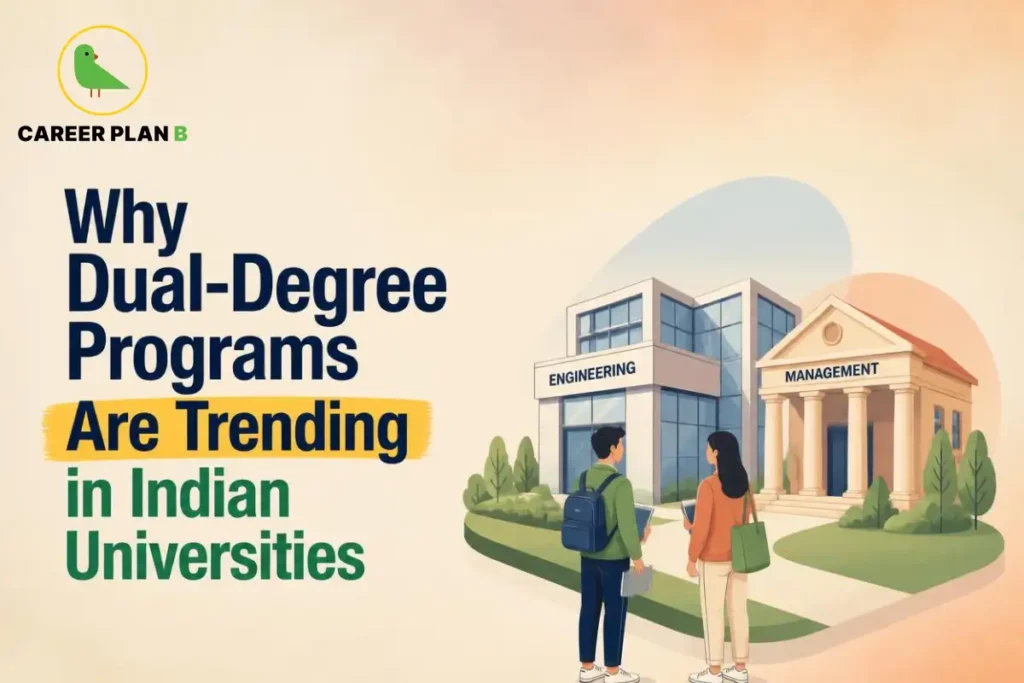
Introduction
The Indian higher education landscape is currently experiencing a massive, highly progressive structural transformation. Gone are the days when students were strictly forced to choose just one rigid career path.
Today, ambitious youth are aggressively looking for innovative ways to maximize their college years and build dynamic resumes. Consequently, dual-degree programs have absolutely exploded in popularity across both government and private institutions.
According to the National Education Policy (NEP) 2020, breaking down strict academic silos is now a top national priority. Therefore, understanding exactly how these simultaneous degrees work can give you a massive competitive edge in the modern job market.
This comprehensive guide will break down the official University Grants Commission (UGC) rules, explore popular degree combinations, and explain why this trend is completely reshaping corporate recruitment.
1. The Official UGC Dual Degree Guidelines
Before 2022, pursuing two formal degrees at the exact same time was strictly prohibited across India. However, the UGC has completely revamped these outdated restrictions to foster multidisciplinary learning.
Students can now officially enroll in two distinct programs, such as seamlessly combining a regular B.Sc. with an online B.A. in Psychology. Furthermore, you can even pursue two fully online degrees simultaneously, provided both universities hold official UGC recognition.
This highly progressive rule ensures that your second degree remains legally valid for both government exams and private sector jobs. Ultimately, these updated guidelines provide modern students with unparalleled academic freedom and personalization.
2. Saving Massive Time and Financial Resources
Traditional sequential learning requires students to finish one degree entirely before starting another. This outdated approach easily consumes up to six consecutive years of expensive college tuition and hostel fees.
Conversely, dual-degree programs allow you to stack your academic credentials highly efficiently. By pursuing a recognized online degree alongside your regular college classes, you effectively halve your overall study time.
Moreover, online and ODL programs are generally far more affordable than standard on-campus courses. Therefore, this simultaneous approach remains a highly cost-effective strategy for families seeking premium educational value without acquiring massive student loans.
3. Interdisciplinary Skills for the Modern Job Market
Today’s rapidly evolving job market demands highly versatile candidates who can effortlessly bridge the gap between different industries. A traditional single degree frequently restricts your professional knowledge to one narrow specialization.
However, actively combining diverse fields creates incredibly attractive, future-proof candidate profiles. For instance, a physical B.Tech engineering student who simultaneously completes an online MBA gains both deep technical prowess and high-level management skills.
Furthermore, completing two rigorous programs simultaneously clearly proves your exceptional time management and deep self-discipline. Ultimately, this multidisciplinary approach guarantees you stand out immediately during highly competitive campus placements.
4. Exciting International Twinning Opportunities
The aggressive push for dual degrees extends far beyond domestic online courses. The UGC has actively approved regulations enabling Indian colleges to partner directly with prestigious international universities.
Through these unique twinning programs, ambitious students can study partially in India and partially abroad. This incredible global exposure previously required massive, often unaffordable international student loans.
Now, students receive separate degrees from both the Indian and foreign institutions simultaneously upon graduation. Consequently, this massively boosts your chances of securing lucrative post-study work visas and elite international corporate roles.
For Personalized Guidance
Comparative Overview: Single vs. Simultaneous Degrees
The following table summarizes the primary metrics between traditional learning and the new dual-degree framework, helping you quickly strategize your college years.
| Evaluation Metric | Traditional Single Degree | UGC Dual Degree Framework |
|---|---|---|
| Academic Timeline | 3 to 4 Years (Sequential) | 3 to 4 Years (Simultaneous) |
| Skill Development | Highly Specialized / Narrow | Multidisciplinary / Broad |
| Official Recognition | Fully UGC Approved | Fully UGC Approved (if guidelines met) |
| Corporate Appeal | Standard Employability | High Employability & Versatility |
| Financial Cost | Standard Tuition Fees | Slightly Higher (Adding an affordable ODL degree) |
(Source: Educational framework comparisons strictly aligned with official UGC guidelines and NEP 2020 mandates).
How Career Plan B Helps
Deciding whether to pursue two rigorous academic programs simultaneously can easily overwhelm young students. Career Plan B assists ambitious undergraduates and concerned parents in navigating these modern academic choices with absolute confidence. Through our highly Personalised Career Counselling and advanced Psycheintel and Career Assessment Tests, we thoroughly evaluate your natural academic bandwidth. Furthermore, our customized Admission and Academic Profile Guidance ensures you select the perfect, non-overlapping dual degree combinations, mapping out a Career Roadmapping strategy tailored for absolute corporate success.
Get In Touch With Us
Frequently Asked Questions
Q1. What are the official UGC dual degree guidelines?
The UGC allows students to pursue two full-time academic programs simultaneously. Typically, this involves combining one regular physical degree with one fully online or ODL degree to prevent class schedule overlaps.
Q2. Can I do a B.Sc. and a B.A. at the same time?
Yes, absolutely. Under the NEP 2020 framework, you can pursue diverse disciplines simultaneously, such as studying Data Science while completing an Arts degree online.
Q3. Are simultaneous degrees valid for government jobs?
Yes. As long as both your degrees are obtained from officially recognized, UGC-approved institutions, they are completely valid for both government exams and private sector recruitment.
Q4. Is it difficult to manage two academic programs simultaneously?
It naturally requires excellent time management and strict personal discipline. However, choosing one flexible online degree makes balancing assignment deadlines and examinations significantly easier.
Q5. What is a foreign twinning degree program?
A twinning program allows you to complete part of your degree at an Indian university and up to 30% of your credits at a partnering foreign university, earning prestigious global credentials.
Conclusion
Analyzing the current higher education landscape reveals exactly why dual-degree programs are trending in Indian universities. By actively utilizing the flexible UGC dual degree guidelines, students can bypass traditional academic restrictions and rapidly build highly versatile, multidisciplinary skill sets. Furthermore, whether you choose a domestic online combination or an international twinning degree, these simultaneous qualifications offer unmatched corporate leverage. Most importantly, developing this diverse academic portfolio early guarantees a highly resilient, future-proof professional foundation.
If you are ready to identify the exact degree combinations that fit your unique strengths, consult Career Plan B today to build a meticulously personalized roadmap to success.