Team6 · November 4, 2026
Introduction
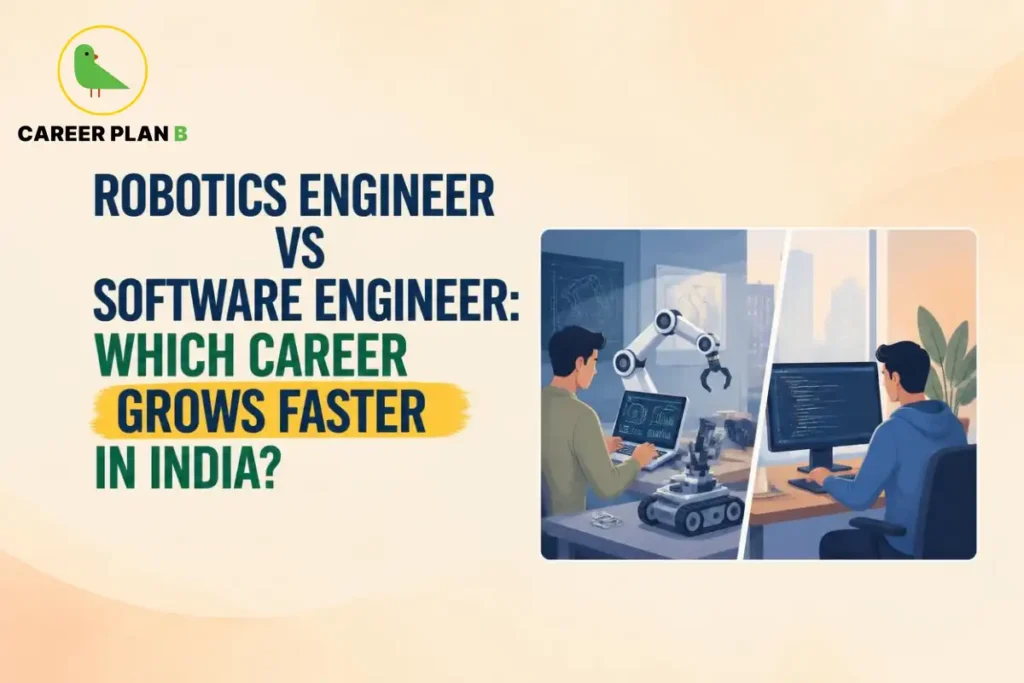
India is producing over 1.5 million engineering graduates every year. Yet, one question keeps coming up in college corridors, career counselling sessions, and family dinner tables alike: should I go into robotics or software? The debate around Robotics Engineer vs Software Engineer is no longer just about personal interest. It is about where the jobs are, how fast you can grow, and which field will still be thriving a decade from now. If you are an engineering student or a professional weighing your options, this blog breaks down both careers honestly: growth pace, salary, future scope, and everything in between so you can make a decision you will not regret.
What Does a Robotics Engineer Actually Do?
A robotics engineer designs, builds, and maintains robotic systems used across industries. Think of the robotic arms assembling cars at Tata Motors, drones being tested by DRDO, or autonomous systems being developed at ISRO. The work sits at the intersection of mechanical engineering, electronics, and computer science. Robotics engineers write embedded code, design sensors, and integrate hardware with software to make machines perform real-world tasks. The role demands a strong grip on automation and robotics jobs, which are now expanding into agriculture, healthcare, defence, and electric vehicles. It is a highly specialised field, which means the entry bar is higher, but so is the long-term reward.
What Does a Software Engineer Actually Do?
A software engineer builds, tests, and maintains software applications from the mobile apps on your phone to the backend systems running India’s banking infrastructure. Software development career opportunities span across IT services, SaaS companies, fintech, edtech, and startups. Whether you are writing code for a product company in Bengaluru or working remotely for a global firm, software engineering offers a wide runway. The Ministry of Electronics and Information Technology (MeitY) has been actively pushing India’s digital economy, which directly fuels demand for software engineers across sectors. The skill set is versatile, and the learning curve, while steep initially, becomes more navigable with structured training and practice.
Career Growth Who Climbs Faster?
This is the heart of the Robotics Engineer vs Software Engineer debate, and the honest answer is it depends on what kind of growth you are chasing.
Robotics Engineering Career Growth
Robotics engineering career growth tends to be slower at the start because the field demands multi-disciplinary expertise. You are not just coding; you are understanding mechanical systems, control theory, and hardware integration simultaneously. However, once you hit the mid-career stage, the specialisation premium kicks in. Senior robotics engineers and automation architects are in short supply, which pushes compensation and influence significantly upward. Organisations like ISRO, DRDO, HAL, and private players in the EV and manufacturing sectors are actively hiring. The National Skill Development Corporation (NSDC) has also identified robotics as a high-priority sector under its future skills initiative.
Software Development Career Opportunities and Growth
Software engineers typically see faster early-career momentum. Entry-level roles are more abundant, interview pipelines are well-defined, and the community support through platforms like NPTEL is robust. Lateral movement is also wider. A software engineer can shift from backend development to machine learning, cloud architecture, or product management without starting over. The trade-off is that the field is more competitive at the junior level, with a larger pool of candidates chasing similar roles.
Salary Showdown: Robotics vs Software in India
When it comes to software engineer salary in India, entry-level roles at mid-sized IT firms typically start between ₹4 to ₹7 LPA, while product companies and startups can offer ₹10 to ₹20 LPA for strong candidates. Senior software engineers with 8–10 years of experience can comfortably reach ₹30 to ₹50 LPA or more at top firms.
Robotics engineers at the entry level often start between ₹4 to ₹8 LPA, but the gap narrows quickly at mid and senior levels. Specialised roles in defence PSUs, aerospace, or industrial automation can offer ₹15 to ₹40 LPA with additional government benefits. With India’s push under the PLI scheme for electronics and advanced manufacturing, robotics-related roles are seeing faster salary appreciation than they did even five years ago.
Have Any Doubts?
Future Scope: Where Is the Industry Headed?
The robotics vs. software engineering scope is a question that cannot be answered in isolation anymore because the two fields are converging. Artificial intelligence, machine learning, and embedded software are all becoming core parts of robotics engineering. Meanwhile, software engineers who upskill into AI and IoT are increasingly working on systems that blur the boundary between code and physical hardware.
India’s Industry 4.0 push, supported by initiatives under MeitY and the National Manufacturing Policy, is creating strong demand for professionals who understand both domains. The EV sector, backed by the FAME II policy, is also generating new roles in embedded systems and robotic manufacturing. In short, both careers have strong futures; the scope is not shrinking for either, only evolving.
How to Choose Based on Your Strengths
Use these pointers for a quick self-assessment as part of your career path for engineers in India:
- Do you enjoy hands-on building, tinkering, and working with physical systems? Robotics may suit you better.
- Are you more comfortable sitting with a screen, debugging logic, and shipping features quickly? Software engineering is likely your groove.
- Are you looking for faster job placement right after graduation? Software has a more defined entry path.
- Are you okay with a longer runway in exchange for deep specialisation and higher long-term differentiation? Consider robotics.
- Do you want to work in defence, aerospace, or advanced manufacturing? Robotics opens those doors more directly.
Neither choice is wrong. What matters is aligning the career with your natural strengths and long-term goals. This is also where professional guidance makes a real difference.
How Career Plan B Helps
If you are stuck on the Robotics Engineer vs Software Engineer decision, Career Plan B can bring clarity. Through personalised one-on-one career counselling, psychometric and career assessment tools like Psycheintel, and structured career roadmapping sessions, Career Plan B helps engineering students and professionals identify which path genuinely fits their strengths, interests, and market realities, not just what sounds impressive.
For Latest Information
Frequently Asked Questions (FAQs)
1. Is robotics engineering a good career in India?
Yes. With India’s push in defence manufacturing, EVs, and industrial automation, robotics engineering career growth is accelerating. Roles in DRDO, ISRO, and private sector automation firms are expanding steadily.
2. Which has better job opportunities: robotics or software engineering?
Software engineering currently has a larger volume of job openings. However, robotics offers higher specialisation value and less competition at senior levels, making the engineering career comparison India-specific and context-dependent.
3. Can a software engineer move into robotics?
Yes, especially if they upskill in embedded systems, ROS (Robot Operating System), and control algorithms. Platforms like NPTEL offer relevant courses to bridge the gap.
4. What is the average software engineer salary in India at senior levels?
Senior software engineers with 8–10 years of experience typically earn between ₹30 to ₹50 LPA at top product and tech companies, with higher packages at global firms.
5. Which engineering field is more future-proof?
Both are future-proof, but in different ways. Software development career opportunities will remain broad, while the robotics vs. software engineering scope is increasingly overlapping as AI and automation merge the two disciplines.
Conclusion
The Robotics Engineer vs Software Engineer debate does not have a universal winner; it has a right answer for each individual. Software engineering offers a faster on-ramp, wider job volume, and strong lateral flexibility. Robotics engineering offers deep specialisation, rising demand in emerging industries, and a long-term edge in a world moving rapidly toward automation. India’s policy environment, from FAME II to Industry 4.0 initiatives, is creating momentum for both. The smarter move is not to chase the trend but to understand your strengths, map them to market demand, and build a focused career plan around that. If you need help doing exactly that, Career Plan B is a great place to start. Visit Career Plan B to explore personalised counselling and career assessment options built specifically for engineering students and professionals in India.