Team Career Plan B · July 17, 2026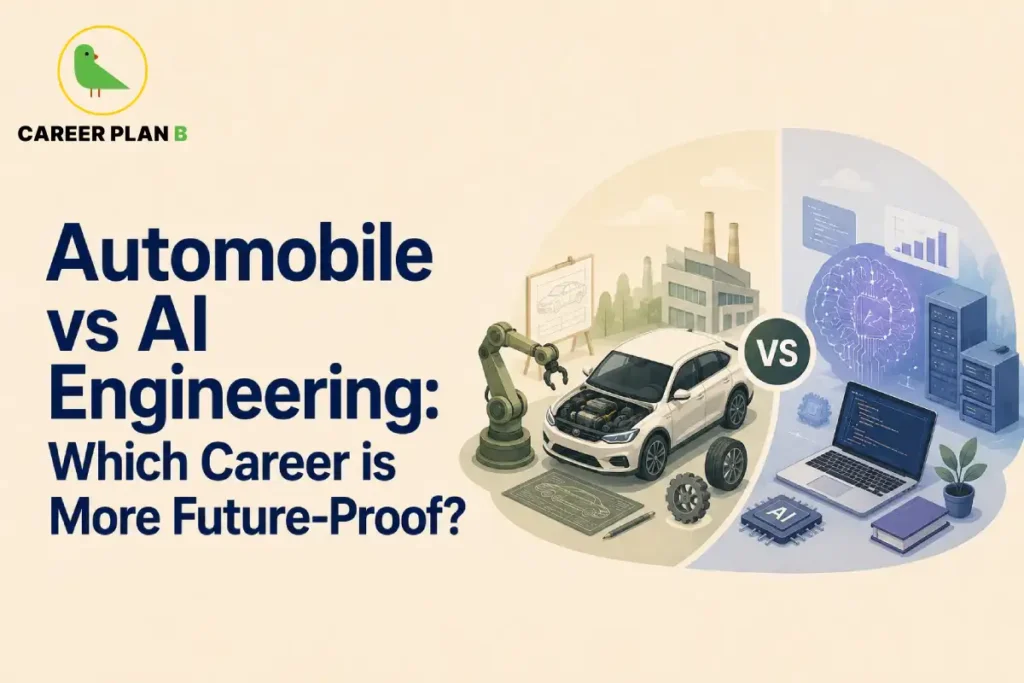
Introduction
If you’re an engineering aspirant right now, you’ve probably heard two fields mentioned more than any other: automobile engineering and artificial intelligence. Both are seen as exciting, high-growth areas, which naturally leads to the question: automobile vs AI engineering, which career is more future-proof? It’s a genuinely tough question, especially with AI reshaping so many traditional industries, including automotive itself. This blog compares what each field offers today, where they’re converging, and how you can decide based on your own strengths and interests.
Why Students Are Comparing Automobile and AI Engineering
Both automobile engineering and AI engineering are frequently labelled as “future careers”, which naturally creates confusion for students trying to pick one path. Adding to this, the rapid rise of AI has made many students wonder whether traditional engineering branches like automobile engineering will remain relevant. This is a fair concern, but as we’ll see, the reality is more nuanced; these fields aren’t necessarily competing with each other. In many ways, they’re increasingly working together, which matters a lot for future-proof engineering careers.
What Automobile Engineering Offers Today
Automobile engineering has evolved significantly over the past decade. Its scope today includes the following:
- Traditional vehicle design, manufacturing, and safety systems
- Electric vehicle architecture and battery integration
- Automation in vehicle systems and manufacturing processes
- Sustainable transport and emission-reduction technologies
Far from being replaced, the automobile engineering career scope has expanded to include newer technologies, showing that the field is transforming rather than shrinking.
What AI Engineering Offers Today
AI engineering, on the other hand, focuses on building intelligent systems that can learn, predict, and automate tasks. Its scope includes:
- Machine learning and data-driven systems
- Automation and robotics
- Natural language processing and computer vision
- Cross-industry applications, from healthcare to finance to manufacturing
The AI engineering career scope is notably broad, since AI skills apply across nearly every industry, not just one specific sector.
Automobile vs AI Engineering: Key Differences
| Aspect | Automobile Engineering | AI Engineering |
|---|---|---|
| Core Focus | Vehicle design, manufacturing, safety | Machine learning, data, automation |
| Industry Scope | Primarily automotive, expanding to energy/mobility | Cross-industry (healthcare, finance, automotive, governance) |
| Core Subjects | Mechanics, thermodynamics, vehicle dynamics | Statistics, programming, machine learning |
| Typical Roles | Vehicle design engineer, EV systems engineer | ML engineer, data scientist, AI systems engineer |
| Flexibility | Domain-specific | Highly transferable across sectors |
This comparison highlights that which engineering branch has better future prospects really depends on whether you prefer deep specialization in one industry or broader cross-sector flexibility.
Where the Two Fields Are Converging
Rather than being separate paths, automobile engineering and AI are increasingly overlapping.
AI in Automobile Engineering
AI is now being used in autonomous vehicle systems, predictive maintenance, and smart manufacturing processes within the automotive industry. This growing overlap means that AI in automobile engineering is no longer a niche idea; it’s becoming a core part of how vehicles are designed, built, and maintained. This convergence shows that choosing one field doesn’t necessarily mean giving up on the other. In fact, many of the most interesting emerging roles sit right at this intersection.
For Personalized Guidance
Which Career Is More Future-Proof?
Honestly, there’s no single correct answer to this career comparison for engineering students. Both fields are growing, and both are expected to remain relevant for years to come.
That said, a few points are worth considering. AI engineering offers broader cross-industry flexibility, since AI skills can be applied almost anywhere. Automobile engineering offers deep, hands-on expertise in a specific, evolving industry that itself is increasingly adopting AI.
According to AICTE, technical curricula across engineering branches are being updated to include AI-related electives, reflecting how these skills are becoming relevant even outside traditional AI-specific degrees. The IndiaAI Mission, launched by the Government of India, is also expanding AI education and infrastructure nationally, which is likely to benefit students across multiple engineering disciplines, not just dedicated AI programmes. Meanwhile, ARAI‘s ongoing research into automation and autonomous vehicle systems reflects how deeply AI is being integrated into automotive engineering itself.
Ultimately, engineers who combine strong domain knowledge, whether in automobiles or another field, with foundational AI skills are likely to have the strongest, most future-proof position of all.
How Career Plan B Helps
Still torn between these two career paths? Career Plan B can help you decide with clarity. Through personalised career counselling, PsycheIntel and career assessment tests, and admission and academic profile guidance, we help you understand which field aligns better with your interests and strengths. Our career roadmapping process also helps you explore hybrid paths, like AI applications within automotive engineering, so you can build a career that’s genuinely future-ready.
For Latest Information
Frequently Asked Questions
- Will AI replace automobile engineering jobs?
Not entirely. AI is transforming how automobile engineering is practiced, especially in automation and predictive systems, but it’s not eliminating the need for core vehicle design and engineering expertise.
- Can I combine automobile engineering and AI skills?
Yes, and it’s increasingly encouraged. Many emerging roles, like autonomous vehicle engineering, specifically require a blend of both skill sets.
- Which field has better long-term demand?
Both fields show strong long-term demand, though AI’s cross-industry applicability gives it slightly broader flexibility, while automobile engineering offers deep, specialized growth within the mobility sector.
- Do I need to choose one branch exclusively?
No. Many students study automobile engineering with AI-related electives or certifications, allowing them to build expertise in both areas.
- Is AI engineering a completely separate degree from computer science?
It’s closely related, often falling under computer science or dedicated AI and data science programmes, though many colleges now offer it as a specialized branch.
- How can I decide which path is right for me?
Consider whether you’re more drawn to physical, mechanical systems or data-driven, software-based problem-solving. Exploring introductory courses in both areas can also help clarify your interest.
Conclusion
When comparing automobile vs AI engineering, which career is more future-proof? The honest answer is that both fields are evolving in ways that make them relevant for years to come, and increasingly, they’re evolving together. Rather than viewing this as an either-or decision, it’s worth considering how these fields might complement each other in your career. If you’d like personalized guidance on which path, or combination of paths, suits you best, Career Plan B is here to help you plan it out.