Team Career Plan B · October 14, 2026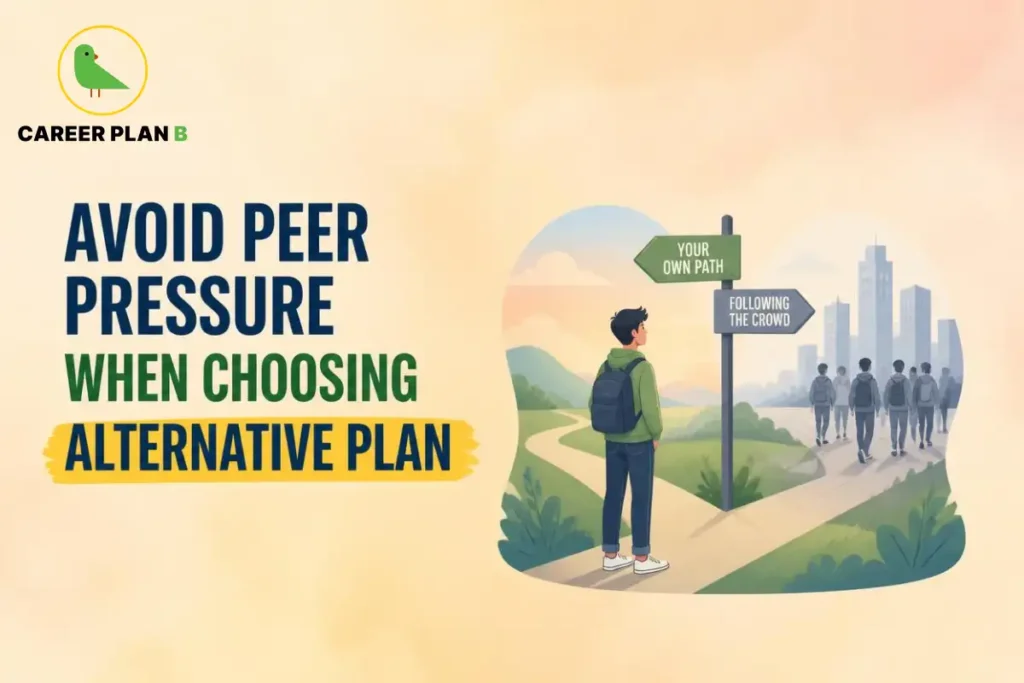
Introduction
Riya had her heart set on psychology. But when her entire friend group started talking about economics honours at Delhi University, she quietly shelved her plan and followed them. She told herself it was a “logical choice.” It wasn’t. It was peer pressure in career choices wearing the costume of logic. And she is not alone — thousands of students across India make the same silent compromise every year, especially when CUET 2026 results are around the corner and the pressure to “decide fast” is at its peak.
The next few weeks after CUET 2026 will test not just your scores, but your ability to think for yourself. Everyone around you will have an opinion, your friends, your relatives, that one uncle at every family gathering. But here is the truth: your backup plan, your alternative admission, your Plan B it needs to be yours. This blog is here to help you build exactly that, without letting anyone else’s choices drown out your own.
When Everyone Around You Seems to Have It All Figured Out
There is this strange thing that happens right after an entrance exam. Suddenly, everyone seems confident. Your classmate is already talking about which hostel they’ll pick. Your best friend has “finalised” three colleges. Your cousin got into a private university and is acting like the world is sorted.
And there you are still thinking, still unsure, still scrolling through college websites at midnight.
Here is what nobody tells you: most of that confidence is performance. A lot of students are just as confused as you are — they are simply better at hiding it, or they have stopped questioning and started copying. The pressure to match that energy, to have a quick answer when someone asks “so which college are you going to?” That pressure is real, and it quietly pushes students into decisions that were never really theirs. This is where peer pressure in career choices begins not in a big dramatic moment, but in small, everyday comparisons.
What Is an Alternative Plan and Why Does It Matter After CUET 2026?
Let’s get one thing straight: having a backup plan is not a sign of failure. It is a sign of intelligence.
CUET 2026 is being attempted by lakhs of students across India, competing for a limited number of seats in central universities. According to the National Testing Agency, CUET has seen participation grow significantly each year, with hundreds of thousands of students vying for courses in institutions like Delhi University, BHU, JNU, and Jawaharlal Nehru University, among others. The math is simple: not everyone will get their first choice, and that is okay.
An alternative plan means you have identified:
- Private college admissions that align with your strengths and career goals
- Courses or streams that genuinely interest you, not just ones your friends are applying to
- Institutions with strong placement records or academic programmes that suit your long-term path
Private universities in India, many of which are among the best in the country, do not require CUET scores. They have their own admission processes, and they offer some excellent programmes in areas like law, design, business, media, psychology, and more. Your backup plan, if thought through well, can actually become your best plan.
The Peer Pressure Trap — How It Silently Shapes Wrong Decisions
“My Friends Are All Applying There, So Should I”
This is one of the most common things career counselors hear. A student walks in with a college list that is almost identical to their friend’s. When asked why, the answer is usually some version of: “We’ve been together since school, so it made sense.”
It sounds sweet. But friendships and career paths are two very different things. Your friend might thrive in a commerce programme. You might suffocate in it. Following someone into a course that does not suit you will not keep the friendship alive — it will just give you four years of regret.
Social Media Is Making It Worse
Open Instagram or YouTube right now and you will find a flood of students talking about CUET 2026 prep, college reactions, “I got into DU” videos, and ranking lists. It creates a visual scoreboard that nobody asked for. Students start measuring themselves against highlight reels and that comparison culture bleeds directly into their alternative plan decisions.
Research in adolescent psychology consistently shows that social comparison, especially during high-stress transitions like exam results, significantly increases anxiety and leads to impulsive decision-making. When you are anxious and impulsive, you do not choose the best college, you choose the most visible one, the one everyone is talking about. And that is how peer pressure in career choices quietly ruins an alternative plan before it even begins.
Signs You Are Choosing a Backup Plan for the Wrong Reasons
Sometimes the pressure is so subtle that you do not even realise it is happening. Here are a few honest signs that your backup plan might be driven by others, not by you:
- You chose a college because your friend is applying there, not because you researched it
- You dropped a course you were genuinely interested in because “nobody does that”
- You feel embarrassed to mention your backup option in front of your peer group
- You cannot explain why you want to study a particular subject beyond “it seemed like a good idea”
- You keep changing your list every time someone else mentions a new college
- You feel anxious when your choices do not match what the group is doing
If two or more of these sound familiar, pause. That is not a plan — that is a reaction.
How to Build an Alternative Plan That Is Actually Yours
Know Your Strengths First
Before you look at any college, look at yourself. What subjects do you genuinely enjoy? What kind of environment helps you learn best — a big campus, a smaller college, a city, a quieter town? What do you want your next four years to feel like?
These are not dramatic, life-altering questions. They are practical ones. And the answers will help you build a list that makes sense for you, not for your friend group. Tools like career assessment tests can be genuinely useful here not to tell you what to do, but to help you see patterns in your own interests and aptitude that you might have overlooked.
Research Private College Admissions Independently
Private college admissions run on their own timelines and their own criteria. Some of the most respected private universities in India — institutions like Ashoka University (ashoka.edu.in ), Flame University (flame.edu.in ), Symbiosis International University (siu.edu.in), and Shiv Nadar University (snu.edu.in ) offer strong academic programmes across humanities, sciences, business, law, and design.
Spend time on official university websites. Read about their programmes, fee structures, scholarship options, and placement data. Do not rely on what someone told someone who told someone else to go to the source. Your alternative plan should be built on research, not rumour.
Think Long-Term, Not Just Right Now
Peer pressure is always about right now. What looks good right now, what your friends are doing right now, what will make you seem sorted right now. But your career is not a right-now decision. It is a five, ten, twenty-year decision. A private college that suits your interests and gives you real skills will serve you far longer than a central university course you stumbled into because everyone else was applying.
Ask yourself: Where do I want to be at 25? At 30? Work backwards from there, and your alternative plan will start to take shape on its own.
How Career Plan B Helps
Career Plan B helps students navigate post-CUET decisions with clarity, confidence, and structured support so they don’t have to figure it all out alone:
- Personalized Career Counselling: Helps students explore their options after CUET, shortlisting private colleges and courses based on their academic profile, interests, and long-term goals.
- Psycheintel & Career Assessment Tests: Provides data-backed insights into aptitude, personality traits, learning styles, and academic/career fit, helping students understand their true strengths before making decisions.
- Admission & Academic Profile Guidance: Supports students in evaluating private university options, understanding eligibility, and building a strong, well-aligned academic profile.
- Career Roadmapping: Helps students create a structured long-term plan that connects their post-CUET choices with future academic and professional pathways.
- End-to-End Support: Offers a safe, non-judgmental space where students can discuss their options openly and make informed decisions that feel truly their own.
For Latest Information
Frequently Asked Questions
Q1. Is it okay to not get into my first-choice college after CUET 2026?
Absolutely. A large number of students including many who go on to have remarkable careers — do not get their first choice. What matters is what you do with the options in front of you. A well-chosen alternative plan can be just as valuable, sometimes more so, than the original goal.
Q2. Are private colleges a good backup option after CUET?
Yes, and they deserve more credit than they often get. Many private universities in India offer internationally recognised programmes, strong faculty, and excellent career support. Private college admissions often run independently of CUET, giving you a separate and often more flexible pathway.
Q3. How do I know if peer pressure is affecting my college choices?
If you cannot explain your college preference without mentioning what your friends are doing — that is a sign. A choice driven by your own research, interests, and goals will always have a clear personal reason behind it.
Q4. When should I start working on my alternative plan for CUET 2026?
Now. Not after results. Not after the counselling rounds begin. Building your alternative plan early before the result anxiety sets in gives you clarity and confidence when you need it most.
Q5. Can a career assessment test actually help me choose a college or course?
Yes, when used correctly. Career assessments do not make decisions for you; they help you understand your own aptitudes, interests, and personality patterns. That self-awareness is the foundation of any good career decision, backup plan or otherwise.
Conclusion
Your backup plan is not a consolation prize. It is a choice and like every important choice in your life, it should belong to you. The noise around CUET 2026 will get louder before it gets quieter. Friends will share results, families will compare, and social media will make it feel like everyone else has it sorted. But under all of that noise, your voice is still there, the one that knows what you actually want.
Listen to it. Build a plan that reflects your strengths, your curiosity, and your version of a good future. Peer pressure in career choices is real, it is powerful, and it has derailed many promising students before. But it only wins when you stop paying attention to yourself. So stay in your lane, do your research, ask for help when you need it, and trust that a plan built on self-awareness will always outlast one built on comparison.