Team Career Plan B · October 14, 2026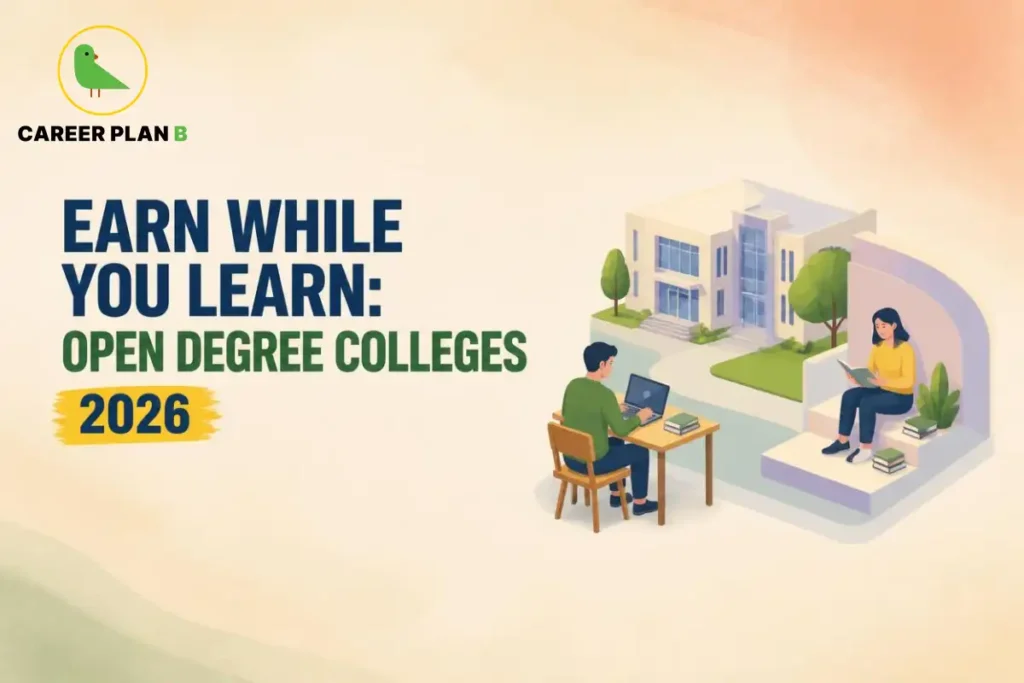
Introduction
Every year, lakhs of students sit for CUET with one dream to get into a good college and build a life they are proud of. And every year, some of them get there. But what about the ones who don’t? What about the student who studied hard, gave it everything, and still didn’t get the rank they needed? If that’s you right now, this blog is written for you. Open degree colleges in 2026 are not a consolation prize — they might just be the smarter path nobody told you about.
The idea of earning while you learn is not new, but in 2026, it has become more real, more structured, and more respected than ever before. Whether you missed your target college in CUET 2026, want to start building work experience early, or simply need a more flexible way to pursue your degree — open degree colleges in 2026 are worth understanding properly, not just as a backup, but as a genuine choice.
What Does “Earn While You Learn” Actually Mean?
Let’s be honest. When most people hear “earn while you learn,” they picture someone doing a low-skill part-time job on the side while barely managing their studies. That’s not what this is.
Earning while you learn, in the context of open and distance education, means this: your schedule is yours. You study at your own pace, attend classes online or on weekends, and use the rest of your time to intern, freelance, work, or even start something of your own. You’re not choosing between a degree and experience — you’re building both at the same time.
The Old Way vs. The New Way of Going to College
The old way was straightforward. You got a rank, joined a college, attended classes from Monday to Friday, gave exams in December and May, and graduated in three or four years. Internships, if any, happened in the summer. Work happened after.
The new way looks different. You enroll in an open or private online university. Your lectures are available on a portal. You study in the mornings, evenings, or weekends — whichever works for you. Meanwhile, you’re working at a startup, doing a certification course, freelancing as a designer, or even helping run a family business. By the time you graduate, you don’t just have a degree. You have something to show for those three years.
That shift is real, and in 2026, more students than ever are choosing it not because they had to, but because they looked at both options and made a call.
What Are Open Degree Colleges — And Why Are They Booming in 2026?
Open universities and distance learning colleges in India operate under a model where physical attendance is either minimal or entirely optional. You enroll, you access your study material, you appear for exams and you earn your degree. The UGC (University Grants Commission) and DEB (Distance Education Bureau) regulate these institutions to ensure your degree holds value.
In 2026, the boom in open university courses in India is being driven by a few clear reasons. First, the job market has changed. Employers now care more about skills and experience than the name of your college. Second, online infrastructure in India has improved massively — good internet, affordable laptops, and well-designed learning platforms have made distance learning genuinely effective. Third, students are smarter about their options. The stigma around open degrees is fading fast.
Key Differences Between Regular, Distance, and Open Universities
| Type | Attendance | Flexibility | Exam Mode | Example |
|---|---|---|---|---|
| Regular University | Daily, in-person | Low | Offline | Delhi University |
| Distance Education | Occasional contact classes | Medium | Offline/Online | IGNOU |
| Online/Open University | Fully online | High | Online proctored | Amity Online, Manipal Online |
This table matters because many students confuse distance education with open universities. They are related but not the same. Knowing which one you’re enrolling in helps you plan better.
Top Open and Private Universities to Consider in 2026
This is where things get practical. If you’re exploring open degree colleges in 2026, here are the institutions worth looking at with their official sources, so you know exactly where to verify.
IGNOU — The Giant You Already Know
IGNOU (Indira Gandhi National Open University) is the largest open university in the world by enrollment. It offers undergraduate, postgraduate, diploma, and certificate programmes across almost every field from BA and BCom to nursing, law, and social work.
What makes IGNOU work for the earn-while-you-learn student is simple: no fixed timetable, study material delivered to you, and exams held twice a year. Admissions for 2026 are open and you can check all current programmes directly at the official website: https://www.ignou.ac.in
IGNOU degrees are UGC-recognised and widely accepted by employers and for further studies including government jobs.
Amity Online, Manipal Online & Other Private Backup Options
Private universities with strong online arms have grown significantly. A few names that carry genuine credibility in 2026:
Amity University Online — Offers UGC-entitled online degrees in management, IT, journalism, and more. Live sessions, recorded lectures, and industry projects are part of the curriculum. Official portal: https://www.amityonline.com
Manipal University Online — One of the more structured online degree programmes available in India. Offers BBA, BCA, MBA, MCA and more with a learning management system that mirrors a real campus experience. Official website: https://online-manipal.in/
LPU Distance Education (LPUDE) — Lovely Professional University’s distance wing offers a range of undergraduate and postgraduate programmes. Official portal: https://www.lpude.in
CUET 2026 Didn’t Go as Planned? Here’s Why That’s Okay
Let’s talk about this directly, because nobody else will. CUET 2026 results carry a lot of weight — cutoffs for central universities like Delhi University, JNU, and BHU are competitive, and not everyone makes it to their first-choice college. That’s a hard moment. But it is just a moment, not a verdict on your future.
The students who do well in life are rarely the ones who got lucky with a rank. They are the ones who figured out the next move quickly, adapted, and kept going.
How Open Admissions Work as a Backup Plan for CUET 2026 Students
Open and private online universities do not require CUET scores for admission. Most have their own entrance tests or admit students on the basis of Class 12 marks. This means even if your CUET 2026 rank didn’t take you where you wanted to go, you can still start your undergraduate journey in 2026 itself without losing a year.
Some students also choose to do both: enroll in an open university now, appear for CUET again next year, and then transfer or continue based on the result. It’s a legitimate strategy. You don’t have to sit at home and wait.
Can You Really Work and Study at the Same Time?
This is the question every parent asks and every student secretly wonders about. The honest answer is: yes, but it depends on how you structure your time.
Open and distance programmes are designed for exactly this. The workload is real — you will have assignments, projects, and exams. But unlike a traditional college, you’re not required to be in a classroom from 9 to 5. That freedom, used wisely, is powerful.
Real Scenarios — What a Typical Week Could Look Like
Scenario 1 — The Intern: Sneha enrolled in IGNOU’s BA Programme after her CUET 2026 score didn’t meet DU’s cutoff. She found a part-time internship at a digital marketing firm three days a week. Evenings and weekends are for her coursework. By her second year, she had real work experience on her resume, something many regular college students don’t have until they graduate.
Scenario 2 — The Freelancer: Rohan started freelancing as a video editor while pursuing his BCA through Manipal Online. His college schedule never clashed with client work. He graduated with both a degree and a small but growing client base.
Scenario 3 — The Competitive Exam Preparer: Aisha used her open degree programme as a foundation while preparing for the UPSC Civil Services examination. The flexibility meant she could dedicate prime study hours to her UPSC preparation without falling behind on her degree.
These aren’t extraordinary stories. They are increasingly common ones.
For Personalized Guidance
Things to Watch Out For Before You Enroll
Here is where you need to be careful, because not every institution that claims to offer an open degree is legitimate.
- Watch out for fake universities. The UGC maintains an updated list of fake universities in India. Before enrolling anywhere, check this list at https://www.ugc.gov.in/page/Fake-Universities.aspx
- Read the programme details carefully. Check whether your chosen course is eligible for government jobs, higher studies, or professional certifications. Not all open degrees carry the same scope.
- Understand the exam pattern. Some universities have moved to online proctored exams while others still require you to visit exam centres. Know what you’re signing up for.
- Don’t be lured by low fees alone. Some institutions charge very little but offer poor academic support. Balance affordability with quality and recognition.
How Career Plan B Helps
Career Plan B helps students decide their next step after CUET 2026 with clarity, confidence, and personalized direction:
- Personalized Career Counselling: Helps students evaluate their CUET outcome and explore suitable open degree or private university options based on their profile, interests, and long-term goals.
- Psycheintel & Career Assessment Tests: Provides data-backed insights into aptitude, personality traits, learning styles, and academic/career alignment to identify pathways that genuinely fit the student.
- Admission & Academic Profile Guidance: Supports students in shortlisting institutions, understanding eligibility, and planning applications for open universities and private colleges.
- Career Roadmapping: Helps students build a structured long-term plan that connects their immediate admission choice with future academic progression and career outcomes.
- End-to-End Guidance: Assists students in choosing between institutions and pathways so they don’t just select a backup option, but a meaningful academic direction aligned with their goals.
For Latest Information
Frequently Asked Questions
Q1. Can I apply to open universities if I did not appear for CUET 2026?
Absolutely. Open and distance universities have independent admission processes. CUET scores are not required. Most admit students based on Class 12 marks or their own entrance tests.
Q2. Will an open degree be accepted for postgraduate admissions?
In most cases, yes. UGC-recognised open degrees are accepted for PG admissions at many universities including IGNOU itself and several state and central universities. However, it’s always advisable to check the specific eligibility criteria of the PG programme you’re targeting.
Q3. Is IGNOU the only option for open education in India?
No. While IGNOU is the most well-known, institutions like Amity Online, Manipal Online, NMIMS Global Access, and LPUDE are credible alternatives with strong academic structures and UGC-DEB recognition.
Q4. Can I switch to a regular university after doing a year in an open university?
It depends on the university’s lateral entry and credit transfer policies. Some universities allow it, some don’t. If this is your plan, research it before enrolling, not after.
Conclusion
A missed rank or a lower-than-expected CUET score doesn’t close any doors — it just changes which door you walk through first. Open degree colleges in 2026 have genuinely evolved. They are structured, recognised, and increasingly respected in the job market and academic world alike. The earn-while-you-learn model gives you something a traditional degree often can’t: real time, real experience, and real flexibility to build your future on your own terms.
So if you’re standing at that crossroads right now, take a breath. You haven’t lost anything. You’ve just found a different starting point. And sometimes, the alternate route is the one that takes you exactly where you were meant to go just faster, and with a lot more to show for it.