Team5 · July 31, 2026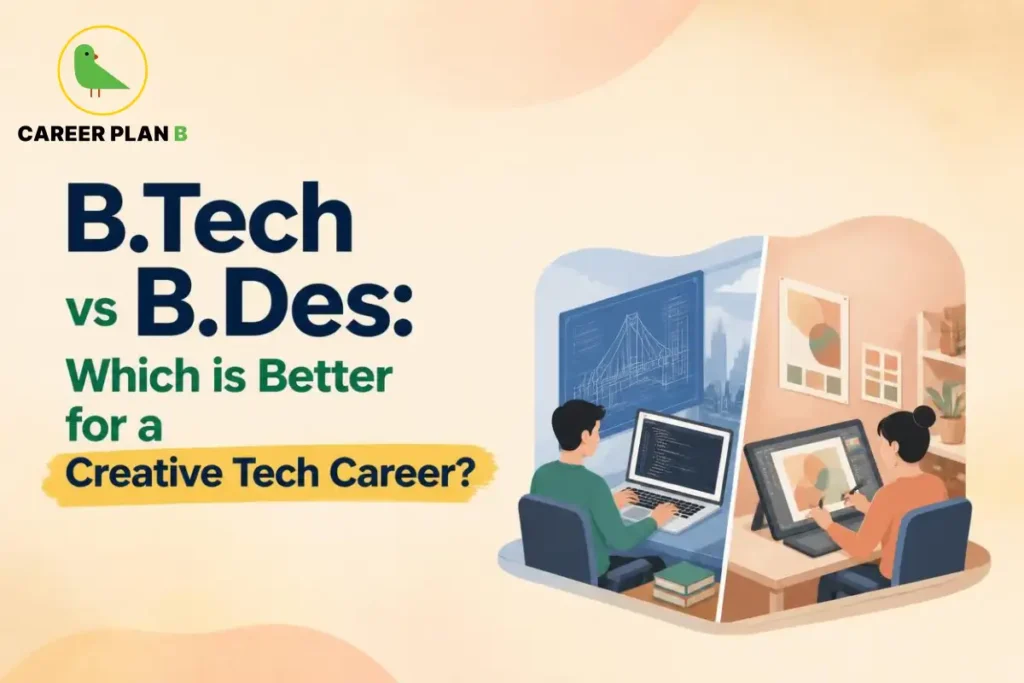
Introduction
Creative tech careers no longer fit neatly into “engineer” or “designer” boxes. Students choosing between B.Tech vs B.Des often assume these are opposite paths, when the reality is more layered.
This guide covers what each degree trains you for, and how to choose based on your target creative tech career.
Why This Question B.Tech vs B.Des Matters More in 2026?
The line between engineering and design has become official, not just informal. IIT Delhi launched a new four-year “B.Tech in Design” programme, explicitly built to combine both disciplines.
This programme requires both JEE Advanced and UCEED scores for admission, treating technical and design aptitude as equally essential. This alone shows that B.Tech vs B.Des is no longer a strict binary in India’s higher education system.
What B.Tech Actually Trains You For
B.Tech falls under AICTE’s definition of technical education, covering engineering, research, and applied training.
Admission typically requires JEE Main or JEE Advanced scores. Physics, Chemistry, and Mathematics remain core Class 12 subjects.
The degree builds deep technical skills: systems thinking, computation, and rigorous problem-solving methods. For creative tech roles needing strong engineering fundamentals, like game engine development, B.Tech offers a more rigorous technical foundation.
What B.Des Actually Trains You For
The National Institute of Design offers Bachelor’s programmes across five faculty streams and 20 diverse design domains.
Admission usually goes through NID’s own Design Aptitude Test or UCEED. Both test creative thinking over technical knowledge.
B.Des builds a different kind of rigour: user research, visual communication, prototyping, and design thinking applied to real-world problems. For creative tech roles centred on user experience, product design, or visual storytelling, B.Des offers training more directly aligned with the work itself.
The Hybrid Middle Ground: B.Tech in Design
IIT Delhi’s new programme sits deliberately between these two traditions. Roughly half its courses come from core engineering departments, and half from the Design department itself.
Students study engineering and sciences in year one, alongside other B.Tech students, before moving into design-focused coursework and design projects from year two onward. This structure directly trains students for genuinely hybrid creative tech roles, like designing AI-driven interfaces or building AR/VR products end-to-end.
Which Path Fits Which Kind of Creative Tech Career
Neither degree is universally better; the right choice depends on which side of “creative tech” appeals more. If you want to build the underlying technology, whether game engines, AI systems, or AR/VR infrastructure, B.Tech gives you that depth directly.
If you want to shape how people experience that technology, through UI/UX, product design, or visual identity, B.Des trains exactly those skills. Roles in India’s growing AVGC-XR sector draw from both backgrounds, depending on whether the work leans toward technical build or creative direction.
Some students genuinely want both, and for them, hybrid programmes like IIT Delhi’s B.Tech in Design offer a direct, structured path. This option remains limited in seats, so it will not fit every student’s location or exam performance.
Step-by-Step Roadmap to Decide
- Identify whether you’re more drawn to building systems or shaping user experience.
- Research whether your target creative tech role needs deep technical skills, design skills, or both.
- Check entrance exam requirements: JEE for B.Tech, UCEED or NID DAT for B.Des, or both for hybrid programmes.
- Look at actual coursework and student portfolios from shortlisted colleges, not just brochures.
- Speak with professionals working in your target creative tech role about which background helped them most.
Have Any Doubts?
Benefits, Challenges, and What the Data Says
Both B.Tech and B.Des now feed directly into India’s growing creative tech economy, from gaming and AR/VR to product design and digital branding. The emergence of hybrid programmes shows official recognition that these skill sets increasingly overlap.
However, no official government dataset directly compares starting salaries or placement rates between B.Tech and B.Des graduates in creative tech roles. Figures claiming one degree earns more circulate widely online but usually come from private placement reports, not verified government data. Treat such comparisons as indicative only.
Common challenges include limited seats in hybrid programmes like IIT Delhi’s B.Tech in Design, making pure B.Tech or B.Des routes more accessible for most students. Building relevant skills alongside either degree, through internships or personal projects, often matters more than the degree label itself.
How Career Plan B Helps
Choosing between B.Tech vs B.Des without a clear picture of your target creative tech role can feel like guesswork. Career Plan B simplifies this through:
- Personalised Career Counselling: matching your technical and creative strengths to the right degree for your specific goals
- Psycheintel Career Assessment Tests: identifying whether you lean toward systems-building or user-experience-focused work
- Admission and Entrance Exam Guidance: helping you understand JEE, UCEED, and NID DAT requirements for your shortlisted colleges
- Structured Career Roadmapping: a clear step-by-step plan from your degree choice to a specific creative tech career
For Latest Information
Frequently Asked Questions
Q1. Is B.Tech or B.Des better for a creative tech career?
Neither is universally better. B.Tech suits technical, systems-building roles, while B.Des suits user-experience and visual design roles.
Q2. What is B.Tech in Design, and how is it different?
It is a hybrid programme, like IIT Delhi’s, combining engineering and design coursework, requiring both JEE Advanced and UCEED scores.
Q3. Do I need JEE to get into B.Des?
Not usually. Most B.Des programmes use UCEED or NID’s own Design Aptitude Test instead of JEE scores.
Q4. Can B.Tech graduates work in UI/UX design roles?
Yes, especially with additional design skills built through courses or projects, though B.Des offers more direct training for these roles.
Q5. Is there official data comparing B.Tech and B.Des salaries?
No official dataset compares them directly. Treat salary comparisons from private sources as indicative only.
Q6. Which degree is better for careers in gaming or AR/VR?
It depends on the specific role. Technical, engine-building roles favour B.Tech, while visual and experience design roles favour B.Des.
Conclusion
B.Tech vs B.Des is not a contest with one correct answer for every student. B.Tech builds deep technical foundations, B.Des builds design and user-experience expertise, and hybrid programmes now formally recognise how much these skills overlap in creative tech careers.
The strongest choice comes from understanding the specific creative tech role you want, not from assuming one degree carries more prestige than the other.
Connect with Career Plan B today to map the right degree path for your creative tech ambitions.