Team2 · June 16, 2026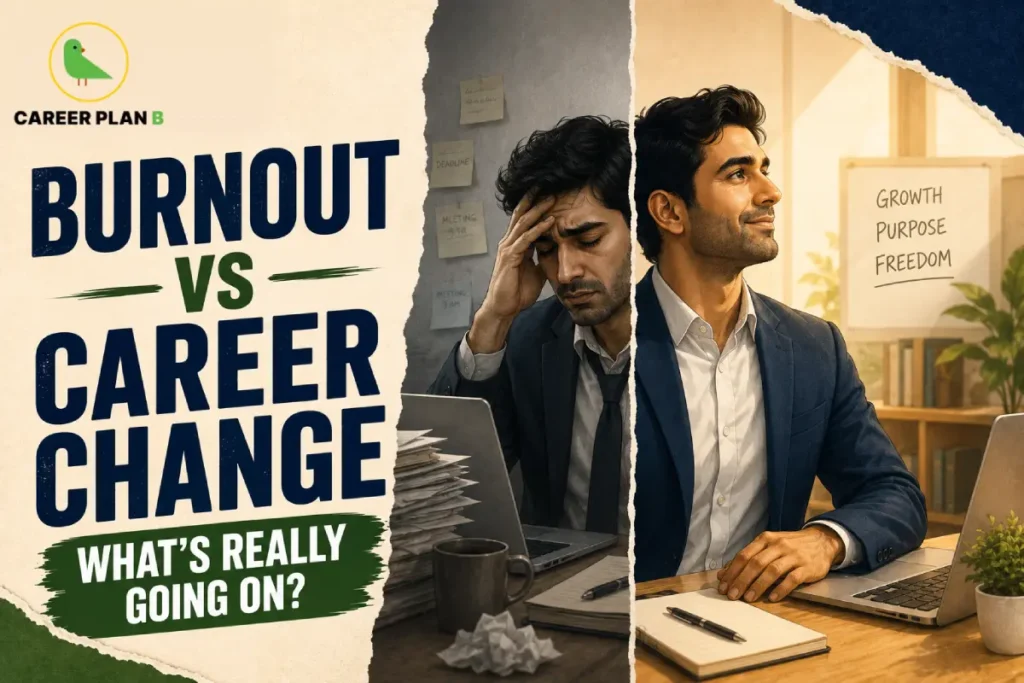
Introduction
There’s a particular kind of Sunday evening dread that a lot of young professionals in India know too well. You’re staring at the ceiling, your chest feels heavy, and the thought of logging in tomorrow feels almost physically painful.With career burnout counselling in India becoming increasingly common, one question still goes unasked: are you burned out from your job, or are you genuinely in the wrong career? Answering this demands a specialized approach, which is why structured career counselling for working professionals is so crucial to help untangle deep workplace fatigue from actual career mismatch.
These two things feel identical from the inside — but they are not the same, and confusing one for the other can cost you years of your life. Burnout is recoverable with rest, support, and the right environment. A career mismatch, on the other hand, follows you no matter where you go. This blog is here to help you figure out which one you’re actually facing and what to do next.
The Confusion: “Am I Burned Out, or Do I Hate My Career?”
Picture Arjun. He’s 24, a software engineer at a well-known product startup in Bengaluru. He has a solid package, his parents are proud and has a great LinkedIn profile . But every morning, he genuinely cannot make himself care. He stares at Jira tickets the way someone stares at a wall. He’s snapping at his teammates. He hasn’t slept properly in weeks.
Now picture Meera. She’s 26, a marketing manager at a media company in Mumbai. She loves storytelling, she’s genuinely good at her job, and she has a wonderful team. But her manager is toxic, the deadlines are brutal, and she hasn’t had a real weekend in eight months. She too wakes up dreading work. Arjun and Meera look like they have the same problem. They don’t.
Arjun may be in the wrong career. Meera is almost certainly burned out. And the mistake most people make and most well-meaning family members make on their behalf is treating these two situations with the same advice: “Just push through,” or equally unhelpfully, “Just quit.”
Both pieces of advice can be catastrophically wrong depending on which situation you’re actually in.
Burnout Symptoms: Job-Specific, Recoverable, and Context-Dependent
The World Health Organization officially classifies burnout in the ICD-11 as an occupational phenomenon not a medical condition defined as a syndrome resulting from chronic workplace stress that has not been successfully managed.
Specifically, the WHO identifies three core dimensions of burnout: feelings of energy depletion or exhaustion; increased mental distance from one’s job, or feelings of negativism or cynicism related to one’s job; and a sense of ineffectiveness and lack of accomplishment.
What makes burnout distinctly different from a career problem is that it is situational and context-specific. Here is what burnout typically looks like in practice:
- You feel exhausted and drained, but you can still remember moments — maybe not long ago when you genuinely liked this work or felt energised by it.
- The problem feels attached to this job, this company, this manager, or this workload — not to the nature of the work itself.
- On a long holiday, you feel like yourself again. You stop dreading work-related thoughts. You feel some hope.
- You may feel useless, powerless, or empty and these feelings are linked specifically to your job conditions, such as lack of control over your schedule, unclear expectations, or interpersonal conflict at work.
- The cynicism you feel is targeted. You’re cynical about this organisation, not about the entire field.
Signs of burnout in the workplace include feeling negative or cynical about your job, feeling unable to do your best work, and feeling disillusioned sometimes to the point where people rely on food, substance use, or other coping mechanisms just to get through the day.
The important thing to understand about burnout is that it is recoverable. A change in environment, workload, management, or working conditions can genuinely restore someone who is burned out. Cognitive Behavioural Therapy (CBT) is an evidence-based treatment for burnout and can be provided one-to-one, in groups, or alongside career counselling. Rest, therapy, boundary-setting, and structural support can bring a burned-out person back to feeling purposeful and engaged — in the same career, just under better conditions.
Career Change Signals: When the Problem Is the Career Itself
Now let’s talk about something different and harder to admit. Some people are not burned out. They are simply in the wrong career. And no amount of rest, no manager change, no company switch, and no salary hike will fix that.
Here’s what career misalignment looks like and it’s subtly different from burnout:
- The exhaustion is not context-specific. You’ve tried different companies in the same field, and the emptiness follows you. A new job gave you energy for maybe three months, then the same dread returned.
- You feel no spark, even on good days. On a relaxed afternoon with no pressure and no deadlines, you still don’t find yourself drawn to the work. There’s no curiosity, no pull.
- Your values are not reflected in the work. You’re an empathetic person who ended up in a cutthroat, metric-obsessed industry. Every day feels like wearing clothes that don’t fit.
- You feel alive doing something else entirely. You find yourself energised when talking to people, but you’re stuck in a data role. Or you feel most like yourself when you’re building things, but you end up in compliance.
- The imagined “dream version” of this career still doesn’t excite you. Ask yourself: if you had the perfect manager, the perfect team, the best compensation in this field — would you be happy? If the answer is genuinely no, that’s a career signal, not a burnout signal.
Career misalignment doesn’t resolve with a holiday. It doesn’t resolve when you get promoted. It shows up in the quiet moments, in the “is this really it?” feeling that doesn’t go away.
The 10-Question Diagnostic: Burnout or Career Change?
Answer honestly. Don’t answer how you think you should feel. Answer how you actually feel.
- Did there used to be a time, even briefly, when you found this work meaningful or interesting?
(Yes = burnout signal. No = career signal.) - When you imagine the same work at a healthier company with a supportive manager, does it feel like relief?
(Yes = burnout signal. Still dread it = career signal.) - On a vacation of two weeks or more, do you feel like yourself again?
(Yes = burnout signal. Not really = career signal.) - Is most of your frustration directed at your boss, team, or workplace culture rather than the work itself?
(Yes = burnout signal. No = career signal.) - Do you feel physically exhausted, numb, or cynical in ways that feel new, not how you’ve always felt about this work?
(Yes = burnout signal. No = career signal.) - When you think about a completely different career, does it feel like freedom or just another thing you’ll eventually dread?
(Freedom = career signal. Another thing to dread = burnout signal.) - Have there been moments in the past year when the work felt worthwhile, even briefly?
(Yes = burnout signal. No = career signal.) - If your workload were cut in half tomorrow, would you feel okay about coming to work?
(Yes = burnout signal. Still not okay = career signal.) - Do you frequently lose track of time doing something related to a different field?
(Yes = career signal. Not really = burnout signal.) - If money were not a factor, would you still do this kind of work?
(Yes = burnout signal. Absolutely not = career signal.)
Scoring:
• 6+ burnout signals: You’re likely dealing with burnout rather than a career mismatch.
• 6+ career signals: A deeper career misalignment may be the issue.
• 5/5 split: You’re in the grey area where burnout and career mismatch often overlap.
The Dangerous Middle: Burnout From a Career Mismatch
Here’s the case that is the hardest to diagnose and the one that CareerPlanB’s counsellors encounter most often in sessions. Some people are burned out because they are in the wrong career.
This is not the same as being burned out at a good job. This is a person who chose engineering because their parents expected it, or law because they thought it would make them financially secure, and they’ve been grinding through it for years on sheer willpower. They are exhausted but it’s not because the workload is too heavy. It’s because they’ve been doing work that doesn’t align with who they are, every single day, for years on end.
According to the India Skills Report 2023–24, nearly 49% of Indian graduates are considered unemployable due to a mismatch between their education and industry demand but what is less talked about is the mental health cost of that mismatch for those who do get employed. When you spend years in a field you weren’t suited for, the exhaustion accumulates not just from overwork but from misalignment.
This category of person often tells themselves they just need a break. They take a month off. They come back refreshed for about three weeks. Then the same dull ache returns because the problem was never the workload—it was the career itself. Ignoring this cycle can quickly calcify into long-term career stagnation in your 30s, where your professional growth completely grinds to a halt.
If you recognise yourself here, please hear this clearly: this is not a personal failure. India’s Gen Z professionals increasingly face a growing gap between evolving personal expectations and rigid professional environments and many young people landed in their current fields not out of passion but out of pressure, fear, or a lack of early career guidance. This is exactly the space that career counselling is designed to address.
What Happens If You Misdiagnose It
The consequences of getting this wrong are not trivial.
If you treat a career mismatch as burnout: You take a break, come back, and white-knuckle it through a few more years. Your mental health quietly deteriorates. You become someone who is perpetually tired, secretly resentful, and never quite able to explain to your family why you’re unhappy despite having a “good job.” Eventually, you may hit a wall in your 30s that is far harder to course-correct from.
If you treat burnout as a career change signal: You quit a job, maybe even a career that you were genuinely suited for, just because the conditions were bad. You start over in a new field with the energy of a fresh start. Six months in, once the novelty fades and the real work begins, you’re exhausted again. You start wondering if the problem is you. It isn’t. But you’ll have lost time, money, and possibly confidence.
When change is desired and shifts are made quickly and without a plan, the result is often more job changes, more stress, more burnout, and more instability. The decision to stay or go must be grounded in clarity, not desperation.
Why a Career Counsellor Handles This Better Than a Therapist Alone
This is worth saying clearly, because in India, there is still a tendency to treat these problems as purely emotional — something to process with a therapist or simply to push through.
A therapist is extraordinarily valuable. Burnout, especially deep burnout, often comes with anxiety, depression, and a damaged sense of self-worth that genuinely requires therapeutic support. CBT has been shown to be effective for burnout and can be delivered alongside career counselling or work with employers. If you’re struggling emotionally, please don’t dismiss that.
But a therapist is not trained to do what a career counsellor does. A therapist will help you process how you feel about your situation. A career counsellor helps you assess the situation itself — your skills, your values, your aptitude, your options, and your realistic path forward.
When you are in the middle of the burnout-versus-career-change confusion, you need both kinds of clarity. You need to understand your emotional state and your professional landscape. Treating only the emotional layer without examining the career layer is like treating the symptom without diagnosing the illness.
A career counsellor will ask you questions a therapist may not: What are your core strengths? Where do you actually thrive at work? How does the job market in your field really look? And are the requirements of a realistic transition achievable given your age, background, and goals?
Have Any Doubts?
When You Need Both: The Referral Approach
At CareerPlanB, this is something that comes up in sessions regularly. Some clients arrive for career counselling and it becomes clear within the first session that they need therapeutic support as well because the burnout has become severe, or because there’s anxiety and emotional distress that is clouding their ability to think clearly about their future.
Others arrive for therapy and discover that a large part of their unhappiness is structural and career-specific, not something therapy alone can resolve.
The wisest approach recognises that these two things work together. Think of it this way: therapy helps you stabilize the ground beneath your feet. Career counselling helps you figure out which direction to walk. You often need both and the sequence matters. Trying to make major career decisions when you are emotionally exhausted and dysregulated is like trying to read a map in a storm. You may need to heal a little first, or you may need the career clarity to even understand what you’re healing from.
If you’re working with a therapist and also sensing that your distress is career-specific, bring it up. A good therapist will refer you to a career counsellor and at CareerPlanB, we work collaboratively with mental health professionals when the situation calls for it.
Self-Assessment Tool: Burnout or Career Change?
Use this as a quick gut-check. Be honest with yourself.
| Question | Burnout | Career Change |
|---|---|---|
| Do you remember loving this work at some point? | Yes | No, never quite |
| Does a good holiday restore your motivation? | Yes | Temporarily at best |
| Is the problem mostly the environment/people? | Yes | No, it’s the work itself |
| Do you feel energised imagining a better version of this role? | Yes | No |
| Are you curious about the field even when not working? | Sometimes | Rarely |
| Does the thought of a completely new career feel like relief? | Unsure | A clear yes |
| Have you tried a different company in the same field? | Not yet | Yes, same result |
If most of your answers sit in the Burnout column: focus on rest, boundaries, therapy, and potentially a change in environment before making any drastic moves.
Should most of your answers sit in the Career Change column: the question isn’t whether to change — it’s how to do it thoughtfully, with proper assessment of your strengths, interests, and options.
Falling split down the middle: you may be in the career-mismatch-burnout overlap — the category that most benefits from a structured conversation with a career counsellor.
Frequently Asked Questions
Q1: How do I know if I need career burnout counselling in India or an actual career change?
The simplest test is this — if you can imagine loving your work under different conditions, it’s likely burnout. If you can’t picture it regardless of the environment, a career change deserves serious consideration.
Q2: Can career burnout in India fix itself if I just take a long break?
A break can restore energy, but it rarely resolves the underlying cause. If you return to the same role, same culture, and same patterns, burnout typically resurfaces within months — rest treats the symptom, not the source.
Q3: What’s the real difference between burnout vs career change as a solution?
Burnout is about depletion — you need recovery, boundaries, and possibly a role or environment shift. A career change is about misalignment; you need a fundamentally different direction. Confusing the two leads to decisions you regret.
Q4: Is job burnout career counselling different from regular therapy or mental health support?
Yes. Therapy addresses emotional and psychological recovery, while job burnout career counselling focuses specifically on your professional identity, work patterns, and what structural changes in your career would actually resolve the problem.
Q5: Should I make a career change decision while I’m still burnt out?
Ideally, no. Major career decisions made at peak exhaustion are often reactive rather than intentional. The goal of burnout counselling is to first stabilise clarity, then make the call not the other way around.
How Career Plan B Helps
The emotions involved exhaustion, guilt, confusion, family pressure, financial anxiety make it genuinely hard to think clearly about your own situation. That’s not a weakness. That’s just how it works when you’re inside the problem.
This is exactly the kind of clarity that a free discovery session with CareerPlanB is designed to help you find. In a single conversation, a trained career counsellor can help you begin to separate what is burnout from what is misalignment, understand what your next step should actually look like, and feel less alone in a decision that can genuinely change the course of your life.
Get In Touch With Us
Conclusion
The question — “Am I burned out, or do I need a career change?” is one of the most important questions a young professional can ask. And it deserves a real answer, not a guess made in exhaustion at 2 AM. Career burnout counselling in India is not about being dramatic or weak; it’s about making the single most significant decision of your professional life with clarity, not confusion.
Whether you’re a student standing at the edge of your first major career choice, or a young professional five years in and quietly wondering if you took a wrong turn you deserve to know which problem you’re actually solving. Getting this right doesn’t just change your job. It changes how you show up for your life.