Team6 · October 6, 2026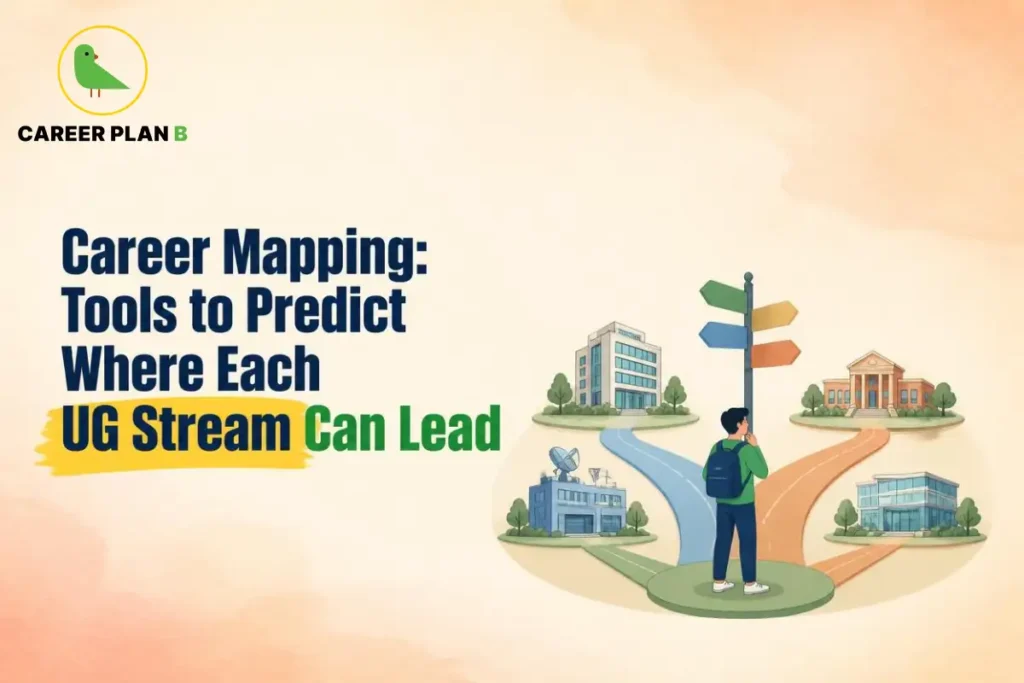
Introduction
Choosing a UG stream often feels like committing to a single, fixed future, when in reality most degrees branch into far more directions than students realize going in. Career mapping for UG students is exactly the process of understanding those branches ahead of time, rather than discovering them by accident three years into a degree.
This guide covers a genuine government-backed tool for this exact purpose, alongside a practical framework for mapping your own UG stream to realistic career directions, so your planning rests on structured methodology rather than guesswork.
A Genuine Government Tool Most Students Don’t Know About
Here’s a fact worth knowing before anything else: the National Career Service, an initiative of the Ministry of Labour and Employment, Government of India, offers free psychometric and aptitude assessments alongside career counselling services, specifically designed to help individuals identify suitable career paths (source: ncs.gov.in). The platform operates through more than 900 Model Career Centres nationally, offering in-person counselling, resume support, and structured career guidance alongside its online tools, entirely free of charge.
This matters because career mapping tools don’t have to mean an expensive private consultation; a genuine, government-run assessment and counselling infrastructure already exists, and most students simply never discover it.
UG Career Planning: Why Mapping Matters Before You Choose
UG career planning done properly starts before you even finalize your stream, not after. Each undergraduate discipline genuinely branches into multiple distinct career clusters, some obvious, some far less so. A Commerce graduate might assume their only paths are accounting or an MBA, when the same degree genuinely supports paths into data analytics, digital marketing, or even UX research with the right additional skill-building. Mapping these branches early helps you make more intentional elective and internship choices throughout your degree, rather than realizing your options only when it’s time to apply for your first job.
Career Mapping Tools: Building Your Own Framework
Career mapping tools don’t need to be complicated software; a genuinely useful framework combines a few concrete steps. Start with a skills and interest inventory, honestly listing what you’re naturally drawn to and what you’re demonstrably good at, ideally validated through something like NCS’s own free psychometric assessment rather than pure self-assessment alone. Next, research the actual career clusters your specific stream supports, not just the most obvious one, by looking at where recent graduates from your target programme have genuinely gone. Finally, identify the specific skills or certifications that bridge your degree to each potential cluster, since most career pivots require some additional, targeted skill-building beyond your core coursework.
Have Any Doubts?
Career Options After Graduation: Mapping by Stream
Career options after graduation vary considerably by UG stream, and understanding the genuine breadth matters more than defaulting to the single most obvious path. Science graduates in core disciplines like Physics, Chemistry, or Biology can move toward research, data-focused roles, science communication, or further specialized study, not just a single predetermined academic track. Commerce graduates can branch into finance, analytics, entrepreneurship, or operations, well beyond the traditional CA or MBA default. Arts and humanities graduates often have the widest, least obvious branching, into content strategy, public policy, UX research, and civil services preparation, fields that value strong analytical and communication skills over a specific technical credential.
Read more:- College Prediction: Case Studies With Real Score Scenarios
Undergraduate Career Paths: The Value of Mapping Early vs. Late
Undergraduate career paths mapped early, ideally starting in your first or second year rather than your final semester, give you meaningful time to build bridge skills, internship experience, or relevant certifications before graduation pressure sets in. Students who map their options late often find themselves choosing from whatever’s immediately available rather than a path they’ve deliberately prepared for. This is precisely why treating career mapping as an ongoing process throughout your degree, not a one-time decision at the very end, genuinely changes your outcomes.
Career Guidance After 12th: Where Mapping Should Actually Begin
Career guidance after 12th ideally starts the mapping process even before you select your UG stream, since understanding a stream’s genuine breadth of outcomes helps you choose more intentionally in the first place. Using a free, structured assessment like NCS’s own psychometric tools at this stage, combined with honest research into where a specific stream’s graduates actually go, gives you a genuinely stronger foundation than choosing a stream based purely on family expectation or peer pressure.
How Career Plan B Helps
Building a genuine, structured career map for your specific UG stream, rather than guessing or defaulting to the most obvious path, takes real, personalized guidance.
- Personalized Career Counselling: Helps you map your specific UG stream to genuine, realistic career directions based on your actual interests and strengths.
- Psychometric & Career Assessment Tests: Identifies your natural aptitudes and interests to guide which career cluster within your stream genuinely fits you.
- Career Roadmapping: Builds a concrete, step-by-step plan connecting your current coursework to your target career direction well before graduation pressure sets in.
- Admission & Academic Profile Guidance: Supports you in selecting electives, internships, and certifications that genuinely bridge your degree to your mapped career goals.
Get In Touch With Us
Frequently Asked Questions
1. Is there a genuinely free, government-backed career mapping tool in India?
Yes. The National Career Service, run by the Ministry of Labour and Employment, offers free psychometric assessments and career counselling through its online portal and over 900 Model Career Centres nationally.
2. When should career mapping for UG students actually begin?
Ideally as early as possible, before finalizing your stream if feasible, or at minimum during your first or second year of a degree, rather than waiting until final-year placement season.
3. Does every UG stream genuinely branch into multiple career paths?
Yes, though the branches aren’t always obvious; most degrees support several distinct career clusters beyond the single most commonly assumed path.
4. What’s the biggest mistake students make with UG career planning?
Mapping their options too late, often only in their final semester, leaving little time to build the bridge skills or experience needed for a path beyond the most obvious default.
5. Can career guidance after 12th help before I even choose my UG stream?
Yes. Understanding a stream’s genuine range of outcomes before committing helps you choose more intentionally, rather than selecting based purely on assumption or peer pressure.
Conclusion
Career mapping for UG students works best as an early, ongoing process, not a last-minute scramble during final-year placements, and genuine tools for this exist through India’s own government-backed National Career Service alongside deliberate self-research into your stream’s real branching paths. Understanding the full breadth of where your degree can lead changes how you approach electives, internships, and skill-building throughout your entire degree.
Start mapping your options now, using structured assessment tools rather than assumption alone. If you’d like help building a genuine, personalized career map for your specific situation, Career Plan B’s counsellors are ready to guide you through it.