Careerplanb · August 3, 2026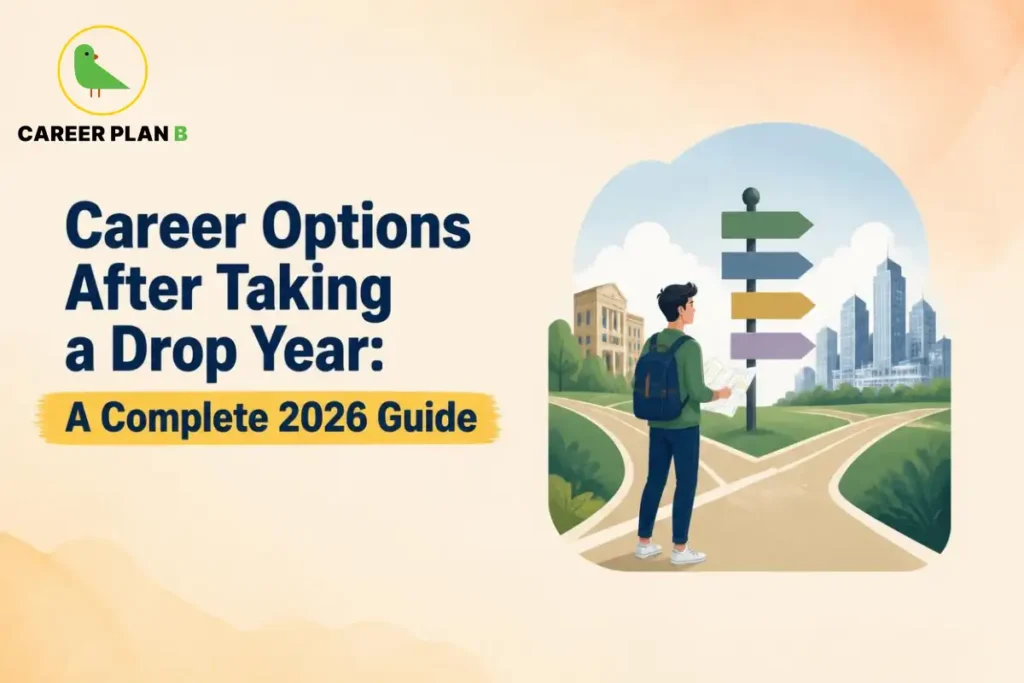
Introduction
The drop year is finally over. Now what? This question hits harder than most people expect. Suddenly, Career Options After Drop Year become the only thing that matters, whether your results went as planned or not.
Thankfully, this decision does not need to feel overwhelming. This guide walks through every realistic path forward, from reattempting an exam to switching direction entirely. By the end, Career Options After Drop Year will feel like a clear roadmap, not a source of anxiety.
First, Where Do You Actually Stand?
Before exploring options, be honest with yourself. Your next step depends heavily on why you took the drop year in the first place. Therefore, start by identifying which of these situations matches you.
- You retook an exam and improved significantly. Your path likely continues as planned, just with better prospects.
- You retook an exam and results still fell short. This is genuinely the hardest position, and it deserves careful thought, not panic.
- You used the year for exploration, not exam prep. Your next step is about converting that exploration into a concrete decision.
- Personal circumstances caused the gap. Your priority is finding a path that fits your current readiness, not last year’s plan.
Why Does This Matter So Much?
Each starting point leads to a genuinely different set of smart next steps. Consequently, generic advice rarely helps here. Instead, matching your actual situation to the right path saves months of wasted effort.
Confused about your next steps? Get a personalized roadmap tailored to your career goals.
What to Do After Taking a Drop Year for Exam Preparation
If your drop year is centered on JEE, NEET, CLAT, or another competitive exam, your options branch based on your result. Fortunately, none of these branches are dead ends.
If Your Score Improved Enough
Move forward with counselling and admission as planned. However, do not skip the college and branch research stage. For instance, non-CS engineering branches from lower-ranked private colleges often show weak placement outcomes, so verify NIRF rankings and branch-specific placement data before finalising your choice.
If Your Score Still Fell Short
This is genuinely difficult, but it is not the end of your options. First, decide honestly whether a second drop year makes sense, based on how close you came and whether your preparation method actually changed. If not, several strong alternatives exist within the same broad field.
| Country | Approx. Total Cost (1-Year Master’s) | Post-Study Work Duration |
|---|---|---|
| Germany | ₹12 to ₹22 lakh | 18 months job-seeker visa |
| UK | ₹35 to ₹55 lakh | 18 months from 2027 (currently 24 months) |
| Canada | ₹35 to ₹55 lakh | Up to 3 years (PGWP) |
| USA | ₹50 to ₹80 lakh | Up to 36 months (STEM OPT) |
Notice how each alternative stays connected to your original interest. As a result, your drop year preparation does not go to waste, even without your target exam result.
Suggested blog :- NGO and Social Impact Careers for Drop-Year Students
Career Options After Drop Year If You Explored Instead of Studied
Not every drop year revolves around an entrance exam. If yours involves internships, certifications, or genuine career exploration, your next step looks different. Essentially, you now need to convert that exploration into a decision.
How Do You Actually Turn Exploration Into a Plan?
Start by reviewing what genuinely held your interest during the year. Then, match that interest against realistic degree or certification paths. Skills now matter more than degrees alone for many freshers, so a focused certification alongside your degree choice can strengthen your position considerably.
- Enjoyed data or numbers? Consider B.Sc Statistics, BCA, or a data analytics certification alongside a core degree
- Enjoyed design or visual work? Explore UI/UX design, B.Des, or a portfolio-based creative field
- Enjoyed business or strategy? Look into BBA, commerce-based degrees, or business analytics programmes
- Still genuinely unsure? A flexible, multidisciplinary degree with minors can keep multiple doors open
Should You Consider Skill-Based or Certification Routes?
Yes, and this option deserves far more attention than it usually gets. Employers increasingly prioritise demonstrable skill over degree prestige alone, especially for entry-level tech and analytics roles. Therefore, pairing your degree with a focused certification can meaningfully shorten your path to a strong first job.
Which Skill Areas Are Actually Worth Pursuing in 2026?
Certain fields currently show genuine demand-supply gaps in India. For example, AI, data analytics, and cybersecurity talent shortages remain significant, creating real opportunity for motivated freshers who build practical skills early.
- Data Analytics or Data Science – strong demand across nearly every industry, pairs well with almost any degree
- Full Stack Development – especially valuable for BCA, B.Sc Computer Science, or engineering students
- Digital Marketing – accessible entry point for arts, commerce, or humanities graduates
- UI/UX Design – portfolio-driven, works well for creatively inclined students regardless of stream
What If You Are Still Completely Unsure?
This is more common than most students admit. If nothing above feels clearly right, do not force a decision purely to end the uncertainty. Instead, take these structured steps first.
- Take a proper aptitude or psychometric assessment, rather than guessing based on family expectations alone
- Talk to people working in two or three fields you find mildly interesting, even briefly
- Choose a flexible degree path that allows minors or electives, so your final decision can wait a little longer
- Set a firm decision deadline, since indefinite exploration can become its own trap
A Word of Caution Before You Decide
Avoid choosing a path purely to end family pressure or social comparison. A rushed decision after a drop year often leads to a second, even harder pivot later. Therefore, verify course details and recognition through official university and UGC sources before committing.
How Career Plan B Helps
Figuring out Career Options After Drop Year genuinely benefits from structured, outside guidance rather than family opinions alone.This is where Career Plan B can help by offering:
- Personalised Career Counselling: Provides expert guidance based on individual interests, skills, and career goals, helping you decide the right next step after your drop year.
- Psychometric & Career Assessment Tests: Identifies strengths, personality traits, and suitable career opportunities, especially useful if you remain genuinely unsure of direction.
- Career Roadmapping: Creates a clear step-by-step plan to achieve academic and professional goals, including realistic timelines for your chosen path.
- Admission & Academic Profile Guidance: Helps in selecting the right courses and colleges and improving academic profiles, so your next step is genuinely well-informed.
Get In Touch With Us
Frequently Asked Questions
1. What should I do if my drop year exam results still did not improve enough?
Consider closely related alternative fields that use your existing preparation, such as BDS or nursing after NEET, or explore whether a second, better-structured attempt genuinely makes sense.
2. Is it too late to switch fields entirely after a drop year?
No. Streams and career paths are far more flexible than they used to be, and switching direction after 12th remains genuinely common and workable.
3. Should I prioritise a degree or a skill certification after my drop year?
Ideally both. A core degree paired with a focused, in-demand certification tends to offer the strongest combination for today’s job market.
4. How do I know if I need a career assessment or just more time to think?
If you have already spent significant time reflecting without clarity, a structured psychometric assessment can meaningfully speed up the decision process.
5. Are non-traditional careers actually viable after a drop year?
Yes. Fields like digital marketing, UX design, and data analytics offer genuine, well-paying opportunities, regardless of your original academic stream.
Conclusion
A drop year does not have to end in a single, narrow outcome. Whether your exam results improved, fell short, or you spent the year exploring instead, genuine options remain open. The real task now is matching your actual situation to a thoughtful next step, not rushing toward the first available choice.
If you are still weighing your next move, structured guidance can bring real clarity quickly. The right decision now, made carefully, shapes a stronger path for years ahead. Talk to a Career Plan B counsellor today to map out your best next step after your drop year.