Careerplanb · August 3, 2026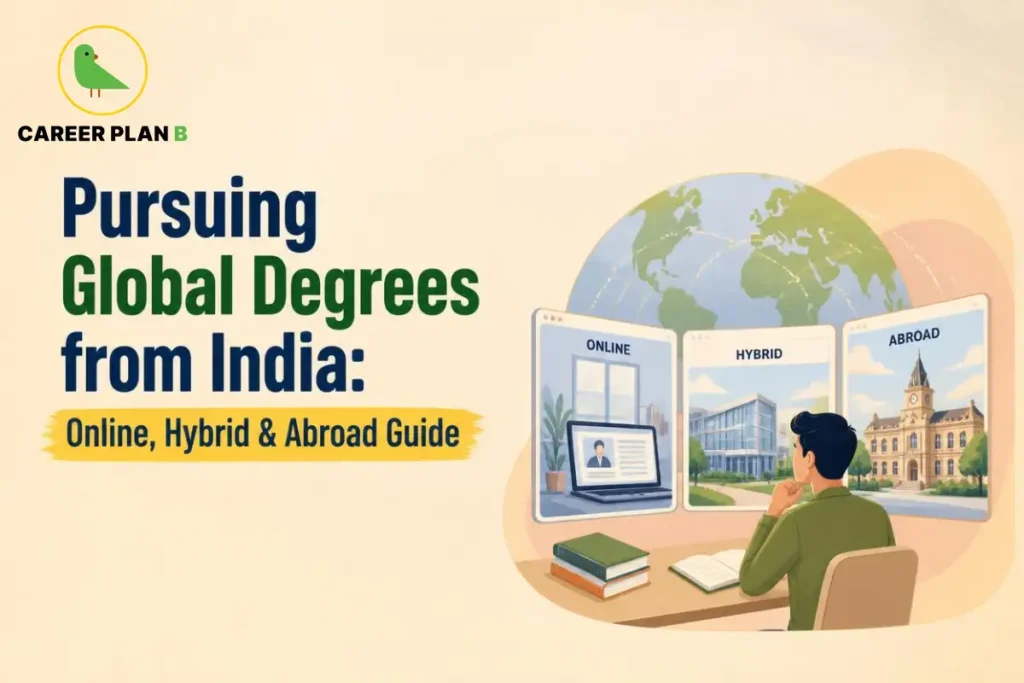
Introduction
Not long ago, a global degree meant one thing only. Pack your bags, apply for a visa, and relocate for years. That single path has now split into three genuinely different routes. Today, Global Degrees from India can mean studying fully online, choosing a hybrid model, or still moving abroad completely.
So, which path actually makes sense for you? This guide compares all three routes honestly, covering real costs, visa rules, and career recognition. By the end, Global Degrees from India will feel like a clear decision, not a confusing maze.
Option 1: Fully Online Global Degrees from India
Online degrees have grown far beyond basic certificates. Today, universities like MIT, Stanford, and Oxford offer online programs that carry serious weight. In fact, employers in India, including major tech companies, hire online graduates from top global universities at salaries matching campus graduates.
However, not every online degree carries equal value. Therefore, Online International Degree Programs work best when the university itself is genuinely well-ranked and accredited. For instance, AACSB-accredited online MBAs from reputed universities command strong salaries, often between forty and eighty lakh rupees in India.
What About Visa Rules for Online Study?
This is where online programs hit a real limitation. Most countries, including the US, UK, and Australia, do not grant student visas for fully online programs. Consequently, if your goal includes living and working abroad, a purely online degree will not get you there directly.
For Personalized Guidance
Option 2: Hybrid Degree Programs
Hybrid models solve exactly this visa gap. Students typically begin their degree online or locally in India, then transfer abroad for part of the programme. As a result, Hybrid Degree Programs India now offer a genuinely practical middle path between staying local and relocating fully.
Several structures exist within this model. Some students complete one year locally before moving overseas. Others attend short in-person sessions abroad while studying primarily online. Either way, this approach significantly reduces both cost and immigration risk.
Why Are International Campuses in India Part of This Trend?
Foreign universities are now opening campuses directly inside India. Notably, only institutions ranked among the global top 500 are permitted to do so under current UGC regulations. This ensures genuine academic credibility, not just a foreign-sounding brand name.
Furthermore, students at these campuses often retain flexibility. Many can transfer to the main overseas campus after their first or second year. Others complete the entire degree in India while still earning a qualification awarded by the parent international university.
Option 3: Studying Fully Abroad
Full relocation remains the most traditional route, and it still offers the deepest immersion. However, the numbers have shifted considerably in 2026. For example, total one-year master’s costs now range from roughly twelve lakh rupees in Germany to eighty lakh rupees in the USA.
| Country | Approx. Total Cost (1-Year Master’s) | Post-Study Work Duration |
|---|---|---|
| Germany | ₹12 to ₹22 lakh | 18 months job-seeker visa |
| UK | ₹35 to ₹55 lakh | 18 months from 2027 (currently 24 months) |
| Canada | ₹35 to ₹55 lakh | Up to 3 years (PGWP) |
| USA | ₹50 to ₹80 lakh | Up to 36 months (STEM OPT) |
Notably, visa risk has become a real strategic factor too. US student visa rejection rates for Indian applicants have climbed sharply in recent years. Meanwhile, Germany has been approving the vast majority of Indian student visas, often within days.
How Should You Actually Compare These Countries?
Do not simply chase brand names or rankings. Instead, weigh five practical factors together. These include career outcome alignment, post-study work duration, total cost-to-payback ratio, visa approval probability, and genuine cultural fit for you.
Which Option Actually Fits You Best?
There is no single universal answer here. Instead, the right choice depends entirely on your specific goals. Use this simple framework to narrow things down.
Recommended blog:- Building Global Careers with Indian Distance Degrees
- Want to work while studying? Fully online programs from top-ranked universities offer flexibility without relocation.
- Want reduced cost and visa risk, but still some global exposure? Hybrid programs or Indian campuses of foreign universities fit well.
- Want deep immersion, networking, and post-study work rights? Studying fully abroad remains the strongest option, despite higher cost.
- Uncertain about your long-term country of residence? Hybrid pathways let you delay that decision while keeping options open.
Does Recognition Actually Matter for Employers?
Yes, but perhaps not in the way most families assume. Most private employers in India care far more about university ranking and accreditation than about UGC certification specifically. However, for regulated professions like medicine or law, checking with the relevant professional body remains essential before enrolling.
How Should You Actually Get Started?
Before choosing any path, work through these steps carefully.
- Define your end goal first, whether that means working abroad, returning to India, or staying genuinely flexible
- Verify accreditation and ranking for any university, whether online, hybrid, or fully abroad
- Model total cost against realistic starting salary, not just tuition fees alone
- Check current visa rules for your specific target country, since these change frequently
- Speak to recent graduates from your shortlisted programme wherever possible, for an honest, ground-level view
A Word of Caution Before You Commit
Always verify a foreign university’s accreditation and UGC approval status directly through the UGC portal, especially for campuses operating within India. Additionally, confirm current visa and post-study work policies through each country’s official immigration website before finalising your decision.
How Career Plan B Helps
Choosing between online, hybrid, and fully abroad paths for Global Degrees from India is rarely a simple decision. This is where Career Plan B can help by offering:
- Personalised Career Counselling: Provides expert guidance based on individual interests, skills, and career goals, helping you decide between online, hybrid, or fully abroad global degree paths.
- Psychometric & Career Assessment Tests: Identifies strengths, personality traits, and suitable career opportunities, useful for judging readiness for international study formats.
- Career Roadmapping: Creates a clear step-by-step plan to achieve academic and professional goals, including realistic cost and visa timelines for your chosen path.
- Admission & Academic Profile Guidance: Helps in selecting the right courses and colleges and improving academic profiles, so your global degree choice is genuinely outcome-driven.
Get In Touch With Us
Frequently Asked Questions
1. Are online international degrees actually recognised in India?
Yes, especially from top-ranked, accredited universities. Employers generally value university brand and accreditation over UGC certification for private sector roles.
2. Can I get a student visa for a fully online degree?
Generally, no. Most countries, including the US, UK, and Australia, require some in-person component to qualify for a student visa.
3. What exactly is a hybrid degree programme?
It combines study in India with structured international exposure, through short campus visits, exchange semesters, or eventual transfer to an overseas campus.
4. Which country currently offers the best value for studying abroad?
Germany currently stands out for low or no tuition, strong visa approval rates, and a clear post-study work pathway for STEM graduates.
5. Do foreign university campuses in India offer genuine international degrees?
Yes, provided the institution is UGC-approved and ranks among the global top 500, since only such universities are permitted to operate campuses in India.
Conclusion
Global education is no longer a single road. It has genuinely split into online, hybrid, and fully abroad paths, each suited to different goals and budgets. For Indian students and professionals in 2026, this flexibility is a real advantage, not a source of confusion, once the options are clearly understood.
If you are still weighing which path fits your goals, structured guidance can bring real clarity fast. The right global degree path, chosen deliberately, shapes opportunities for decades ahead. Talk to a Career Plan B counsellor today to map out the right global degree path for you.