Team Career Plan B · July 13, 2026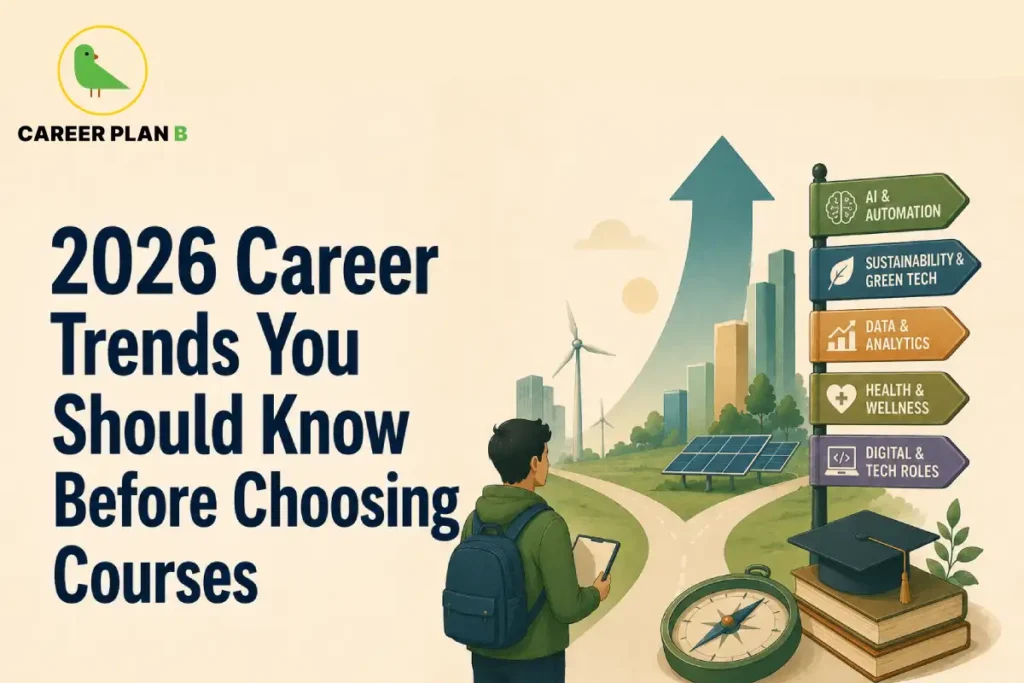
Introduction
Choosing a course used to be simple: pick a stream, get a degree, get a job. That formula is breaking down. Employers today care less about which degree you hold and more about what you can actually do — and the fields growing fastest in 2026 often don’t map neatly onto traditional degree categories at all.
If you’re choosing a course this year — whether after Class 12, during college, or as a career switch — picking based on outdated assumptions about “safe” careers can cost you years of misdirected effort. The smarter approach is understanding where the real momentum is before you commit time and money to a specific programme.
This guide breaks down the career trends genuinely shaping 2026 in India, and what they actually mean for the courses you choose next.
Trend 1: AI Literacy Is Becoming a Baseline Skill, Not a Specialisation
AI is no longer a niche technical skill reserved for computer science graduates. In 2026, AI literacy is expected across marketing, HR, finance, healthcare, and even creative fields — because the tools themselves have become that widespread.
What This Means for Course Selection
You don’t need a full data science degree to stay relevant. A short, focused AI or prompt engineering certification alongside your core degree — commerce, arts, or science — is often more useful than people expect. Employers are increasingly hiring for “AI-augmented” roles, where domain knowledge plus basic AI fluency beats a generic tech degree with no specialisation.
Trend 2: Green and Sustainability Careers Are Moving From Niche to Mainstream
India’s renewable energy push, ESG reporting requirements, and climate-linked government policy are creating consistent, growing demand for professionals in sustainability, environmental compliance, and clean energy — sectors that barely existed as formal career categories a decade ago.
Courses Worth Watching
- Environmental Science and Sustainability Management programmes
- Renewable Energy Engineering and solar technician certifications
- ESG Analysis and Sustainability Reporting short courses
This trend particularly benefits students from science, engineering, and even commerce backgrounds who want a stable, growing sector without competing in an oversaturated job market.
Trend 3: Healthcare and Allied Health Careers Are Expanding Beyond MBBS
Not every healthcare career route runs through a medical seat. India’s healthcare system is expanding rapidly in allied and paramedical fields — nursing, physiotherapy, medical technology, health informatics, and mental health support — all of which face genuine talent shortages.
Why This Matters Now
Students who miss a medical seat often assume healthcare is closed off entirely. It isn’t. Diploma and degree programmes in allied health fields offer real, stable careers with growing demand — and shorter, more accessible entry paths than the MBBS route.
Trend 4: Skill-Based Hiring Is Replacing Degree-First Hiring
This is arguably the biggest structural shift affecting how you should choose courses in 2026. More employers — particularly in tech, digital marketing, design, and content — are hiring based on demonstrated skill and portfolio, not just degree pedigree.
What This Changes About Your Course Decision
- A shorter, skill-focused certification (in UX design, data analytics, digital marketing) can open doors that a generic degree alone won’t
- Government platforms and recognised certifications increasingly carry real weight with employers, not just private course names
- Building a portfolio alongside your course matters as much as the course itself
Trend 5: Hybrid and Multidisciplinary Degrees Are Gaining Ground
The old rigid separation between Science, Commerce, and Arts is loosening. Multidisciplinary programmes — combining data science with design, or economics with public policy — are becoming more available and more valued by employers who want adaptable thinkers, not narrow specialists.
Signs This Trend Is Real
- More universities are adopting flexible credit systems that let students combine subjects across streams
- Roles like UX researcher, policy analyst, and business analyst increasingly draw from mixed academic backgrounds
- Employers are explicitly listing “interdisciplinary thinking” as a hiring criterion in job descriptions
Trend 6: Remote and Freelance-Compatible Skills Are a Genuine Career Strategy
The rise of India’s freelance and remote work economy means the skills you build don’t just need to get you a job — they need to work independently of geography. Content writing, digital marketing, coding, design, and video editing are all skills that translate directly into freelance income, regardless of where you live.
Why This Should Influence Course Choice
If a course builds a portable, demonstrable skill, it has value whether you end up in a full-time job, freelancing, or building something of your own. This is a meaningful shift from courses that only make sense within a single, specific employer structure.
Have Any Doubts?
Quick Comparison: 2026 Trend vs Course Direction
| Career Trend | Course Direction to Explore |
|---|---|
| AI Literacy Across Sectors | Short AI/data certifications alongside your core degree |
| Green & Sustainability Careers | Environmental science, renewable energy, ESG courses |
| Allied Health Expansion | Nursing, physiotherapy, health informatics diplomas |
| Skill-Based Hiring | Portfolio-building certifications (UX, digital marketing, coding) |
| Multidisciplinary Degrees | Flexible, credit-based hybrid programmes |
| Remote & Freelance-Ready Skills | Content, design, coding, video editing certifications |
How to Actually Choose a Course With These Trends in Mind
-
- Don’t chase the trend blindly. A course only makes sense if it also fits your natural strengths and interests — trend-chasing without genuine fit leads to burnout, not career growth.
- Prioritise demonstrable skill over just a certificate. Whatever course you pick, ask whether it produces something you can show — a portfolio, a project, a working prototype — not just a completion certificate.
- Check for formal recognition. Especially for shorter or skill-based courses, verify the certifying body is genuinely recognised, since not every certificate carries equal weight with employers.
- Keep future flexibility in mind. Choose courses and institutions that allow credit transfer or further study later, so an early choice doesn’t permanently lock you out of other directions.
How Career Plan B Helps
Navigating the many pathways after graduation can be overwhelming without the right guidance. Career Plan B helps you through:
-
- Personalised Career Counselling to match your academic profile, interests, and financial goals to the most suitable career path.
- Psycheintel Career Assessment Tests to determine whether clinical practice, research, teaching, or corporate roles suit your personality and strengths.
- Admission and Academic Profile Guidance to help you prepare for competitive postgraduate entrance exams and government recruitment processes.
- Structured Career Roadmapping to lay out a clear step-by-step path from graduation to your target role, with timelines, exam calendars, and skill-building milestones.
For Latest Information
Frequently Asked Questions
Q1. Do I need to switch to a tech-related course to stay relevant in 2026?
Not necessarily. AI literacy and digital skills matter across every field now, but pairing them with your existing interest — whether that’s healthcare, design, or commerce — is often more effective than switching entirely.
Q2. Are short-term certifications actually valued by employers, or is a full degree still necessary?
Both have a role. A degree remains important for regulated professions and long-term credibility, but certifications increasingly matter for demonstrating specific, current skills — especially in tech, design, and digital marketing.
Q3. Is it too late to pivot toward a green or sustainability career if I’m already in a different stream?
No. Many sustainability and renewable energy roles welcome candidates from science, engineering, and even commerce backgrounds through focused certifications and diploma programmes.
Q4. How do I know if a trend is genuinely growing or just hype?
Look for consistent signals — government policy support, rising job postings, and multiple companies actively hiring for the role — rather than a single viral headline or course advertisement.
Q5. Should I choose a multidisciplinary degree even if it’s less well-known than a traditional one?
It depends on the specific programme’s recognition and structure. A genuinely well-designed multidisciplinary course can be a strong choice, but verify its academic and industry credibility before committing.
Conclusion
The courses that make sense in 2026 aren’t necessarily the ones that made sense five years ago. AI literacy, sustainability careers, allied health, and skill-based hiring are reshaping what “safe” and “future-proof” actually mean. Choose a direction that combines genuine trend momentum with your own strengths — not one or the other alone.
Not sure which 2026 career trend actually fits you? Career counselling can help you map the right course choice with clarity and confidence.