Team6 · September 18, 2026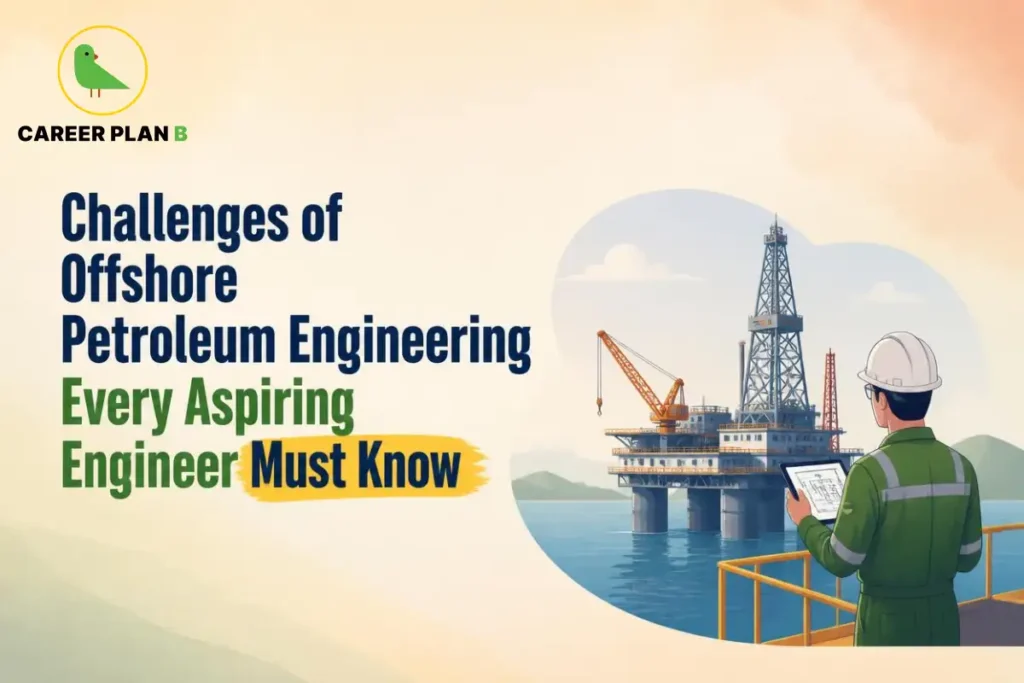
Introduction
There are very few engineering careers as demanding, complex, and consequential as offshore petroleum engineering. Working hundreds of kilometres from the coastline, on massive floating platforms above waters thousands of metres deep, these engineers keep the oil and gas flowing that powers entire economies. But the challenges of offshore petroleum engineering are unlike anything encountered in a typical engineering role and understanding them is essential for anyone seriously considering this career path.
India’s offshore oil and gas sector is significant and growing. From the prolific Mumbai High fields operated by ONGC to the deepwater Krishna-Godavari Basin blocks, offshore oil and gas engineering India represents a critical pillar of the country’s energy security. Yet these operations come with formidable technical, environmental, safety, and human challenges that every aspiring offshore engineer must be prepared to face.
This blog breaks down those challenges honestly and explains what it takes to not just survive but excel in this extraordinary field.
Why Offshore Petroleum Engineering Is Uniquely Challenging
Onshore petroleum engineering is already a technically demanding profession. Offshore takes every challenge and multiplies it by distance, depth, cost, and consequence.
A single deepwater drilling operation can cost upwards of one million US dollars per day. Equipment failures, weather disruptions, or engineering errors do not just affect productivity they can trigger environmental disasters, endanger lives, and result in losses running into billions. The Directorate General of Hydrocarbons oversees India’s offshore exploration and production activities and enforces stringent compliance standards precisely because the stakes are this high.
ONGC offshore operations, which account for a significant share of India’s domestic crude production, involve hundreds of engineers working across fixed platforms, floating production units, and drill ships under some of the most demanding conditions in the engineering world.
Technical Challenges in Offshore Petroleum Engineering
Deepwater Drilling Challenges
As easily accessible shallow-water reserves decline, the industry is pushing into deeper and more complex formations. Deepwater drilling challenges are substantial maintaining wellbore stability at extreme depths, managing riser systems that connect the seabed to the surface platform, and controlling mud weights to prevent blowouts all become exponentially harder as water depth increases. India’s KG-D6 block, for instance, involves operations in water depths exceeding 1,000 metres, where even small miscalculations carry enormous risk.
Subsea Engineering Problems
Subsea engineering problems represent one of the most technically advanced frontiers in petroleum engineering. Equipment installed on the ocean floor wellheads, manifolds, flowlines, control systems must function reliably for years or decades without the possibility of easy maintenance or replacement. Engineers must design for extreme pressure, near-zero temperatures, and complete inaccessibility, relying on remotely operated vehicles (ROVs) for any intervention work.
High-Pressure High-Temperature Reservoirs
Many offshore reservoirs, particularly in deepwater formations, are classified as High-Pressure High-Temperature (HPHT) environments. Drilling and completing wells in HPHT conditions demands specialised materials, equipment rated far beyond standard specifications, and extremely precise engineering judgement. Standard tools and techniques simply do not work at these extremes.
Corrosion and Material Degradation
Saltwater, hydrogen sulphide, and carbon dioxide in produced fluids create aggressive corrosion environments that relentlessly attack steel structures, pipelines, and equipment. Managing corrosion through material selection, protective coatings, cathodic protection, and chemical injection is a continuous and critical challenge in offshore oil and gas engineering India.
Environmental and Weather-Related Challenges
India’s offshore operations face significant environmental and meteorological pressures. The Arabian Sea and Bay of Bengal home to most of India’s offshore blocks are subject to cyclonic activity, particularly during the monsoon season. Operations must be suspended or severely curtailed during adverse weather, adding to project timelines and costs.
Beyond weather, environmental compliance is a growing challenge. Offshore operations carry the risk of oil spills, produced water discharge, and disturbance to marine ecosystems. The Ministry of Environment, Forest and Climate Change mandates strict environmental impact assessments and ongoing monitoring for all offshore projects. The Ministry of Earth Sciences also plays a regulatory role in monitoring India’s marine environment, further adding to the compliance framework offshore engineers must navigate.
Engineers are increasingly required to design operations that meet zero-discharge standards and minimise the ecological footprint of offshore activity a technical and regulatory challenge that continues to intensify.
Safety Challenges and Regulatory Standards
Oil platform safety standards in offshore petroleum engineering exist for good reason the consequences of failure are catastrophic. Blowouts, fires, structural collapses, and gas leaks on offshore platforms can result in mass casualties, environmental destruction, and the loss of billions of rupees in assets.
In India, the Oil Industry Safety Directorate under the Ministry of Petroleum and Natural Gas sets and enforces safety standards for all oil and gas operations, including offshore platforms. Compliance with OISD standards covering blowout prevention, fire and gas detection systems, emergency shutdown procedures, and evacuation protocols is mandatory and non-negotiable.
The Directorate General of Shipping also regulates the safety of floating offshore structures and the personnel working aboard them. Offshore petroleum engineers must be deeply familiar with these regulatory frameworks and maintain current safety certifications including Basic Offshore Safety Induction and Emergency Training (BOSIET) throughout their careers.
The Indian Coast Guard coordinates emergency response for offshore incidents, adding another layer of institutional oversight to offshore operations safety.
Have Any Doubts?
Human and Logistical Challenges
Beyond the technical and environmental dimensions, an offshore petroleum engineer career involves a set of human challenges that are often underestimated by students considering this path.
Offshore engineers typically work on rotational schedules commonly 28 days on the platform followed by 28 days onshore. Life on a platform means confined living quarters, limited personal freedom, separation from family, and exposure to high-stress emergency situations. The psychological demands of this lifestyle are real and should be considered seriously before committing to an offshore career.
Logistical challenges are equally significant. Supplying a remote offshore platform with equipment, consumables, food, and personnel requires meticulous planning. Any supply chain disruption can halt operations entirely.
The National Institute of Ocean Technology under the Ministry of Earth Sciences conducts research relevant to offshore operations and technology development, and offers insights into the evolving challenges of working in India’s marine environment.
Skills Required to Overcome These Challenges
The skills required for offshore engineering go beyond technical knowledge. Successful offshore engineers need strong expertise in drilling, reservoir management, and subsea systems. They also need crisis management and cross-disciplinary communication skills.
Offshore engineers must make quick decisions and lead teams during emergencies. They also need physical fitness and a strong understanding of safety regulations. Working in isolated conditions requires psychological resilience.
Engineers can build lasting offshore careers by developing technical expertise and personal resilience. Relevant certifications can also strengthen their skills and career prospects.
How Career Plan B Helps
An offshore petroleum engineer career is not for everyone and knowing whether it suits your personality, strengths, and life goals before committing is invaluable. Career Plan B offers PsycheIntel career assessments that help you understand your aptitude for high-pressure, technically demanding environments like offshore engineering.
Their personalised career counselling and roadmapping services help you build the right academic profile, target the right certifications, and approach offshore recruitment with a clear and confident strategy so you make this major career decision with full clarity.
Get In Touch With Us
Frequently Asked Questions
1. What are the biggest technical challenges of offshore petroleum engineering?
Deepwater drilling challenges, subsea engineering problems, HPHT reservoir management, and corrosion control are among the most significant technical challenges. Each requires specialised knowledge and equipment well beyond standard onshore engineering practice.
2. Is offshore petroleum engineering safe as a career?
With strict compliance to OISD regulations and international safety standards, offshore operations are heavily regulated. However, the inherent risks are real, and engineers must maintain current safety certifications and follow rigorous protocols at all times.
3. What certifications are required for offshore petroleum engineering in India?
BOSIET (Basic Offshore Safety Induction and Emergency Training) is a standard requirement. Engineers must also be familiar with OISD standards and, depending on the role, may need additional certifications in well control, firefighting, and offshore survival.
4. How does the monsoon season affect offshore oil and gas engineering India?
Monsoon conditions particularly in the Bay of Bengal can force temporary suspension of drilling and production operations. This adds complexity to project planning and requires engineers to build weather-related contingencies into operational schedules.
5. What is the salary range for an offshore petroleum engineer in India?
Offshore roles typically command a premium over onshore positions due to the demanding conditions. Entry-level offshore engineers at companies like ONGC can expect ₹8–12 LPA, while experienced professionals in private or international firms can earn significantly more, along with offshore allowances and rotation benefits.
Conclusion
Offshore petroleum engineering brings major challenges and rewarding career opportunities. Engineers face deepwater drilling and subsea engineering challenges. They must also follow strict safety and environmental standards.
Rotational offshore work can also create personal challenges. However, the field offers strong technical growth, global exposure, and career satisfaction.
If you are drawn to this path, go in with clear eyes and thorough preparation. And if you want help building a focused strategy to get there, Career Plan B is ready to guide you from where you are today to where you want to be.
Offshore engineering is not the easiest career but for the right engineer, it is one of the most extraordinary ones.