Team6 · November 3, 2026
Introduction
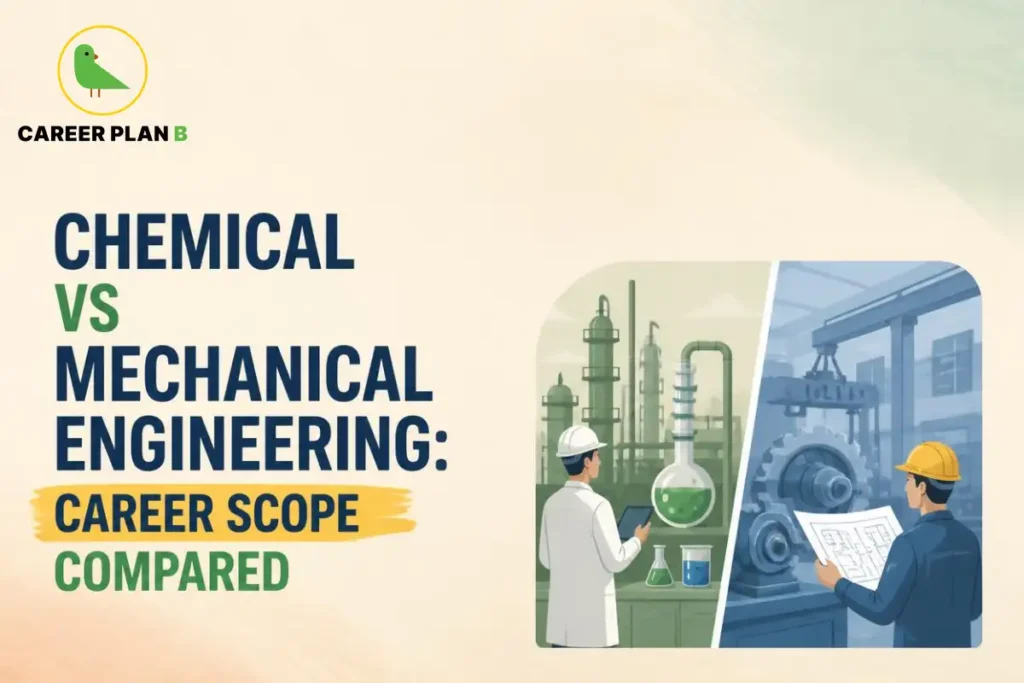
If there’s one debate that never seems to go away among engineering aspirants, it’s Chemical vs Mechanical Engineering: Career Scope. Both are “core” branches, both have been around for decades, and both promise solid job prospects, but they lead you into very different worlds.
According to the U.S. Bureau of Labour Statistics, employment of mechanical engineers is projected to grow 9 per cent from 2024 to 2034, much faster than the average for all occupations. Chemical engineering, meanwhile, continues to anchor industries like petrochemicals, pharmaceuticals, and energy.
So which one offers better career scope: chemical or mechanical engineering? In this blog, we’ll compare what each field involves, the industries they lead to, salary expectations, and how to figure out which one fits you best.
What Is Chemical Engineering?
Chemical engineering applies chemistry, physics, biology, and maths to design large-scale processes that transform raw materials into useful products, fuels, plastics, fertilizers, medicines, and more.
This field has a strong chemical engineering career scope in process-heavy industries, with sub-specializations in petrochemicals, polymers, and biochemical engineering. If you enjoy chemistry and large-scale systems thinking, this could be a great fit.
What Is Mechanical Engineering?
Mechanical engineering is one of the broadest and oldest engineering disciplines, focused on designing, building, and maintaining machines, engines, and mechanical systems. From automobiles to robotics to HVAC systems, mechanical engineers are everywhere.
The mechanical engineering job opportunities span almost every industry imaginable: automotive, aerospace, manufacturing, energy, and even emerging fields like robotics and electric vehicles.
Chemical vs Mechanical Engineering: Key Differences
While both fields share foundational engineering principles, their focus areas and work environments differ significantly.
Curriculum and Core Subjects
Chemical engineering students study thermodynamics, fluid mechanics, reaction engineering, and process design with a strong chemistry component. Mechanical engineering students focus on mechanics, materials science, thermodynamics, and machine design with less emphasis on chemistry.
Industries and Work Environment
| Aspect | Chemical Engineering | Mechanical Engineering | 2026–2027 Strategic Comparison & Alignment |
|---|---|---|---|
| Core Industries | Petrochemicals, pharmaceuticals, fertilizers, energy | Automotive, aerospace, manufacturing, robotics | Chemical engineering anchors heavily on process-driven chemical and energy sectors, whereas mechanical engineering drives discrete manufacturing, mobility, and automation. |
| Typical Roles | Process engineer, plant engineer, R&D scientist | Design engineer, production engineer, maintenance engineer | Daily responsibilities transition from thermodynamic mass balance and plant safety (chemical) to CAD modeling, mechanical stress analysis, and machinery lifecycle optimization (mechanical). |
| Work Setting | Process plants, refineries, labs | Factories, design studios, R&D centers | Chemical engineers operate frequently on-site in refineries and pilot plants, while mechanical engineers split time between digital design studios and manufacturing shop floors. |
| Breadth of Industry | Concentrated in process industries | Spread across nearly all manufacturing sectors | Mechanical engineering provides broader cross-sector mobility, whereas chemical engineering rewards deep specialization in process safety, green hydrogen, and petrochemical assets. |
This comparison highlights a key point: chemical engineering job opportunities are more concentrated but often highly specialized, while mechanical engineering offers broader, more diverse entry points across industries.
Have Any Doubts?
Career Scope and Salary Comparison
Let’s look at how the two compare in terms of pay and growth potential.
In the United States, the BLS Occupational Outlook Handbook reports that the median annual wage for chemical engineers was $121,860 in May 2024, while the mechanical engineering outlook shows a median annual wage of $102,320 for mechanical engineers in May 2024, with employment projected to grow 9 per cent through 2034.
In India, both branches offer strong starting packages, with chemical engineering often leading in process-heavy sectors like pharma and petrochemicals, while mechanical engineering tends to offer wider access to jobs across automotive, manufacturing, and infrastructure projects.
| Factor | Chemical Engineering | Mechanical Engineering | 2026–2027 Strategic Comparison |
|---|---|---|---|
| Entry-Level Salary (India) | ₹3.5 – ₹6 LPA | ₹3 – ₹5.5 LPA | Both core branches offer comparable starting brackets, with chemical engineering slightly ahead due to high-margin process and energy sector recruitment. |
| Mid-Career Growth | Strong in process industries | Strong across diverse sectors | Mechanical engineering offers broader lateral mobility across automotive, manufacturing, and robotics, whereas chemical engineering scales steeply within specialized refineries and process plants. |
| Global Demand | Steady, concentrated | Broad and consistently high | Mechanical engineering provides highly versatile international mobility, while chemical engineering demand is tied directly to global energy transitions, petrochemical hubs, and green hydrogen initiatives. |
| Government Job Avenues | PSUs, chemical departments | PSUs, railways, defence, manufacturing | Mechanical engineering opens doors to extensive public sector enterprises including railways, defence production, and public utilities, whereas chemical engineering anchors primarily on energy and chemical PSUs (e.g., IOCL, ONGC). |
Which Branch Offers More Job Security?
Both branches offer solid job security, but for different reasons. Chemical engineering benefits from steady demand in essential industries like pharma and energy, while mechanical engineering’s broad applicability means opportunities exist across almost every sector of the economy, making it easier to pivot between industries.
Which One Should You Choose?
Here’s where it gets personal. Ask yourself:
- Do I enjoy chemistry and working with processes on a large scale? → Chemical engineering may suit you
- Am I drawn to machines, mechanisms, and how things are built or move? → Mechanical engineering could be your path
- Do I want to work in a specific process industry like pharma or petrochemicals? → Chemical engineering offers focused opportunities
- Do I want flexibility to work across automotive, manufacturing, robotics, or energy? → Mechanical engineering offers broader options
This decision plays a big role in your overall engineering branch selection after 12th, so take time to reflect rather than choosing based on trends alone.
How Career Plan B Helps
Deciding between Chemical vs Mechanical Engineering doesn’t have to be a guessing game. Career Plan B offers personalised career counselling to help you understand which branch aligns with your interests and strengths. Their Psycheintel and Career Assessment Tests reveal your natural aptitudes, while Admission and Academic Profile Guidance and Career Roadmapping help you choose the right colleges and plan your career path with clarity.
For Latest Information
Frequently Asked Questions (FAQs)
1. Which is easier, chemical or mechanical engineering?
Both have challenging coursework, but mechanical engineering tends to be more broadly applicable, while chemical engineering involves more chemistry-heavy concepts.
2. Which branch offers more job opportunities right after graduation?
Mechanical engineering generally offers more diverse entry points due to its presence across many industries, while chemical engineering opportunities are concentrated in process industries.
3. Is chemical engineering only for pharma and petrochemicals?
No, chemical engineers also work in food processing, materials, environmental engineering, and energy sectors.
4. Can mechanical engineers work in the chemical industry?
Yes, mechanical engineers often work in chemical plants in roles related to equipment design, maintenance, and machinery.
5. Which branch has better salary growth in the long term?
Both offer strong growth potential; chemical engineering often sees higher pay in specialized process roles, while mechanical engineering offers steady growth across diverse industries.
Conclusion
When comparing chemical vs mechanical engineering career scope, there’s no clear winner, only what aligns best with your interests and goals. Chemical engineering offers deep expertise in essential process industries, while mechanical engineering provides broad flexibility across countless sectors.
Take time to explore both fields, reflect on what excites you, and don’t hesitate to seek guidance if you’re unsure. The right choice isn’t about which branch is “better”; it’s about which one keeps you engaged and motivated for the long run. So, which direction feels right for you?