Team Career Plan B · November 2, 2026
Introduction
One undetected gas leak. One mislabelled chemical drum. One skipped safety drill. In the chemical industry, small oversights can turn into large-scale disasters within minutes. This is precisely why the role of a chemical safety engineer is not just important; it is indispensable. India’s chemical industry is one of the largest in Asia, contributing over 7% to the country’s GDP, and it operates across thousands of facilities handling hazardous substances every single day. A chemical safety engineer is the professional standing between normal operations and catastrophe. If you are building a career in this field or are already in it, there are certain things you simply must know about the science, the law, the skills, and the mindset. This blog covers all of it.
Who Is a Chemical Safety Engineer and What Do They Do?
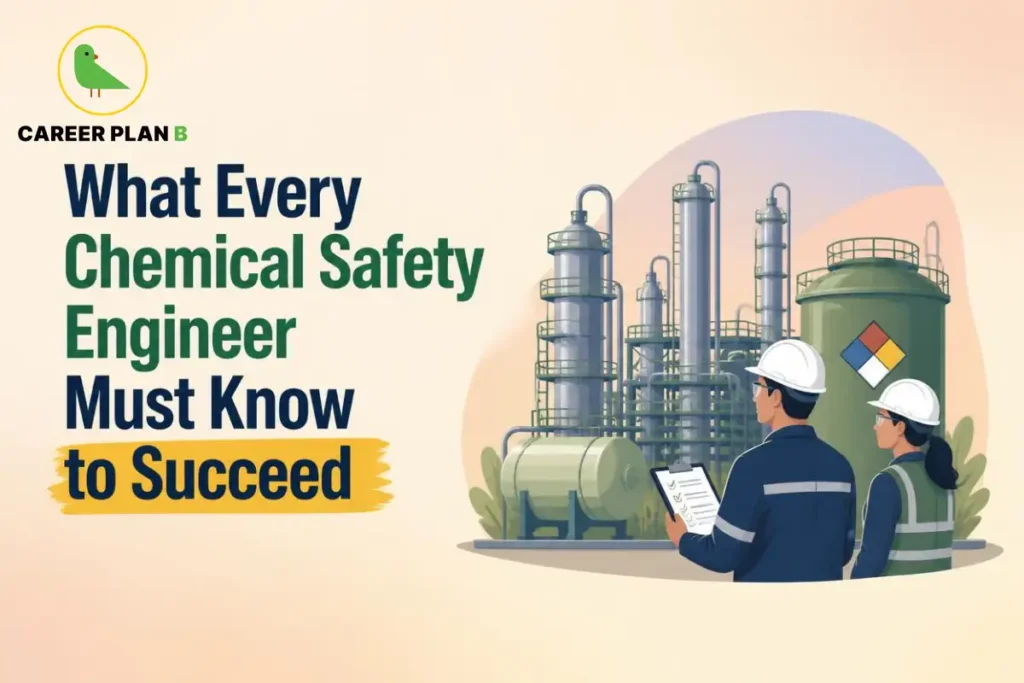
A chemical safety engineer is a trained professional responsible for identifying, evaluating, and controlling chemical hazards in industrial environments. They design safety systems, ensure regulatory compliance, conduct risk assessments, and prepare emergency response plans.
More Than Just Following Rules
Many people confuse a safety officer with a chemical safety engineer. A safety officer typically oversees general workplace safety signage, PPE compliance, and fire exits. A chemical safety engineer goes much deeper. They analyse chemical reactions, assess toxic exposure limits, evaluate process design for failure points, and work with plant engineers to eliminate hazards at the source. The role demands both engineering knowledge and regulatory awareness, which makes it one of the most technically demanding positions in the chemical industry.
Core Technical Knowledge Every Chemical Safety Engineer Must Have
Understanding Chemical Hazards and Classifications
The first thing a chemical safety engineer must master is how chemicals behave when things go wrong. Every chemical in an industrial setting carries at least one of these hazard profiles: flammability, toxicity, reactivity, corrosivity, or environmental hazard. Understanding these profiles is not optional; it is the foundation of everything else.
India follows the Globally Harmonised System (GHS) of classification and labelling of chemicals, which standardises how hazardous chemicals are identified, communicated, and handled across facilities. Every safety engineer must be fluent in reading and interpreting Safety Data Sheets (SDS), formerly called MSDS, which contain critical information about chemical properties, exposure limits, storage requirements, and emergency response procedures.
Hazardous chemical handling guidelines are not bureaucratic formalities. They are the result of decades of industrial accidents and hard-won learning. Knowing them thoroughly is the baseline for this career.
Process Safety Management The Non-Negotiable Foundation
Process safety management (PSM) is the structured discipline of preventing catastrophic releases of toxic, reactive, or flammable chemicals. As a process safety management engineer, you will work with tools and methodologies including:
- HAZOP (Hazard and Operability Study): A systematic technique for identifying potential hazards in process design by examining deviations from normal operating conditions.
- FMEA (Failure Mode and Effects Analysis): A method for identifying how equipment or systems might fail and what the consequences would be.
- What-If Analysis: A brainstorming approach that examines potential scenarios of process failure.
- LOPA (Layer of Protection Analysis): A semi-quantitative method for assessing whether existing safeguards are sufficient to reduce risk to acceptable levels.
These are not tools you read about once. They are skills you practise regularly on actual plant data and design documents. Mastery of chemical hazard risk assessment through these methods separates a competent safety engineer from an exceptional one.
Key Indian Laws and Regulations You Cannot Afford to Ignore
Chemical plant safety regulations in India are governed by a combination of central laws, rules, and regulatory bodies. Every chemical safety engineer must know these inside out.
Factories Act, 1948 This is the primary legislation governing occupational health and safety in manufacturing facilities across India. It lays down provisions for working conditions, hazardous processes, inspections, and worker welfare. Chemical plants fall under Schedule 1 of the Act as hazardous industries.
Manufacture, Storage and Import of Hazardous Chemicals (MSIHC) Rules, 1989 These rules, under the Environment Protection Act 1986, govern how hazardous chemicals are manufactured, stored, and imported in India. They define threshold quantities for notifiable chemicals and mandate on-site and off-site emergency plans.
Environment Protection Act, 1986 This overarching legislation empowers the central government to take measures for environmental protection, including regulation of hazardous substances. Safety engineers working near chemical discharge or emission points must be thoroughly familiar with this Act.
DGFASLI (Directorate General Factory Advice Service and Labour Institutes) functions under the Ministry of Labour and Employment and is responsible for advising the central and state governments on the administration of the Factories Act. It also conducts research and training on industrial safety and occupational health.
PESO Petroleum and Explosives Safety Organisation PESO regulates the safe manufacture, storage, transport, and use of petroleum, explosives, and compressed gases. For chemical safety engineers working in facilities involving flammable liquids or pressurised systems, PESO regulations are directly applicable.
Understanding occupational health and safety in chemical engineering requires active knowledge of all these frameworks, not just a passing familiarity with their names.
Essential Skills Beyond the Classroom
Risk Assessment and Emergency Response Planning
Industrial chemical safety in India demands engineers who can act under pressure, not just analyse in comfort. A chemical safety engineer must be capable of developing and executing emergency response plans, including mock drills, evacuation procedures, fire suppression system checks, and coordination with local emergency services.
Reading and interpreting SDS documents quickly and accurately during an emergency is a practical skill that comes with regular practice. So is coordinating with plant operators to implement corrective actions following a near-miss incident.
Communication and Cross-Team Coordination
This is a skill that is rarely taught in engineering colleges but is absolutely critical in the field. A chemical safety engineer interacts with plant workers on the shop floor, production managers in the boardroom, government inspectors during audits, and environmental consultants during assessments. You need to communicate hazard information clearly to all of them using different language, different levels of technical detail, and different approaches depending on the audience.
The best safety engineer is not just the most technically knowledgeable person in the room; they are the most effectively heard.
Top Industries and Employers Hiring Chemical Safety Engineers in India
| Industry | Key Roles | Major Employers |
|---|---|---|
| Petrochemicals & Refining | Process Safety Engineer, HSE Officer | ONGC, BPCL, HPCL, IOCL, GAIL |
| Pharmaceuticals | EHS Compliance Engineer, Safety Auditor | Sun Pharma, Dr. Reddy’s, Cipla |
| Fertilisers & Agrochemicals | Safety Systems Engineer, Hazard Analyst | NFL, RCF, Coromandel International |
| Paints & Specialty Chemicals | Chemical Risk Engineer, Safety Coordinator | Asian Paints, Pidilite, Atul Ltd |
| Nuclear & Defence | Radiation Safety Engineer, BARC | BARC, DRDO, DAE Facilities |
| Explosives & Mining | PESO Compliance Engineer | Solar Industries, Hindustan Zinc |
The safety engineer career in the chemical industry spans both public sector units and large private manufacturers. PSUs like ONGC, IOCL, BPCL, HPCL, and GAIL regularly recruit safety engineers, and many private chemical companies are now building dedicated EHS (Environment, Health, and Safety) departments as regulatory compliance becomes stricter.
Career Growth and Salary Outlook
| Experience Level | Approximate Annual Salary (INR) |
|---|---|
| Entry Level (0–2 Years) | ₹3.5–6 LPA |
| Mid Level (3–6 Years) | ₹7–13 LPA |
| Senior Level (7–12 Years) | ₹14–25 LPA |
| EHS Manager / Head of Safety | ₹26 LPA and Above |
Certifications that meaningfully improve career growth and earning potential in this field include:
- NEBOSH IGC (National Examination Board in Occupational Safety and Health)
- IOSH Managing Safely
- GATE (Chemical Engineering paper for PSU recruitment)
- Diploma in Industrial Safety (approved by state governments under the Factories Act)
How Career Plan B Helps
Choosing the right path within the chemical safety field, whether it is process safety, EHS compliance, or industrial risk management, can be confusing without the right guidance. Career Plan B offers personalised career counselling, psychometric assessments, and career roadmapping to help chemical engineering students and graduates identify where their strengths fit best.
For Latest Information
Frequently Asked Questions (FAQs)
- What qualifications are needed to become a chemical safety engineer in India?
A B.Tech or B.E. in chemical engineering is the standard starting point. Many employers also look for a diploma in industrial safety (recognised under the Factories Act) or certifications like NEBOSH. A GATE score helps for PSU roles.
- Is chemical safety engineering a good long-term career in India?
Yes. With India’s chemical industry expanding and regulatory enforcement tightening, the demand for trained chemical safety engineers is growing steadily. The role also offers strong job security since safety compliance is legally mandated across all chemical facilities.
- What is the difference between a safety officer and a chemical safety engineer?
A safety officer handles general workplace safety and compliance. A chemical safety engineer has deeper technical expertise in chemical hazards, process safety methodologies like HAZOP and LOPA, and regulatory frameworks like the MSIHC Rules and Factories Act.
- Which government body oversees chemical plant safety in India?
Multiple bodies are involved: DGFASLI oversees factory safety under the Ministry of Labour, PESO regulates petroleum and explosives, and the Ministry of Environment handles hazardous chemical rules under the Environment Protection Act.
- Can a fresher get a job as a chemical safety engineer directly after graduation?
Yes, though most entry-level roles are titled ‘EHS Trainee’, ‘Safety Coordinator’, or ‘Graduate Engineer Trainee’ with a safety focus. Additional certifications and internships at chemical plants significantly improve placement prospects for freshers.
Conclusion
The role of a chemical safety engineer is one of the most technically demanding and socially responsible careers in engineering. You are not just protecting equipment or meeting audit checklists; you are protecting people, communities, and environments from the consequences of chemical hazards. From mastering hazard classifications and process safety tools to staying current with Indian regulations under DGFASLI and PESO, the knowledge base for this career is wide and deep.
But it is also a career with growing demand, strong salaries, and the kind of work that genuinely matters. If you are a chemical engineering graduate looking to make an impact while building a stable and respected career, chemical safety engineering deserves serious consideration. Start building the right skills and certifications today because in this field, being prepared is not just a professional requirement; it is the entire point.