Team5 · July 31, 2026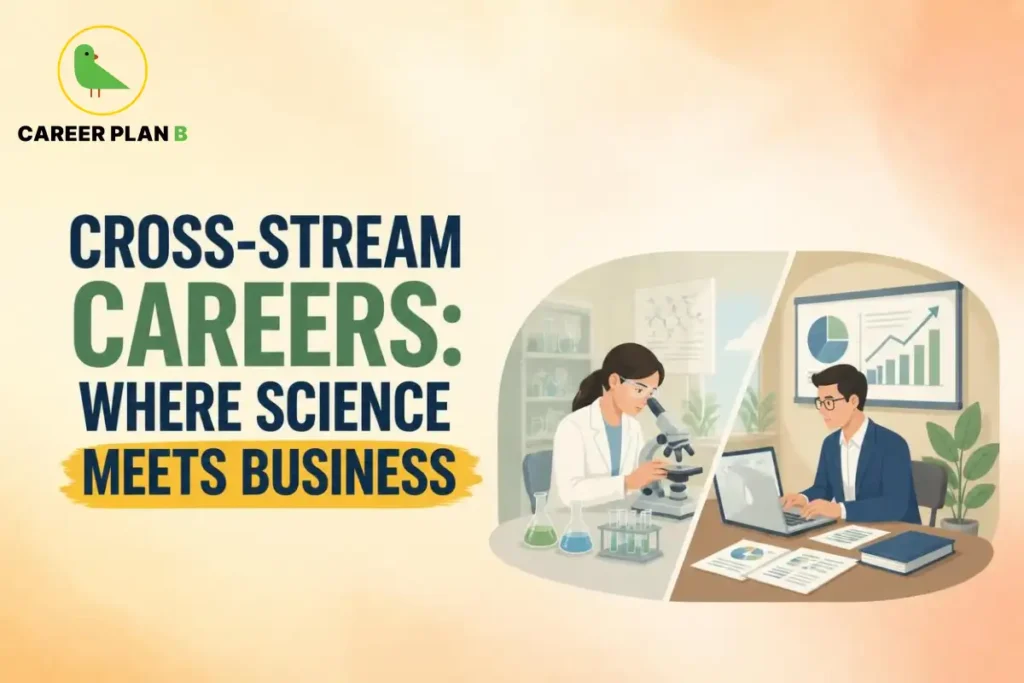
Introduction
What happens when a science background meets a business mindset?
Some of the most interesting career paths today do not fit neatly into one traditional stream. This guide covers cross-stream careers where science meets business in India. You will learn why this combination works, and how official education reforms now support it directly.
Why Are Cross-Stream Careers Becoming More Viable?
For years, Indian education treated science and commerce as separate, largely non-overlapping tracks. Choosing one often meant closing the door on the other entirely.
This rigid separation is now actively being dismantled through policy. The National Education Policy (NEP) 2020 explicitly promotes multidisciplinary education across science, commerce, and humanities together.
This creates genuine institutional support for careers that blend both worlds.
How NEP 2020 Makes Cross-Stream Study Possible?
NEP 2020 introduced flexible undergraduate structures that allow subject combinations once considered unusual. Students can now formally pursue a science major alongside a business or commerce minor.
This is supported through multidisciplinary institutions and a credit-based system that recognises varied combinations. The University Grants Commission (UGC) has further enabled this. It now permits students to pursue two academic programmes simultaneously under specific conditions.
A science student can study business fundamentals without switching streams entirely.
This structural flexibility is what makes cross-stream careers realistically achievable, not just theoretically interesting.
Field 1: Health-Tech and Digital Health Management
Health-tech combines clinical or scientific understanding with business and technology skills. This field manages digital health records, health-tech products, or healthcare operations.
Professionals here often need enough scientific literacy to understand healthcare contexts, alongside business skills to manage systems and stakeholders. This is a clear example of science and business genuinely working together.
Structured pathways into this field are also supported through the National Skills Qualifications Framework (NSQF). It recognises hybrid, competency-based qualifications across sectors.
Field 2: Biotech and Pharmaceutical Business Roles
The biotech and pharmaceutical sector needs people who understand both science and commercial strategy. Roles here include regulatory affairs, product management, and business development within scientific companies.
A strong science foundation helps professionals understand products deeply, while business skills support decision-making, strategy, and growth. Neither skill set alone covers this role completely.
Field 3: Environmental and Sustainability Consulting
Environmental consulting increasingly requires both scientific understanding and business-oriented problem solving. Companies need guidance that is scientifically accurate and commercially practical at the same time.
This field suits students who understand environmental science but also want to work directly with business strategy and client needs.
Field 4: Fintech and Quantitative Finance
Fintech roles often combine strong analytical or mathematical thinking with financial and business knowledge. This includes roles in financial modelling, risk analysis, and financial technology product development.
Students with a strong science or mathematics background, paired with financial literacy, are well suited to this space. This overlap is becoming increasingly common as financial products grow more technically complex.
How to Build a Cross-Stream Careers Path
Pursuing a cross-stream career works best with a deliberate, structured approach.
- Identify your primary strength. Decide whether science or business feels like your stronger foundation.
- Explore multidisciplinary programmes. Look for NEP-aligned courses that allow your chosen minor or elective combination.
- Build practical bridge skills. Add courses or certifications specifically connecting your two areas of interest.
- Target roles that value both skill sets. Look specifically for roles describing hybrid science-business requirements.
- Build a portfolio reflecting both sides. Include projects or experience showing scientific understanding and business thinking together.
This turns a broad interest into a concrete, buildable career direction.
Benefits, Challenges, and What the Data Says
NEP 2020’s structural reforms genuinely open up cross-stream study in ways that were not formally possible before. This benefits students who do not want to choose exclusively between science and business.
However, no single official dataset tracks outcomes specifically for cross-stream career paths. Instead of estimating this impact, this guide focuses on the structural flexibility NEP 2020 is explicitly designed to enable.
Challenges include limited institutional awareness of these combinations, and the need for students to actively seek out multidisciplinary options themselves.
Have Any Doubts?
The Outlook for Cross-Stream Careers Beyond 2026
As more institutions adopt NEP 2020’s multidisciplinary framework, cross-stream combinations are expected to become easier to access. Fields like health-tech, biotech business, and fintech are likely to keep growing in parallel.
This suggests students who build genuine cross-stream skills now will benefit from these expanding structural changes over time.
How Career Plan B Helps
Understanding whether a cross-stream careers genuinely fits you can feel overwhelming without guidance. Career Plan B simplifies this through:
- Personalised Career Counselling: evaluating whether a cross-stream path suits your specific strengths and interests
- Psycheintel Career Assessment Tests: confirming whether your aptitude leans toward science, business, or a genuine blend
- Admission and Academic Profile Guidance: identifying NEP-aligned multidisciplinary programmes suited to your goals
- Structured Career Roadmapping: a clear plan for building a deliberate, cross-stream career path
For Latest Information
Frequently Asked Questions
Q1.Is it realistic to combine science and business in one career?
Yes. NEP 2020’s multidisciplinary framework now formally supports this kind of subject combination.
Q2.Do I need to choose science or commerce permanently after Class 12?
No. NEP 2020’s flexible structure allows broader subject combinations at the undergraduate level.
Q3.Which fields commonly combine science and business?
Health-tech, biotech business roles, environmental consulting, and fintech are common examples of this blend.
Q4.Do employers value cross-stream skill sets?
Increasingly, yes, particularly in sectors where technical understanding and business strategy both matter.
Q5.How do I start building a cross-stream career?
Identify your stronger foundation first, then deliberately add bridge skills connecting it to the other stream.
Q6.Is this approach harder than choosing one stream only?
It requires more deliberate planning, but NEP 2020’s structural flexibility makes it genuinely achievable today.
Conclusion
Cross-stream careers where science meets business are no longer an unusual exception.
NEP 2020’s multidisciplinary reforms have made combining these streams a genuinely structured, achievable path. Fields like health-tech, biotech business, and fintech all reflect this blend in practice.
Start by identifying your stronger foundation, then deliberately build bridge skills toward the other stream.
Ready to explore whether a cross-stream career fits your goals? Talk to a Career Plan B counsellor and get a personalised roadmap today.