Team Career Plan B · October 13, 2026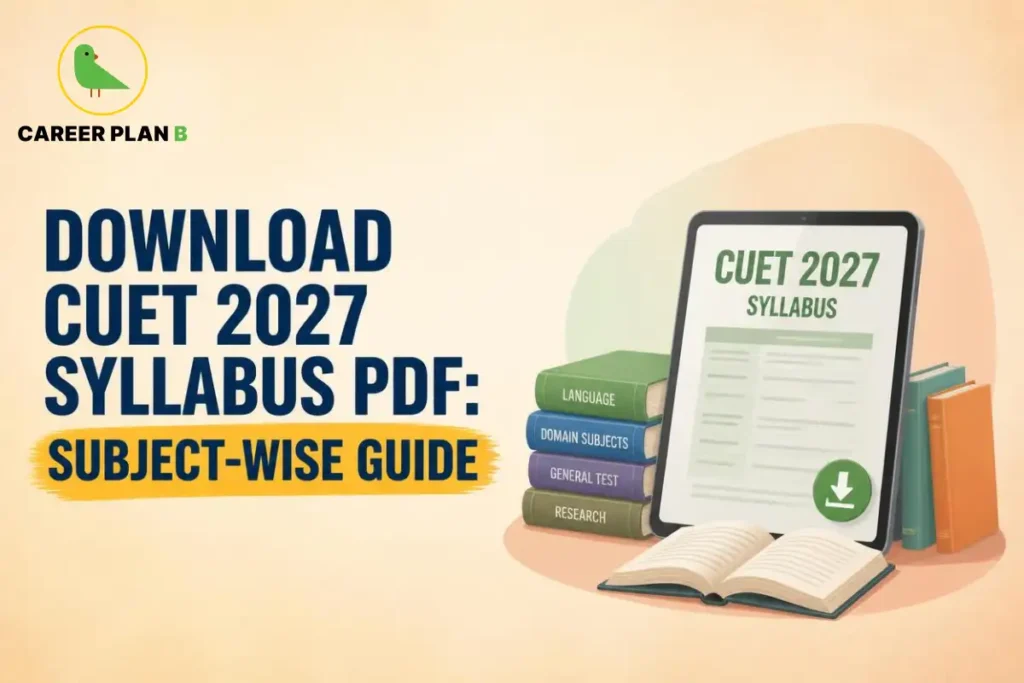
Introduction
It was a regular Tuesday evening when Sneha, a Class 11 student from Lucknow, typed “how to prepare for CUET 2027” into her phone. She had just seen her cousin miss a Delhi University seat by a few marks, not because he studied less, but because he studied the wrong things. He had not looked at the official CUET 2027 Syllabus PDF once. He relied on a random YouTube video, assumed it covered everything, and walked into the exam hall with gaps he did not know existed. Sneha did not want to repeat that story.
If you are a student in Class 11 or 12 right now, reading this blog means you are already ahead. The CUET 2027 Syllabus PDF is not just a document. It is the difference between preparing smart and preparing blind. In this guide, we will walk you through everything — what the syllabus covers, how to download it, and how to turn it into a real study plan that actually works.
What Is CUET and Why Does the Syllabus Matter More Than You Think?
Let us start with the basics, because a lot of students skip this part and pay for it later.
CUET, or the Common University Entrance Test, is a national-level entrance exam conducted by the National Testing Agency (NTA) for admission to undergraduate programmes across central, state, deemed, and private universities in India. Think of it as one exam that unlocks the doors to hundreds of universities across the country, all in one shot.
CUET UG is accepted by all 47 central universities and around 300 institutions in total. That includes big names like the University of Delhi, Jawaharlal Nehru University, Banaras Hindu University, Aligarh Muslim University, and Jamia Millia Islamia.
Now, here is the thing. When so many universities are watching the same scoreboard, and lakhs of students are competing, you cannot afford to be casual about what you study. The official syllabus is your map. Without it, you are basically driving at night without headlights.
A common mistake students make is downloading a third-party “summary” of the CUET UG syllabus instead of referring to the NTA official document. Such summaries often omit specific units or include outdated topics, leading to gaps in preparation. Always go to the source.
What Does the CUET 2027 Exam Look Like? Know the Pattern First
Before you open the syllabus, you need to understand the structure of the exam. Think of it like knowing the rules of a game before you start playing.
CUET UG 2027 is conducted in Computer-Based Test (CBT) mode and follows a three-section structure: Language Test, Domain Subjects, and General Aptitude Test (GAT). Candidates can choose up to 5 test papers based on their target university and course requirements.
Here is a quick overview:
| Section | What It Tests | No. of Papers Available |
|---|---|---|
| Section 1 — Language | Reading, vocabulary, grammar | 13 languages |
| Section 2 — Domain Subjects | Subject knowledge (Class 12 level) | 23 subjects |
| Section 3 — General Test | GK, reasoning, current affairs, quantitative aptitude | 1 paper |
The marking scheme follows MCQ format — 5 marks for a correct answer and minus 1 for a wrong one. So accuracy matters as much as speed.
The CUET subjects will have a uniform duration of 60 minutes for all exam papers. One important thing: the subjects you choose should match the requirements of the university and course you are applying to. Different universities have different combinations. Do not assume. Always check.
How to Download the CUET 2027 Syllabus PDF — Step by Step
This is the part most students get lazy about. They either Google it and land on some random coaching website, or they download an outdated PDF from the previous year. Please do not do that.
The official and most updated syllabus lives on the NTA CUET website at cuet.nta.nic.in. Here is exactly how to get it:
- Open your browser and go to cuet.nta.nic.in
- Look for the “Syllabus” tab or section on the homepage
- You will see a list of subjects — click on the ones you plan to appear for
- Each subject has its own PDF — download only what is relevant to you
- Save them in a folder and label them clearly by subject name
That is it. No sign-up required. No payment. Completely free. A small but important tip: NTA periodically updates the CUET syllabus to align with revised NCERT textbooks. Students who prepared using previous cycles must re-verify their subject syllabi against the latest NTA notification, as unit titles and chapter sequences may have shifted in newly revised NCERT editions. So even if you downloaded the 2026 PDF last year, check again before you begin your 2027 preparation.
CUET 2027 Syllabus Breakdown — Section by Section
Now let us get into the actual content. Think of this as your first real look inside the exam.
Section 1 — Language Test
The key areas evaluated in the Language section include Reading Comprehension, where you will face three types of passages of up to 300 to 350 words — Factual, Narrative, and Literary. You are evaluated on your ability to understand the central theme and the meanings of words used.
Other areas covered include:
- Verbal Ability and Vocabulary
- Grammar and sentence correction
- Rearrangement of sentences
- Books and authors
In the 2025 exam, difficulty in grammar and vocabulary questions increased, and there were more questions from the vocabulary section than from reading comprehension passages. The paper was mostly easy to moderate, but sentence rearrangement had 6 to 7 questions in most shifts.
If English is one of your chosen languages, do not leave reading comprehension and vocabulary for the last week. These need consistent practice.
Section 2 — Domain-Specific Subjects
This is the heart of the CUET exam. The CUET 2027 syllabus for all domain subjects will be the complete NCERT Class 12 syllabus for respective subjects. Several topics from NCERT Class 12 are covered in Class 11 in some boards, so students must note this carefully.
There are a total of 37 subjects in CUET UG, among which 23 are domain-specific subjects and 13 are languages.
Here is a quick look at what key domain subjects cover:
| Domain Subject | Key Topics |
|---|---|
| Physics | Electrostatics, Current Electricity, Optics, Dual Nature of Radiation, Semiconductors |
| Chemistry | Solid State, Electrochemistry, Chemical Kinetics, Coordination Compounds, Biomolecules |
| Mathematics | Relations & Functions, Matrices, Calculus, Vectors, Probability |
| Biology | Reproduction, Genetics & Evolution, Biology in Human Welfare, Biotechnology, Ecology |
| Accountancy | Partnership Accounts, Company Accounts, Cash Flow Statements, Financial Analysis |
| Economics | National Income, Money & Banking, Government Budget, Balance of Payments |
| Business Studies | Nature of Business, Organising, Staffing, Directing, Financial Management |
| History | Bricks, Beads & Bones; Kings, Farmers & Towns; Kinship, Caste & Class; Colonial Cities |
| Political Science | Nation-Building, Democracy, Contemporary World Politics |
| Geography | Human Geography, People & Economy, Geographical Perspectives |
Section 3 — General Test (GAT)
The General Aptitude Test (GAT) covers important topics like General Knowledge, Current Affairs, Logical Reasoning, and Quantitative Aptitude.
In the 2025 exam, Quantitative Aptitude questions were tricky and time-consuming, with topics including mensuration, Simple and Compound Interest, Time and Work, Speed and Distance, Profit and Loss, Percentages, Ratios, Trigonometry, and Height and Distance. The Logical Reasoning section had questions on circular seating arrangement, calendar, blood relations, and coding-decoding.
The GAT is often underestimated. Students from Science or Commerce streams sometimes skip it thinking it is irrelevant. But many universities — especially BHU for Arts and Social Sciences — heavily rely on GAT scores for shortlisting. Do not ignore it.
Subject-Wise Syllabus: Are You Covering Class 11 Too?
Here is something most students miss, and it is a big deal.
Several students skip NCERT Class 11 chapters for subjects like Economics and Political Science, assuming only Class 12 content is tested. In reality, the NTA CUET UG syllabus for some subjects explicitly lists Class 11 units as well.
This is not a rumor. It is right there in the official syllabus PDF. So when you download your subject-wise PDFs from cuet.nta.nic.in, read them carefully. Check every unit. If you see a chapter listed that belongs to your Class 11 textbook, do not skip it just because it feels old.
This is one of the most common reasons students lose marks not because the topic was hard, but because they assumed it would not be asked.
For Personalized Guidance
How to Use the CUET 2027 Syllabus PDF to Build Your Study Plan
Downloading the PDF is only step one. The real work begins when you actually use it. Here is a practical way to approach your CUET 2027 preparation using the syllabus as your backbone:
Step 1 — Map your subjects first: Decide which subjects you need for your target university and course. For example, if you are aiming for a BCom (Hons) seat at Delhi University (du.ac.in), you will likely need English + Accountancy + Business Studies + Economics or Mathematics.
Step 2 — Print or save the PDF for each subject: Go to cuet.nta.nic.in, download the subject-wise PDFs, and keep them open during study sessions. Do not study from memory. Study from the syllabus.
Step 3 — Divide each syllabus into units and mark priority: Some units carry more questions. Some are conceptually heavier. Mark them by difficulty and weight, then plan your months accordingly.
Step 4 — Align with NCERT chapters: Download the official subject-wise syllabus PDF from the NTA website, map each unit to its corresponding NCERT chapter, and complete chapter-wise reading before attempting topic-specific practice questions.
Step 5 — Set monthly revision targets: A good CUET 2027 study plan would break the syllabus into monthly goals, with one full revision round by February and mock tests starting from March onwards.
Common Mistakes Students Make With the CUET Syllabus
Let us be honest for a moment. Most students know they should follow the syllabus. But many do not. Here is why that happens and what to do instead.
“I’ll check the syllabus later”: This is the most dangerous phrase in a student’s vocabulary. By the time “later” arrives, you have already spent weeks studying topics that may not even be tested, while skipping entire units that definitely will be.
Relying on coaching notes alone: Coaching notes are helpful, but they are designed for speed, not completeness. They sometimes skip “minor” topics that NTA then decides to ask about. Always have the official PDF as your final reference.
Not cross-checking subject requirements university-wise: The CUET subject combinations vary significantly by university. For Delhi University, students must pick subjects they studied in Class 12. BHU primarily requires one language paper plus the General Test for Arts and Social Sciences. JNU mandates English plus the General Test for its prestigious language programs. Choose your subjects based on your target university, not just your comfort zone.
Ignoring updates: NTA has added and deleted several topics for subjects including History, Economics, Computer Science, Business Studies, and Physical Education. What was in the 2025 or 2026 syllabus may not be the same in 2027. Always download the latest version.
How Career Plan B Helps
Career Plan B helps students approach CUET 2027 preparation with clarity, strategy, and personalized guidance, ensuring that their efforts are aligned with both academic goals and long-term aspirations:
- Personalized Career Counselling: Helps students identify suitable subject combinations, academic pathways, and preparation strategies based on their target courses, universities, and future goals.
- Psycheintel & Career Assessment Tests: Provides data-backed insights into aptitude, personality traits, interests, and learning styles, helping students recognize their academic strengths and focus their preparation more effectively.
- Admission & Academic Profile Guidance: Supports students in strengthening their academic profile, understanding admission requirements, and making decisions that support future opportunities.
- Subject & University Alignment: Helps students connect subject choices with university eligibility criteria, course requirements, and long-term career aspirations, ensuring every decision serves a purpose.
- Career Roadmapping: Creates a structured, step-by-step plan that links CUET preparation with future academic and professional goals, giving students a clear direction throughout the journey.
- End-to-End Guidance: Assists students throughout the preparation process so they have consistent support, informed decision-making, and a roadmap they can follow with confidence.
For Latest Information
Frequently Asked Questions
Q1. Is the CUET 2027 syllabus based on NCERT textbooks?
Yes, primarily. The CUET 2027 syllabus is based on Class 12 NCERT concepts, making it crucial for students to align their board preparation with CUET strategy from day one. However, for some subjects, Class 11 chapters are also included. Always verify from the official PDF.
Q2. How many subjects can I choose for CUET 2027?
Candidates can choose up to 5 test papers based on their target university and course requirements. This includes a combination of language, domain, and general test papers.
Q3. Will the CUET 2027 syllabus change from the 2026 version?
The NTA typically releases the updated syllabus along with the official notification, usually by December or January before the exam year. It is important to download and check the latest version from cuet.nta.nic.in rather than assuming the previous year’s syllabus applies.
Q4. Does the General Test (GAT) matter for all universities?
Not all universities require it, but many do. BHU primarily requires one language paper plus the General Test for most Arts and Social Sciences programmes. Always check your target university’s CUET subject requirements before finalising your papers.
Q5. Can I appear for a domain subject I did not study in Class 12?
This depends on the university. For Delhi University, students must pick subjects they studied in Class 12. If you choose a subject not in your marksheet, DU will not consider that subject in your merit calculation. Other universities may have different rules, so always check their official admission portals.
Conclusion
Sneha, the student from Lucknow we met at the beginning of this blog, eventually printed out her subject-wise syllabi, stuck them on her wall, and built her schedule around them. She did not just study harder than her cousin — she studied smarter. That is what the CUET 2027 Syllabus PDF gives you: direction, clarity, and confidence.
The best time to start was yesterday. The second-best time is right now. Go to the official portal, download your subject PDFs, and take that first real step toward the university seat you are aiming for. One click today can change the entire story of your preparation tomorrow.