Team Career Plan B · October 13, 2026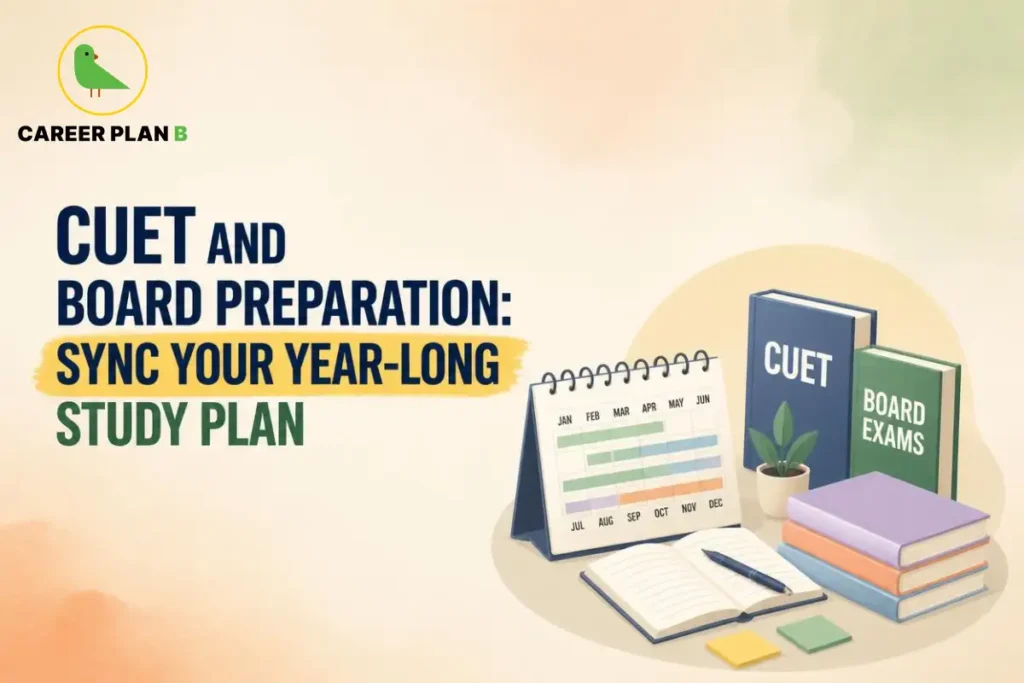
Introduction
Picture this. It’s a Sunday evening in June, and you’ve just finished Class 11. Your phone is full of notifications of seniors posting their CUET scores, relatives asking about “your plan,” and somewhere in that noise, a tiny voice in your head whispering: How do I even begin? You have boards on one side and CUET 2027 on the other, and it feels like you’re being asked to run two races at the same time on two different tracks.
Here’s the truth no one tells you early enough: CUET and Board preparation are not two separate battles. They are, more often than not, the same fight just wearing different jerseys. If you understand how to sync both, this year won’t feel like a war. It will feel like a plan. And that’s exactly what this blog is here to give you.
Why CUET 2027 Is a Game-Changer for Class 12 Students
Not too long ago, getting into a good college meant one thing — your board percentage. A few decimal points could mean the difference between your dream college and your backup. But that world changed in 2022, and it has changed permanently.
The National Testing Agency (NTA) was entrusted with the responsibility of conducting undergraduate entrance tests for all Central Universities from the academic session 2022–23, giving students a single window opportunity to seek admission across the country. That single window is CUET and for the Class of 2027, it is the gateway.
More than 230 universities currently participate in CUET, including 47 central universities like DU, JNU, BHU, JMI, and AMU. Think about that for a moment. One exam. One score. Hundreds of universities. The pressure is real, but so is the opportunity.
Delhi University admissions are no longer based on a candidate’s Class 12 performance. Instead, the CUET UG score is the main selection criteria. The higher the CUET score, the better your chances at top DU colleges. JNU follows the same route JNU admissions are based on CUET scores of the candidates for undergraduate programmes.
So if you’re in Class 11 right now planning for 2027, you’re not just preparing for boards. You’re preparing for the future.
Is CUET and Board Preparation Really That Different?
This is the question that keeps most students up at night. And the honest answer? Less different than you think and more different than you’d hope. Let’s break it down.
Where the Syllabus Overlaps
Here is the most reassuring thing you will read today. The CUET syllabus for domain subjects comprises the whole NCERT Class 12 syllabus for respective subjects — it is not specific to any board like CBSE or ICSE.
This means every chapter you study for your boards from your NCERT textbook is a chapter you’re studying for CUET too. Your Physics chapters, your Accountancy units, your Political Science readings all of it counts twice. For domain subjects, NCERT Class 12 textbooks are non-negotiable. Most questions are directly or indirectly based on them. Think of NCERT as your common base. Build it strong, and both exams benefit.
Where They Diverge and What to Do About It
Here’s where it gets a little tricky. CUET also has two additional sections beyond your domain subjects: a Language section and a General Aptitude Test (GAT). The General Test covers reasoning, simple application of basic mathematical concepts, quantitative arithmetic, algebra, geometry, mensuration, statistics, and general knowledge and current affairs.
Your board exams don’t test any of this. So while your domain subjects are taken care of through board prep, you’ll need to carve out separate time for the GAT and language sections. Not a lot of time but dedicated time. We’ll show you exactly how to fit it in.
Your Month-by-Month Year-Long Study Plan for CUET 2027
This is the section you came for. A practical, honest, stream-agnostic plan to help you move through Class 12 without losing your mind. Save it. Print it. Stick it on your wall.
June–August | Foundation Phase
You’ve just entered Class 12. The year feels long, and that’s actually a gift. Use it.
Right now, your only job is to build your NCERT foundation subject by subject. Don’t race ahead. Don’t buy expensive CUET-specific books just yet. Open your Class 12 NCERT, read each chapter slowly, and make short notes in your own words. NCERT Class 12 textbooks are the primary and most reliable preparation resource. Complete each chapter thoroughly, make concise notes, and highlight key facts, dates, and definitions.
This is also the time to understand CUET’s exam structure. The exam pattern has been streamlined, with subjects now covering 13 languages, 23 domain subjects, and a general test. Visit cuet.nta.nic.in — the official NTA CUET portal and download the syllabus for your domain subjects. Map it chapter by chapter against your Class 12 textbook. You’ll be surprised how neatly they align.
Weekly rhythm: 5 days NCERT reading and notes, 1 day current affairs and GK for GAT, 1 day light revision.
September–November | Build and Practice Phase
By now, you’ve covered most of your syllabus once. The first unit tests or pre-boards might have started. This phase is about going deeper and practising smarter.
Start solving CUET Previous Year Question Papers (PYQPs) for your subjects alongside your board preparation. After completing the syllabus, solve at least 3–5 years of CUET PYQPs for each subject. Identify the types of questions asked, common topics, and your weak areas.
This phase will show you something important: CUET questions are largely MCQ-based, while boards require long-form answers. So practice both formats. Spend your mornings on board-style written answers, and your evenings on CUET MCQ sets. Time management for students becomes a skill you build here not something you’re born with.
Weekly rhythm: 4 days deep subject study + board practice questions, 2 days CUET MCQ practice, 1 day full revision + GAT.
December–January | Board Focus + CUET Revision
Let’s be honest — December gets scary. Your pre-boards are around the corner, school becomes more intense, and anxiety starts to feel like a permanent house guest. This is when most students make a mistake: they drop CUET preparation entirely. Don’t do that.
Instead, shift your ratio. Give boards 70% of your time and keep 30% for CUET revision. You’re not learning anything new for CUET here — you’re just keeping the engine warm. Revise your CUET subject notes, revisit weak topics, and continue solving one mock test per week.
Weekly rhythm: Board long-answer practice (daily), 1–2 hours CUET subject revision (daily), 1 CUET mock test (weekend).
February–March | Final Lap
Your boards are close. Everything feels urgent. But here’s what you need to hear: if you’ve followed the plan above, you are ready. This phase is about trust, not panic.
For boards: focus on full syllabus revision, handwriting practice for answer sheets, and time management within exam duration. For CUET: keep solving PYQPs, attempt full-length mocks under timed conditions, and identify your top 3 weak chapters to revisit one last time.
CUET 2027 is typically held in May, which means you’ll have 6–8 weeks after your boards to give CUET your full attention. Use it well.
Subject-Wise Preparation Tips That Work for Both
Not all streams face the same challenges. Here’s a quick subject-wise breakdown:
Science Students (PCM/PCB)
Physics and Chemistry chapters in NCERT are your holy grail for both exams. For Biology students, NCERT diagrams and definitions come directly in CUET. Don’t skip them. Mathematics is heavily formula-driven — practice daily, even if just 20 minutes.
Commerce Students
Accountancy and Business Studies have near-perfect overlap between boards and CUET. Economics, however, needs extra attention for CUET’s MCQ format — theory is tested quickly, so practice converting long answers into bullet-point recall.
Humanities Students
History, Political Science, and Sociology have wide syllabi. Make timeline-based notes for History (especially for CUET’s factual MCQs). For Sociology and PoliSci, focus on key concepts, thinkers, and case studies that boards and CUET both love.
All Streams: English is a high-scoring section in CUET. It tests reading comprehension, grammar, and vocabulary. Read one editorial or article daily. It takes 15 minutes and pays dividends.
Time Management for Students Juggling Two Big Exams
Let’s talk about the most overlooked skill of Class 12: time management for students. It’s not about waking up at 4 AM or studying 14 hours a day. It’s about studying the right things at the right time.
Here’s a simple daily structure that works:
| Time Slot | Activity |
|---|---|
| 6:00 AM – 8:00 AM | NCERT subject study (board + CUET both covered) |
| School Hours | Attend fully — teacher explanations count |
| 5:00 PM – 6:30 PM | Board-specific practice (long answers, numericals) |
| 7:00 PM – 8:00 PM | CUET MCQ practice / GAT / Language |
| 8:30 PM – 9:00 PM | Current affairs (10 points from the day’s news) |
| Weekend | 1 full mock test + complete review |
The key principle: don’t separate your CUET and board study. Let them share the same study session whenever the syllabus overlaps which is most of the time.
For Personalized Guidance
Common Mistakes Students Make (and How to Avoid Them)
Almost every student preparing for Class 12 falls into at least one of these traps. Check which ones you’re walking toward:
- Treating CUET and boards as separate exams entirely: They share the same syllabus. Integrate your preparation from Day 1.
- Ignoring NCERT and running to guides: Always refer to the CUET UG syllabus uploaded on cuet.nta.nic.in and avoid unofficial sources or guesswork. NCERT is your primary resource, not a backup.
- Skipping the General Aptitude Test until March: GAT needs consistent practice. One hour a week from June is better than cramming it in April.
- Over-studying one subject and neglecting others: CUET allows you to appear for multiple domain subjects. Balance matters
- Not taking mock tests: Reading and solving are different skills. Mock tests teach you speed, accuracy, and calm under pressure. Start them in September, not April.
- Comparing your pace with others: Everyone’s syllabus overlap looks different. Your plan is yours. Stick to it.
How Career Plan B Helps
Career Plan B helps Class 12 students connect exam preparation with long-term academic and career goals, ensuring that success is measured by more than just scores:
- Personalized Career Counselling: Helps students explore their interests, strengths, aspirations, and opportunities so they can make informed decisions about their future.
- Psycheintel & Career Assessment Tests: Provides data-backed insights into aptitude, personality traits, interests, and learning styles, helping students identify courses and career paths that genuinely suit them.
- Admission & Academic Profile Guidance: Supports students in strengthening their academic profile, understanding admission requirements, and planning strategically for future applications.
- Course & University Alignment: Helps students evaluate courses and universities based on their goals, abilities, and long-term aspirations rather than simply following trends or assumptions.
- Career Roadmapping: Creates a structured plan that connects Board exams, CUET preparation, university admissions, and future career objectives into one clear direction.
- End-to-End Guidance: Assists students throughout the decision-making process so every choice is intentional, informed, and aligned with their personal goals.
For Latest Information
Frequently Asked Questions
Q1. Can I prepare for CUET and boards together without compromising on either?
Yes, absolutely. Since the CUET domain subject syllabus is based entirely on NCERT Class 12 content, your board preparation directly supports CUET. The key is to integrate practice — solve MCQs alongside your regular board study instead of keeping them separate.
Q2. How many hours a day should I dedicate specifically to CUET in Class 12?
You don’t need separate CUET hours for domain subjects — that’s covered during board prep. However, dedicate 1–1.5 hours daily to CUET-specific practice: MCQs, PYQPs, GAT, and language sections.
Q3. Is NCERT enough for CUET 2027, or do I need extra books?
The CUET syllabus for domain subjects is the complete NCERT Class 12 syllabus and not specific to any boards. For domain subjects, NCERT is sufficient. For the General Aptitude Test, you may supplement with reasoning and current affairs practice resources.
Q4. When should I start the CUET mock tests?
Ideally, begin solving CUET PYQPs by September and move to full-length mocks by November. After boards, increase mock frequency to 3–4 per week in the final stretch before the May exam.
Q5. Does board percentage still matter if I have a good CUET score?
For most central universities, CUET score is the primary admission criterion. However, eligibility conditions still apply — students must have passed or be appearing in Class 12 from a recognised board, with minimum marks of 45% for General category and 40% for SC/ST/OBC. So boards still matter for eligibility, even if they don’t decide your rank.
Conclusion
Class 12 is one of the most defining years of your life but it doesn’t have to be the most overwhelming. The students who come out of it feeling confident are not necessarily the ones who studied the most. They’re the ones who studied with a plan. CUET and Board preparation, when approached together with a clear month-by-month strategy, stop feeling like two mountains and start feeling like one well-marked trail.
So take a breath. Open that NCERT. Build your foundation one chapter at a time. The exam in May 2027 is not a threat, it is your opportunity, and this year is long enough to make the most of it. Start today, stay consistent, and trust the process. Your CUET 2027 story is still being written to make it a good one.