Shenaz · June 4, 2025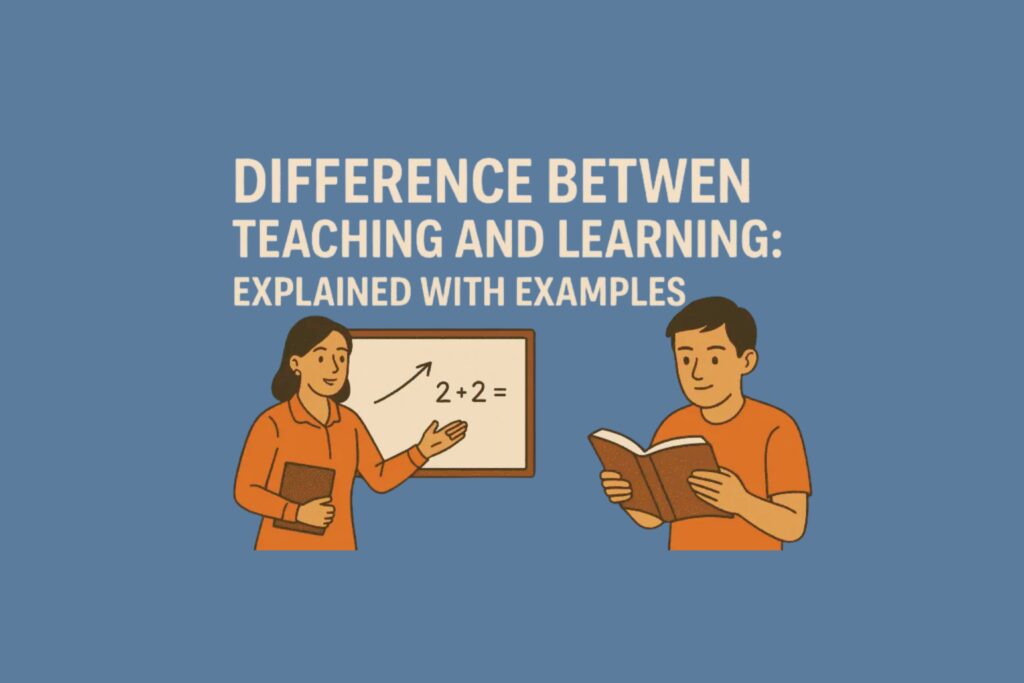
Introduction
In education, the terms “teaching” and “learning” are often used together, but they represent different aspects of the educational process. Understanding the difference between teaching and learning is crucial—not just for educators and students, but also for parents, trainers, and anyone involved in knowledge-sharing.
In this post, we’ll break down these concepts with clear examples, highlight key differences, explore their real-life connection, and compare them with related terms like schooling, education, and training.
What Is Teaching?
Teaching is the intentional act of helping others acquire knowledge or skills. It involves a teacher using structured methods like lectures, discussions, demonstrations, or assessments to guide learners toward understanding.
📘 Example: A teacher explaining Newton’s laws using classroom demonstrations and animations.
What Is Learning?
Learning is the process of understanding or applying new knowledge or skills through study, practice, or experience. It’s a more internal, often self-driven process compared to teaching.
📘 Example: A student solving problems at home to apply Newton’s laws they learned in class.
✅ 10 Differences Between Teaching and Learning
| Aspect | Teaching | Learning |
|---|---|---|
| 1. Definition | Delivering knowledge or instruction | Acquiring knowledge or skill |
| 2. Role | Active role by teacher | Active or passive role by student |
| 3. Objective | To inform and guide | To absorb and apply |
| 4. Control | Teacher-led | Student-led |
| 5. Process | External and planned | Internal and personal |
| 6. Structure | Organized curriculum | Can be spontaneous or structured |
| 7. Tools | Lectures, textbooks, whiteboards | Practice, reflection, discussions |
| 8. Dependency | Needs learner to be present | Can happen with or without a teacher |
| 9. Outcome | Transfer of information | Understanding and retention |
| 10. Evaluation | Based on delivery and participation | Based on application and understanding |
🔗 Relation Between Teaching and Learning
Teaching and learning are two sides of the same coin. While teaching provides direction and structure, learning represents the outcome. Great teaching doesn’t automatically lead to great learning unless the learner is engaged. Similarly, effective learning can occur informally, without formal teaching.
🎯 In essence: Teaching is about giving. Learning is about receiving and applying.
🧠 Real-Life Relationship Between Teaching and Learning
Imagine a driving instructor who teaches road rules and car controls. That’s teaching. When the student practices driving on the road, makes decisions, and builds confidence—that’s learning.
Both are essential. Teaching sets the foundation; learning builds upon it.
📚 Relationship Between Education and Schooling
People often use education and schooling as synonyms, but they are quite different.
-
Schooling refers to formal instruction in a structured environment (like schools or colleges).
-
Education is a broader concept, including both formal and informal methods of learning, such as life experiences, mentorship, self-study, and online courses.
You can be educated without formal schooling, and you can undergo schooling without being truly educated.
🛠️ Differentiate Between Teaching and Training (With Examples)
| Feature | Teaching | Training |
|---|---|---|
| Purpose | Transfer of knowledge/theory | Skill development for practical application |
| Focus | Academic or conceptual understanding | Practical performance and efficiency |
| Duration | Long-term or ongoing | Short-term and task-specific |
| Example | Teaching mathematics in school | Training employees to use new software |
Example of Training: A chef teaching interns how to chop vegetables using the right technique.
Example of Teaching: A teacher explaining food chemistry behind ingredients in a cooking class.
📝 Conclusion
Recognizing the difference between teaching and learning helps improve both how we deliver education and how we absorb it. Teaching focuses on delivering content. Learning focuses on internalizing it.
The more we understand the balance between them—and how they connect with schooling, education, and training—the better we become at both teaching effectively and learning deeply.
🎓 Whether you’re a student, teacher, trainer, or parent, this understanding can help you make education more meaningful and impactful.