Team6 · October 13, 2026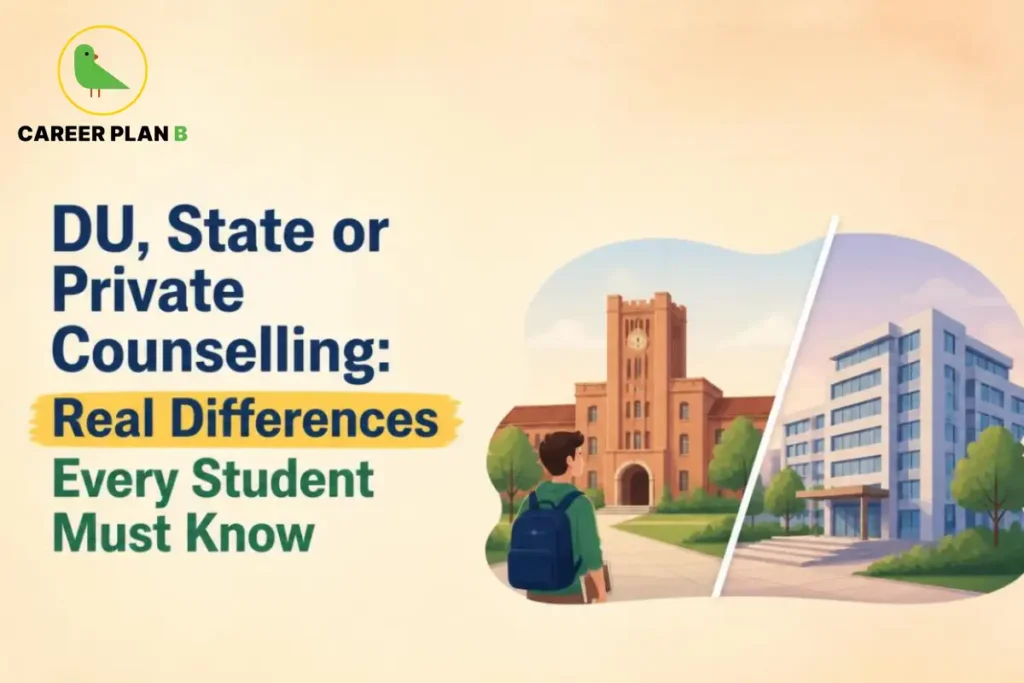
Introduction
It’s that time of the year again. The CUET 2026 results are out, your phone is buzzing with messages from friends, and somewhere in the middle of all that excitement, a tiny voice in your head whispers, “Okay, but now what?” If you’re staring at your scorecard wondering whether to chase a seat in Delhi University or look at other state and private options, you’re not alone. Thousands of students go through this exact moment every year, caught between excitement and confusion.
This is where the real decision begins: DU State or Private Counselling. It’s not just a technical term you’ll see on admission portals; it’s actually the fork in the road that shapes the next few years of your life. And honestly, understanding DU state or private counselling properly can save you from a lot of last-minute panic later.
What Exactly Happens During CUET Counselling 2026?
Let’s rewind a little. Once CUET UG 2026 results are declared, the actual admission journey starts, and it looks very different depending on which type of university you’re aiming for.
The CSAS Portal and How DU Counselling Works
For Delhi University, everything happens through the Common Seat Allocation System, popularly known as CSAS. CSAS is the official centralised online admission portal of the University of Delhi, and it’s the single window through which all undergraduate seats are allocated across Delhi University’s constituent colleges and departments. So instead of running from college to college with forms, you fill your preferences once, and the system does the matching for you.
DU UG admission 2026 is completely based on the candidate’s CUET 2026 scorecard, and CUET UG 2026 is the sole gateway for DU UG admission across 91 constituent colleges. The process is divided into Phase I, college and course mapping, simulated rank declaration, and finally seat allocation and admission in Phase III. It can feel like a maze the first time, but once you go through it step by step, it actually starts making sense.
How Private and State University Counselling Differs
State universities (run by individual state governments) and private universities usually run their own separate counselling processes. They might still ask for your CUET score, but the registration, document verification, and seat allotment happen on each university’s own portal, not through CSAS. So if you’ve applied to multiple types of institutions, you could be juggling two or three different portals at the same time. Keeping a checklist handy here genuinely helps.
DU State or Private Counselling — What’s the Real Difference?
Here’s where most students get stuck. On paper, a “good college” might look the same everywhere, but the experience inside can be worlds apart. Let’s break it down honestly.
| Factor | Delhi University (DU) | State Universities | Private Universities | 2026 Strategic ROI & Risk Insights |
|---|---|---|---|---|
| Admission Process | Centralised via CSAS portal based on CUET UG percentile and subject mapping | Separate state-level counselling or merit-based entrance procedures | Individual university portals, aptitudes/interviews, or CUET acceptance | CSAS minimizes single-point failures but requires careful college-program preference ordering. |
| Fees | Generally low (₹15,000 – ₹38,000 per year across most courses) | Low to moderate (subsidized government tuition frameworks) | Usually higher (₹1.5 Lakh – ₹5.0+ Lakh per year) | DU offers high financial return on investment (ROI); private setups demand strict evaluation of placement metrics. |
| Faculty & Legacy | Long-established, globally reputed academic departments and research bodies | Varies widely by institution; strong localized academic roots | Often newer, modern setups mixed with industry-adjunct faculty | Legacy institutions offer strong academic credibility for foreign university and post-graduate admissions. |
| Infrastructure | Older heritage structures, fully functional labs, and expanding digital libraries | Mixed infrastructure dependent on state budget allocations | Often heavily funded, state-of-the-art campuses and tech labs | Private institutions prioritize physical infrastructure, while DU balances legacy academic resources. |
| Placement Support | Strong alumni networks, active central placement cell (CPC) & top college cells | Decent in flagship state colleges, highly localized recruiter ties | Dedicated corporate placement cells; outcomes vary widely by branch | Tier-1 DU colleges consistently attract top consulting, finance, and tech recruiters. |
| Quota Benefits | Central government reservation norms (SC/ST/OBC-NCL/EWS/PwBD/ECA/Sports) | Strong domicile and regional state reservation quotas (up to 85%) | Minimal statutory quota benefits; institutional scholarship frameworks apply | State universities provide reliable safety options for home-state candidates via high domicile reservation percentages. |
Why DU Still Tops the Wishlist for Many Students
There’s something about saying “I study in DU” that still carries weight, and that’s not just nostalgia talking. The brand value, the alumni network, the Delhi exposure, and the sheer variety of courses make it a magnet for students across India. But here’s the catch: with 91 colleges and lakhs of applicants, competition is intense, and not every course in every college will be within reach for everyone. That’s exactly why having a backup plan isn’t pessimism, it’s just smart planning.
Should You Choose a State University Instead?
Now, before you assume state universities are a “settling for less” option, pause for a second. Many state universities offer genuinely strong programs, especially if you belong to that state and can use domicile quotas.
Here’s what often works in favour of state universities:
- Lower fees compared to most private institutions
- Domicile quota benefits, which can significantly improve your chances
- Familiar environment, especially if you’re staying closer to home
- Established government recognition and long-standing degree value
- Lower competition in certain courses compared to DU’s flagship programs
For students who prioritise affordability and regional comfort, state universities can actually be a smarter, less stressful choice.
What About Private Universities — Are They Worth It?
Private universities often get a mixed reputation, some call them “expensive but easy,” others swear by their facilities and exposure. The truth, as usual, lies somewhere in between.
Things to Check Before Saying Yes to a Private College
Before you get swayed by a glossy brochure or a flashy campus tour video, ask yourself:
- Is the university recognised by UGC and relevant regulatory bodies?
- What do actual placement records (not just promised ones) look like?
- Are the fees justified by the infrastructure, faculty, and exposure offered?
- Does the course curriculum align with industry trends?
- What is the cost of living in that city, beyond just tuition fees?
Private universities can offer modern infrastructure, industry tie-ups, and a more global outlook, but they come at a cost, and that cost isn’t always just financial. It’s important to weigh value against price, not just compare numbers.
Have Any Doubts?
Which One Is Actually Right for You?
Here’s a question worth sitting with: are you choosing a college, or are you choosing the next four years of your life?
Think about it like choosing a pair of shoes for a long trek. The most expensive pair isn’t always the best fit, and the cheapest one might leave you with blisters halfway through. What matters is how well it fits your feet, your goals, your budget, and your comfort.
A few things to genuinely reflect on:
- Your budget and how much your family is comfortable investing
- The specific course you want, not just the university name
- Distance from home and whether you’re ready for that change
- Long-term career goals, research opportunities, or further studies
- Your own personality, do you thrive in big competitive environments or smaller, closer-knit ones?
There’s no universally “right” answer here. There’s only the right answer for you.
How Career Plan B Helps
Career Plan B helps students navigate the choice between DU, state, and private university counselling with clarity, confidence, and personalized guidance:
- Personalized Career Counselling: Helps students evaluate different university pathways based on their strengths, interests, academic profile, budget considerations, and long-term goals.
- Psycheintel & Career Assessment Tests: Provides data-backed insights into aptitude, personality traits, learning styles, and suitable academic and career pathways to support informed decision-making.
- Admission & Academic Profile Guidance: Supports students in comparing universities, understanding admission opportunities, and building a strong academic profile that aligns with their preferred courses and institutions.
- Career Roadmapping: Helps students create a structured long-term plan that connects their college choices with future academic and professional aspirations.
- End-to-End Guidance: Assists students throughout counselling, admissions, and career planning so every decision is thoughtful, strategic, and aligned with their individual goals.
For Latest Information
Frequently Asked Questions
1. Can I apply for DU, state, and private university counselling at the same time?
Yes, you can apply to multiple universities simultaneously. Just remember each one may have its own portal, deadlines, and document requirements, so staying organised is key.
2. Is the CUET score mandatory for state and private university admissions too?
Many state and private universities now consider CUET scores, but some may also have their own entrance criteria. Always check the specific university’s admission notification.
3. Does choosing a private university mean better placements?
Not necessarily. Some private universities have strong placement records, while others don’t. It’s important to look at actual past placement data rather than assuming based on fees alone.
4. What if I don’t get my preferred course in DU through CSAS?
DU’s CSAS process includes multiple rounds and a preference change window, so there’s often a chance to revise choices. Meanwhile, keeping state or private options open as backup is wise.
5. Are state university degrees valued the same as DU degrees?
Government-recognised state university degrees hold valid academic value, though brand recognition may differ. What often matters more in the long run is your skills, internships, and overall profile.
Conclusion
At the end of the day, DU state or private counselling isn’t really about which option “sounds” better to relatives or friends. It’s about which environment will help you grow, learn, and feel like yourself for the next few years. Take your time, compare honestly, and don’t let pressure rush a decision this important.
Whatever you choose, remember that one decision doesn’t define your entire future, it’s just the beginning of a much longer journey. Trust the process, trust your research, and most importantly, trust yourself to make a choice you can grow into.