Team Career Plan B · September 4, 2026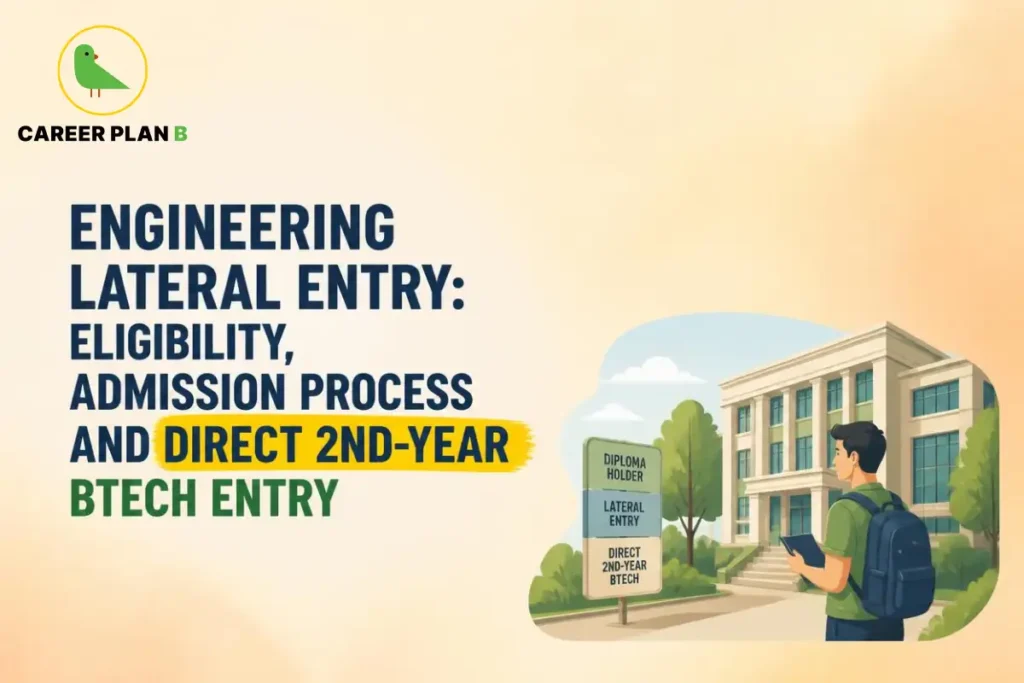
Introduction
Technical education offers clear acceleration pathways for polytechnic diploma holders across India. While standard undergraduate engineering degrees require four academic years, Engineering Lateral Entry enables qualified candidates to bypass the first year entirely.
Many polytechnic graduates ask: how to get lateral entry in engineering and how lateral entry admission works in engineering? Moreover, diploma students regularly explore the specific criteria for engineering lateral entry eligibility after diploma to secure admissions in top institutions.
Technical undergraduate education in India is governed by the All India Council for Technical Education (AICTE). Additionally, degree recognition and university affiliations are overseen by the University Grants Commission (UGC) and respective state technical universities.
This comprehensive guide breaks down the entrance exams, eligibility standards, top specializations, and the complete application roadmap for direct admissions.
What is Engineering Lateral Entry?
Engineering Lateral Entry is an AICTE-approved scheme that allows diploma and BSc graduates to enroll directly into the second year (third semester) of a B. Tech or B.E. program.
Consequently, candidates complete their bachelor’s degree in three years instead of four. Because diploma holders have already mastered core engineering foundational science, initial subjects are waived.
Therefore, B Tech lateral entry offers an accessible route to upgrade technical qualifications without losing academic time.
Three-Year Polytechnic Diploma ➔ Lateral Entry Admission ➔ 3-Year B. Tech (Direct Sem 3) ➔ Full B. Tech Degree
Statutory Engineering Lateral Entry Eligibility Norms
Understanding the statutory engineering lateral entry eligibility criteria ensures candidates prepare accurate verification records. The baseline standards established by the AICTE are clear:
- Qualifying Diploma: Candidates must hold a 3-year AICTE-approved polytechnic engineering diploma.
- Minimum Marks for Diploma: Applicants must score at least 45% aggregate marks (40% for reserved categories).
- B.Sc. Degree Route: B.Sc. graduates with Mathematics in Class 12 and 45% marks in graduation are also eligible.
- D. Voc. Stream: Students passing an approved D. Voc. course in allied technical sectors qualify as well.
Note: Seat allotments operate under a mandatory 10% to 15% supernumerary quota approved by the AICTE beyond sanctioned intake.
Step-by-Step Engineering Lateral Entry Admission Process
The engineering lateral entry admission process operates through state-level counseling and merit-based entrance evaluations.
First, candidates register online on their state technical admission portal. Next, applicants upload diploma marks sheets, category certificates, and identity proofs for scrutiny.
Then, candidates appear for designated state lateral entrance exams (LEET) or participate in merit counseling. After merit ranks are generated, students submit their preferred choices for lateral entry engineering colleges.
Finally, students report to their allotted institution with original documents and settle the admission fees.
Major State Entrance Exams for Lateral Entry B Tech Admission
Most state technical directorates conduct dedicated entrance tests for lateral entry B Tech admission:
| State / Territory | Entrance Examination / Admission Mode | Conducting Technical Authority |
|---|---|---|
| Uttar Pradesh | CUET UG / State Counselling | Dr. A.P.J. Abdul Kalam Technical University (AKTU) |
| West Bengal | JELET | West Bengal Joint Entrance Examinations Board (WBJEEB) |
| Maharashtra | Direct Second Year Engineering (DSE) | Directorate of Technical Education (DTE Maharashtra) |
| Karnataka | DCET (Diploma CET) | Karnataka Examination Authority (KEA) |
| Andhra Pradesh | AP ECET | Andhra Pradesh State Council of Higher Education (APSCHE) |
| Telangana | TS ECET | Telangana State Council of Higher Education (TSCHE) |
| Haryana & Punjab | LEET (Merit & Entrance Modes) | Respective State Technical Education Departments |
Note: Important registration dates and counseling rounds are published on respective state admission portals annually.
Top Specializations for Direct Second Year Engineering Admission
Candidates securing direct second year engineering admission can choose from various high-demand technical specializations:
- Computer Science & Engineering (CSE): Focuses on algorithms, cloud computing, artificial intelligence, and software development.
- Mechanical Engineering: Covers thermodynamics, industrial robotics, fluid mechanics, and CAD modeling.
- Civil Engineering: Focuses on structural design, transportation networks, environmental engineering, and construction planning.
- Electrical & Electronics Engineering (EEE): Covers power grids, microcontrollers, control systems, and electric vehicle architectures.
- Electronics & Communication Engineering (ECE): Explores embedded systems, VLSI design, wireless communication, and signal processing.
Read More:- Diploma to Degree in India: Best Lateral Entry Paths
Key Advantages of Lateral Entry in Engineering
Choosing lateral entry in engineering provides substantial advantages for technical students:
Direct Time and Cost Savings
Because candidates enter the second year directly, they pay college fees for three years instead of four. Consequently, overall educational expenses decrease significantly.
Practical Industry Foundations
Diploma holders bring extensive hands-on workshop and laboratory experience. As a result, they often outperform direct 12th-pass entrants in advanced technical projects.
Equal Academic and Professional Credibility
Graduating students receive the exact same B. Tech degree certificate as standard four-year students. Therefore, lateral entry graduates face zero restrictions in campus placements or government examinations.
Mandatory Documents for Engineering Lateral Entry Admission After Diploma
Candidates must present verified original documents during institutional reporting:
- Class 10 Certificate and Mark Sheet (valid proof of date of birth).
- Final Polytechnic Diploma Passing Certificate and all semester mark sheets.
- State Lateral Entry Entrance Exam Rank Card and Admit Card.
- State Domicile Certificate issued by a competent authority.
- Category / Reservation Certificate (OBC-NCL, SC, ST, EWS, or PwD) in prescribed government formats.
- Transfer Certificate (TC) and Character Certificate from the polytechnic institute.
- Valid Government Identity Proof (Aadhaar Card, Voter ID, or Passport).
For Personalized Guidance
Fee Structure Across Lateral Entry Engineering Colleges
Tuition fees for lateral entry engineering colleges after diploma depend primarily on the college’s administrative type:
- State Government Engineering Colleges: Annual fees typically range between ₹25,000 and ₹75,000 per year.
- Autonomous & Government-Aided Institutes: Annual tuition fees range from ₹60,000 to ₹1,40,000 per year.
- Top Private Engineering Universities: Annual tuition ranges from ₹1,20,000 to ₹2,80,000 per year.
Note: Eligible reserved category students and economically weaker applicants can apply for state post-matric scholarships and tuition fee waiver (TFW) schemes.
Career Scope and Salary After BTech Lateral Entry
Graduates completing their engineering degree through lateral entry enjoy diverse career opportunities in core industries and multinational corporations:
| Job Role / Designation | Average Annual Salary (INR) | Top Recruiting Sectors |
|---|---|---|
| Graduate Engineer Trainee (GET) | ₹3,80,000 – ₹6,50,000 | Manufacturing, Automotive, Construction, and EPC firms. |
| Software Engineer / Developer | ₹4,50,000 – ₹10,50,000 | IT services, SaaS platforms, and enterprise software firms. |
| Assistant Executive Engineer (PSU/Govt) | ₹6,00,000 – ₹12,00,000 | BHEL, NTPC, ONGC, Indian Railways, and State PWD. |
| Embedded Systems Engineer | ₹4,20,000 – ₹8,00,000 | Semiconductor manufacturing, consumer electronics, and EV units. |
| Design & Project Engineer | ₹4,00,000 – ₹7,50,000 | Civil infrastructure, aerospace, and heavy machinery plants. |
How Career Plan B Helps
Choosing the right engineering discipline and navigating state-level lateral entry counseling requires experienced mentorship. Career Plan B supports technical diploma holders across India through:
- Personalised Branch Counseling: We assess your polytechnic background and career goals to identify the best B. Tech streams and accredited colleges.
- Aptitude & Technical Profiling: Our scientific evaluations determine whether core engineering, software roles, or emerging tech align best with your skills.
- State Counseling & Choice Locking: We provide step-by-step guidance for state entrance cutoffs, merit lists, and strategic choice ordering.
- Career Roadmapping: Our mentorship extends beyond degree admission. Furthermore campus placement strategies.
Get In Touch With Us
Frequently Asked Questions
Q1. Can an ITI certificate holder apply directly for B Tech lateral entry?
No, ITI certificate holders are not eligible for direct BTech admission. However, ITI holders can join the second year of a polytechnic diploma first and then pursue lateral entry into BTech.
Q2. Is an engineering degree obtained through lateral entry valid for government jobs?
Yes, degrees completed through lateral entry are approved by the AICTE and recognized by UPSC, SSC, state PSCs, and PSUs for all engineering posts.
Q3. Can a diploma holder change branches during Engineering Lateral Entry?
Most state technical universities allow branch changes to closely related fields. However, specific transition policies depend on individual state counseling rules.
Q4. Are lateral entry students eligible for campus placement drives?
Yes, major IT companies, core engineering firms, and recruiters treat lateral entry students equally during on-campus hiring drives.
Q5. What is the supernumerary quota for B Tech lateral entry seats?
Under standard AICTE regulations, institutions offer 10% to 15% supernumerary seats over and above the approved intake for direct second-year admissions.
Conclusion
Engineering Lateral Entry remains the most effective bridge for polytechnic diploma holders seeking to become full-fledged engineering professionals. By entering directly into the second year, students save valuable academic time and reduce overall educational costs.
Furthermore, combining practical diploma training with an advanced theoretical B. Tech curriculum produces highly competitive engineering graduates. Therefore, motivated diploma holders can accelerate their careers across major private corporations and public sector enterprises.
Review your state entrance exam dates carefully, compile your academic records, and select your target engineering colleges with confidence.