Team Career Plan B · September 4, 2026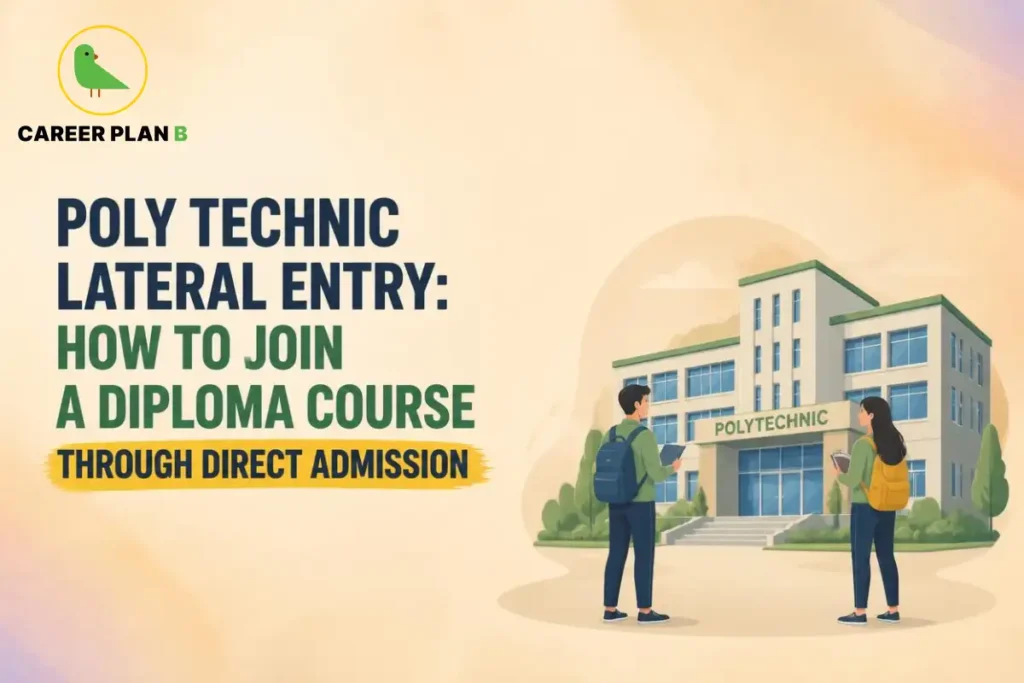
Introduction
Technical education offers accelerated career pathways for students aiming to enter the industrial engineering workforce early. While standard diploma programs require three full years after Class 10, Polytechnic Lateral Entry provides a direct fast-track route.
Many Class 12 Science and ITI graduates ask: how to get lateral entry in polytechnic and what is the polytechnic lateral entry eligibility after 12th? Furthermore, students frequently explore whether polytechnic lateral entry into second year saves academic time without compromising curriculum standards.
Technical diploma admissions across India operate under statutory guidelines framed by the All India Council for Technical Education (AICTE). Additionally, state technical education policies are managed by the Ministry of Skill Development and Entrepreneurship (MSDE) and respective State Directorates of Technical Education (DTE).
This comprehensive guide details the direct admission process, eligibility requirements, popular engineering courses, and career opportunities.
What is Polytechnic Lateral Entry?
Polytechnic Lateral Entry is an official admission scheme approved by the AICTE. It enables qualified candidates to join the second year (third semester) of a diploma program directly.
Consequently, students complete a standard three-year engineering diploma in just two years. The first year of foundational science is waived because qualifying students already completed equivalent coursework in Class 12 or ITI.
Therefore, diploma lateral entry offers an efficient transition from secondary education to professional technical qualifications.
Moreover, lateral entry students study the exact same core engineering curriculum as regular second-year diploma students. As a result, both regular and lateral entry graduates receive identical diploma certificates upon graduation.
Eligibility for Lateral Entry in Polytechnic Colleges
Understanding the polytechnic lateral entry eligibility criteria ensures candidates prepare the correct academic documents. The baseline requirements are defined across specific academic streams:
- Class 12 Science (PCM): Candidates must pass 10+2 with Physics, Chemistry, and Mathematics from a recognized board.
- Class 12 Vocational / Technical: Students who passed 10+2 with technical or vocational subjects are also eligible.
- Two-Year ITI Certificate: Applicants who completed a 2-year ITI trade course after Class 10 qualify directly.
- Minimum Qualifying Marks: Most state technical boards mandate at least 45% aggregate marks (40% for reserved categories).
Note: Exact percentage cutoffs and stream mapping can vary slightly across individual state technical boards and participating universities.
Furthermore, some state boards allow 12th standard students with Mathematics or Biology along with vocational subjects. Therefore, candidates should verify state-specific eligibility brochures during the application period.
Polytechnic Lateral Entry Admission Process
The polytechnic lateral entry admission process follows a structured, merit-based selection cycle. Most states conduct centralized counseling for transparent seat allocation.
First, candidates register online on their state technical board portal during the polytechnic lateral entry admission 2026 window. Next, applicants upload academic marks sheets and trade certificates for automated verification.
Then, students appear for a state lateral entry entrance test (LEET) or participate in merit-based counseling. After merit ranks are published, candidates lock their preferred engineering branches and polytechnic colleges. Finally, students report to their allotted institution with original documents to confirm admission.
Additionally, private polytechnic institutes may offer management quota seats. However, these direct institutional seats still require approval from the state technical board.
State-Wise Lateral Entry Entrance Examinations
Several states conduct dedicated entrance examinations for lateral entry admissions. In contrast, other states admit students based entirely on qualifying academic merit:
| State / Region | Entrance Examination / Admission Mode | Conducting Technical Authority |
|---|---|---|
| Uttar Pradesh | JEECUP (Group K) | Joint Entrance Examination Council, Uttar Pradesh |
| West Bengal | VOCLET | West Bengal State Council of Technical Education |
| Bihar | DCECE (LE) | Bihar Combined Entrance Competitive Examination Board |
| Haryana | Haryana DET-L (Merit-Based) | Department of Technical Education, Haryana |
| Punjab | Punjab LEET (Merit-Based) | Punjab State Board of Technical Education |
| Maharashtra | Direct Second Year Diploma (Merit-Based) | Directorate of Technical Education (DTE), Maharashtra |
| Madhya Pradesh | MP PPT Lateral Entry | MP Directorate of Technical Education |
Note: Registration windows usually open between April and July each academic year. Candidates should monitor state admission portals regularly.
Top Polytechnic Lateral Entry Courses & Specializations
Students can select from various high-demand technical streams during polytechnic admission through lateral entry:
| Diploma Branch | Core Subject Focus | Industry Employment Sectors |
|---|---|---|
| Mechanical Engineering | Thermodynamics, CAD/CAM, manufacturing, and fluid mechanics. | Automotive, heavy machinery, aerospace, and defense plants. |
| Civil Engineering | Structural analysis, surveying, concrete tech, and geotechnical engineering. | Construction, infrastructure development, NHAI, and urban planning. |
| Electrical Engineering | Circuit theory, power systems, electrical machines, and control systems. | State electricity boards, renewable energy, and power grids. |
| Computer Science & IT | Data structures, web development, DBMS, and network security. | Software support, IT maintenance, telecom, and app management. |
| Electronics & Communication | Microprocessors, digital communication, VLSI, and signal processing. | Semiconductor units, consumer electronics, and telecom towers. |
| Chemical Engineering | Chemical processes, plant utilities, thermodynamics, and mass transfer. | Petrochemicals, fertilizer plants, pharmaceuticals, and refineries. |
| Automobile Engineering | Engine design, vehicle dynamics, transmission systems, and EV tech. | Electric vehicle manufacturing, auto assembly, and testing labs. |
Note: Seat availability in specific branches depends on the 10% to 15% supernumerary lateral entry quota approved by the AICTE.
Direct Comparison: Standard 3-Year Diploma vs. Lateral Entry (2-Year)
Evaluating the difference between standard entry and lateral entry helps students make practical academic decisions:
| Feature / Metric | Standard 3-Year Diploma | Polytechnic Lateral Entry (2-Year) |
|---|---|---|
| Entry Qualification | Class 10 Pass | Class 12 (PCM/Vocational) or 2-Year ITI |
| Course Duration | 3 Years (6 Semesters) | 2 Years (4 Semesters) |
| Starting Semester | 1st Semester (Foundational Science) | 3rd Semester (Core Technical Subjects) |
| Tuition Expenditure | Payable for 3 full academic years | Payable for 2 academic years only |
| Curriculum Standard | Standard state diploma syllabus | Identical core engineering syllabus |
| Final Certificate | State Board Diploma in Engineering | State Board Diploma in Engineering |
Consequently, lateral entry students achieve the exact same academic credentials in a shorter timeframe.
Key Benefits of Lateral Entry Polytechnic Admission
Choosing lateral entry in polytechnic offers distinct academic and professional advantages:
Saves One Complete Academic Year
Direct entry into the second year reduces the diploma duration from three years to two years. Consequently, candidates enter the job market twelve months earlier.
Lower Financial Expenditure
Because the course duration is shorter, students pay tuition fees for only two years. As a result, total education costs remain substantially lower.
Smooth Pathway to B.Tech Lateral Entry
After completing the diploma, candidates qualify for direct second-year B.Tech admission through state engineering counseling. Therefore, this route provides an accessible pathway to a full engineering degree.
Hands-On Practical Exposure
Compared to standard academic degrees, polytechnic programs focus heavily on laboratory training and workshop practice. As a result, students develop strong technical competence.
Read more:- Diploma to Degree in India: Best Lateral Entry Paths
Documents Required for Lateral Entry Admission in Polytechnic Colleges
Candidates must keep original certificates along with self-attested copies ready for physical document scrutiny:
- Class 10 Certificate and Mark Sheet (proof of date of birth).
- Class 12 Mark Sheet or 2-Year ITI Trade Certificate.
- State Lateral Entry Admit Card and Rank Card (where applicable).
- Domicile Certificate issued by a competent state authority.
- Category / Reservation Certificate (SC, ST, OBC, EWS, or PwD) in prescribed formats.
- Income Certificate (for fee concession and scholarship claims).
- Character Certificate and Transfer Certificate (TC) from the last attended school or institute.
- Valid Government Photo ID (Aadhaar Card, Voter ID, or Passport).
- Recent passport-size colored photographs.
For Personalized Guidance
Fee Structure for Polytechnic Lateral Entry Courses
The annual cost of pursuing a diploma through lateral entry depends largely on the institution type:
- Government Polytechnic Colleges: Annual tuition ranges between ₹8,000 and ₹15,000 per year.
- Government-Aided Polytechnic Institutes: Annual tuition fees range from ₹18,000 to ₹35,000 per year.
- Private Polytechnic Colleges: Annual tuition fees range between ₹35,000 and ₹75,000 per year.
Note: Many state governments provide full tuition fee waivers and post-matric scholarships for eligible SC, ST, OBC, and EWS students.
Career Scope and Salary After Lateral Entry Diploma
Graduates holding a polytechnic diploma enjoy diverse career opportunities across government and private sectors. Moreover, multinational manufacturing firms actively recruit diploma engineers for supervisory roles.
| Employment Level / Designation | Average Annual Salary (INR) | Primary Hiring Sectors |
|---|---|---|
| Junior Engineer (State Govt / SSC JE) | ₹4,20,000 – ₹6,50,000 | Indian Railways, State PWD, CPWD, and municipal boards. |
| PSU Technical Assistant (BHEL, NTPC, IOCL) | ₹3,80,000 – ₹5,80,000 | Public Sector Undertakings and defense production units. |
| Diploma Engineer Trainee (DET) | ₹2,40,000 – ₹4,00,000 | Tata Motors, L&T, Maruti Suzuki, and Siemens. |
| Quality Control & Maintenance Supervisor | ₹3,00,000 – ₹4,80,000 | Industrial manufacturing, HVAC, and telecom operations. |
| CAD Designer / Draftsman | ₹2,50,000 – ₹4,20,000 | Architectural firms, civil engineering consultancies, and EPC firms. |
Note: Salary packages depend on the candidate’s technical skills, academic performance, and the hiring organization’s compensation policies.
Top Government and Private Polytechnic Colleges in India
Selecting a well-equipped technical institute ensures access to modern workshops and active campus placement drives:
Leading Government Polytechnic Institutes
- Government Polytechnic, Mumbai (Maharashtra)
- Pusa Institute of Technology, New Delhi
- Government Polytechnic, Pune (Maharashtra)
- S.J. Government Polytechnic, Bengaluru (Karnataka)
- Government Polytechnic, Lucknow (Uttar Pradesh)
- Central Polytechnic College, Chennai (Tamil Nadu)
- Government Polytechnic, Ahmedabad (Gujarat)
Leading Private & Aided Polytechnic Colleges
- V.M.K.V. Engineering College Polytechnic, Salem
- Acharya Polytechnic, Bengaluru
- MEI Polytechnic, Bengaluru
- Lovely Professional University (Diploma Wing), Phagwara
- Integral University Polytechnic, Lucknow
How Career Plan B Helps
Navigating technical admissions, comparing polytechnic streams, and selecting the right engineering branch requires strategic guidance. Career Plan B assists students across India through:
- Personalised Admission Counselling: We evaluate your Class 12 or ITI background to recommend the best technical branches and government polytechnics.
- Skill & Aptitude Profiling: Our scientific assessments identify whether mechanical, civil, electrical, or software engineering aligns with your technical strengths.
- Counseling & Choice Locking Support: We provide real-time updates for state lateral entry dates, document verification, and seat preference lists.
- Degree Career Roadmapping: Furthermore, we guide diploma holders through future B.Tech lateral entry admissions and public sector job examinations.
Get In Touch With Us
Frequently Asked Questions
Q1. Can an Arts or Commerce student apply for Polytechnic Lateral Entry?
No, lateral entry requires foundational science education. Only Class 12 Science (PCM), vocational technical, or 2-year ITI pass candidates are eligible.
Q2. Is a lateral entry polytechnic diploma valid for government jobs?
Yes, diplomas obtained through lateral entry are approved by the AICTE and recognized for all state and central government engineering jobs on par with standard diplomas.
Q3. Can I join B.Tech directly after completing a lateral entry diploma?
Yes, diploma holders can join the second year (third semester) of B.Tech through lateral entry engineering counseling.
Q4. Is there an entrance exam for polytechnic lateral entry?
Some states conduct state-level lateral entry entrance exams (such as JEECUP or VOCLET), while other states admit students based purely on Class 12 or ITI merit marks.
Q5. What is the age limit for polytechnic lateral entry admission?
Under standard AICTE guidelines, there is no upper age limit for lateral entry diploma admissions.
Q6. Can an ITI pass student change their engineering branch during lateral entry?
In most states, ITI students must choose a diploma branch aligned with their ITI trade. However, Class 12 Science students can select any available engineering branch.
Conclusion
Polytechnic Lateral Entry offers a practical, cost-effective pathway to build industry-ready technical skills while saving an entire academic year. By entering directly into the second year, students gain hands-on workshop experience and faster access to career opportunities across manufacturing, infrastructure, construction, and engineering industries.
The diploma also provides a strong pathway to higher education through direct second-year B.Tech lateral entry, allowing students to strengthen their technical expertise without starting an engineering degree from the first year. With lower tuition costs, early employment opportunities, and growing demand for skilled professionals in automation and smart manufacturing, Polytechnic Lateral Entry can support both career growth and financial independence.
Check your state counselling schedule, verify your eligibility and documents, and shortlist the right technical branch based on your career goals. Need help choosing the right polytechnic course or planning your admission? Connect with our experts at Career Plan B today for personalised guidance and take the next step toward your technical career.