Careerplanb · July 15, 2026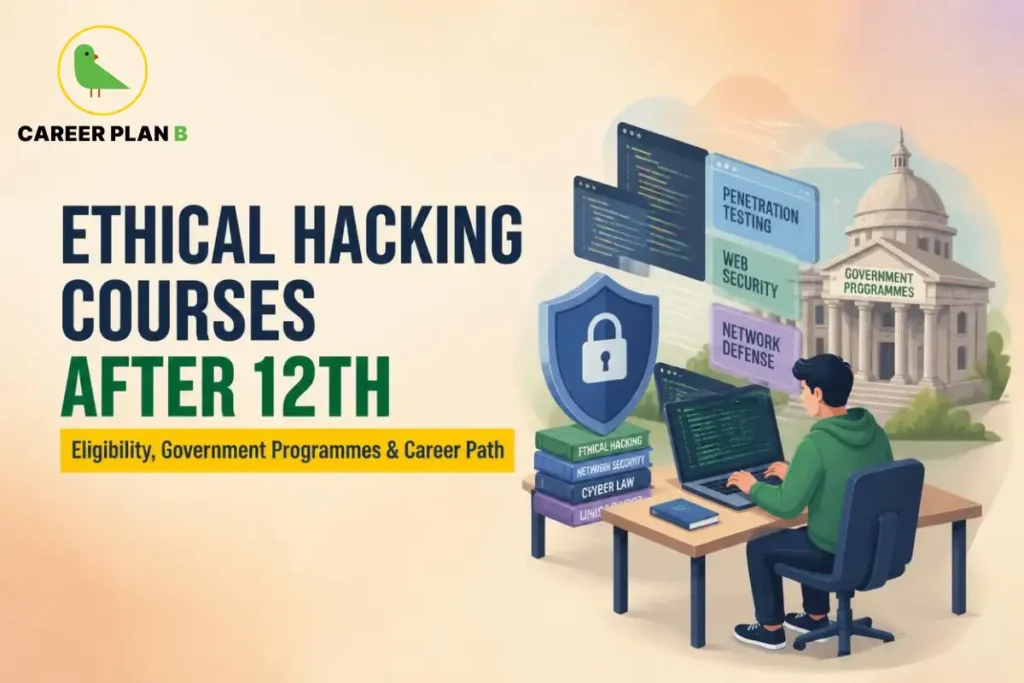
Introduction
Ethical hacking courses after 12th India offer a structured pathway into one of the country’s fastest-growing technology fields. Students can build practical cybersecurity skills through government-supported programmes, recognised certifications, and industry-focused training. The Government of India also promotes cybersecurity skill development through initiatives such as PMKVY 4.0, NIELIT, and the Skill India Digital Hub (SIDH). This guide explains the official training pathways, eligibility requirements, and career opportunities available after Class 12.
What Freelancing Actually Is — And Why It’s Different from Employment
Freelancing means offering specific skills or services to clients on a project or contract basis, rather than being in a fixed employment relationship with one employer. A class 12 student can start freelancing legitimately in India with skills in areas like video editing, graphic design, content writing, digital marketing, web development, photography, tutoring, and translation.
From India’s regulatory standpoint, freelancing falls under the gig and platform economy — a category the Government of India has formally recognised and is actively building policy around. The Code on Social Security, 2020 defines “gig workers” as persons who perform work or participate in a work arrangement and earn from such activities outside of a traditional employer-employee relationship. (Source: PIB — Social Security for Gig Workers, as referenced in SIDH integration with eShram: pib.gov.in/PressReleasePage.aspx?PRID=2222120)
Step 1: Build Verifiable, NSQF-Certified Skills First
The most common mistake new freelancers make is starting with no verifiable credential. The Government of India has an entire infrastructure specifically to help you get industry-relevant skills quickly and affordably.
Skill India Digital Hub (SIDH): The Central Platform
The Skill India Digital Hub (SIDH), launched by the Ministry of Skill Development and Entrepreneurship (MSDE)and built as Digital Public Infrastructure at skillindiadigital.gov.in, is the official unified platform for skill development in India. (Source: PIB — SIDH launch: pib.gov.in/PressReleasePage.aspx?PRID=2042544)
SIDH offers:
- 752+ online courses accessible via web and mobile app (Source: PIB — SIDH statistics: pib.gov.in/PressReleasePage.aspx?PRID=2039515)
- Courses from both government programmes and industry partners including Microsoft, Cisco, HCL Technologies, Tech Mahindra, and others
- Available in 23 Indian languages via the Bhashini integration
- Portable verified credentials — certificates that can be stored, shared, and verified digitally
SIDH is explicitly built for learners, workers, gig workers, and entrepreneurs — including those who are just starting out after school. (Source: PIB — SIDH)
Have Any Doubts?
PMKVY 4.0: Courses for the Digital Economy
Under PMKVY 4.0, the Government has introduced 400+ new courses specifically on AI, 5G technology, Cybersecurity, Green Hydrogen, and Drone Technology — skills directly relevant to freelancing in technology-adjacent sectors. Additionally, 77 customised courses and 102 future-skill job roles have been introduced to improve employability in digital services. (Source: PIB — PMKVY 4.0 Cabinet Approval: pib.gov.in/PressReleaseIframePage.aspx?PRID=2100845)
As on October 31, 2025: 17,611,055 candidates enrolled under PMKVY since inception, with 16,433,033 trained. (Source: PIB — Skill India Mission: pib.gov.in/PressReleasePage.aspx?PRID=2200373)
Step 2: Register on eShram — Government’s Gig Worker Database
Once you start freelancing, even casually, you are part of India’s unorganised workforce. Registering on the eShram portal — maintained by the Ministry of Labour and Employment — creates an official digital identity as a worker and connects you to government schemes for social security and skill development.
SIDH is integrated with eShram specifically so that gig and platform workers can:
- Access NSQF-aligned skilling programmes
- Maintain digital records of their skills and certifications
- Improve their employability through verifiable skill credentials
(Source: PIB — SIDH integration with eShram: pib.gov.in/PressReleasePage.aspx?PRID=2222120)
Step 3: Understand the Entrepreneurship Support Framework
If you plan to grow freelancing into a small business — taking on multiple clients, building a team, or offering productised services — the government has specific support structures:
NIESBUD: National Institute for Entrepreneurship and Small Business Development
NIESBUD (National Institute for Entrepreneurship and Small Business Development), under MSDE, provides entrepreneurship development training and resources. SIDH is integrated with NIESBUD’s UdhyamKart to list products of NIESBUD-trained entrepreneurs and empower small businesses. (Source: PIB — SIDH launch)
Startup India: Government of India’s Startup Portal
The Startup India initiative, under DPIIT (Department for Promotion of Industry and Internal Trade), Ministry of Commerce and Industry, provides a portal listing all central government schemes available to entrepreneurs, including access to funding, regulatory support, and mentorship. (Source: Startup India — startupindia.gov.in)
If your freelancing grows into a formal entity, Startup India recognition provides benefits including income tax exemption for 3 years, self-certification compliance, and access to an ₹10,000 crore Fund of Funds.
Udyam Registration Portal: Formalise Your Practice
Once your freelancing income qualifies you as a micro-enterprise, Udyam Registration (at udyamregistration.gov.in) provides a free, paperless, self-declared registration as an MSME — unlocking access to priority sector lending, government procurement opportunities, and credit guarantee schemes. (Source: PIB — Udyami Diwas 2025: pib.gov.in/PressNoteDetails.aspx?ModuleId=3&NoteId=154772)
What Skills Translate Best to Freelancing After Class 12?
While the choice of skill depends entirely on your aptitude, the PMKVY 4.0 future-skills framework and SIDH’s course catalogue indicate the highest-demand digital and creative skill categories for Indian gig workers: (Source: PIB — PMKVY Year End Review 2025: pib.gov.in/PressReleasePage.aspx?PRID=2217881)
| Skill Category | Government Programme Alignment |
|---|---|
| IT and Digital Services | PMKVY 4.0 IT-ITeS sector courses and Skill India Digital Hub (SIDH) programmes |
| AI and Data | PMKVY 4.0 future skills courses and DBT–IndiaAI MoU programmes |
| Video Editing and Content Creation | PMKVY 4.0 media and creative sector programmes |
| Cybersecurity | PMKVY 4.0 cybersecurity courses and NIELIT certification programmes |
| Digital Marketing | Skill India Digital Hub (SIDH) courses delivered with industry partners |
| Graphic and Visual Design | PMKVY 4.0 creative sector courses and design skill programmes |
Step 4: The Tax Reality — What Every Class 12 Freelancer Needs to Know
Freelancing income in India is taxable. While detailed tax advice is beyond what any blog should provide (consult a Chartered Accountant for personal guidance), the key things to know structurally are:
- Freelancing income is assessed as “Profits and Gains from Business or Profession” under the Income Tax Act
- If your annual income exceeds the basic exemption limit, you must file an income tax return
- The Udyam Assist Platform (for informal micro-enterprises) can help formalise your work and access credit once your practice grows
How Career Plan B Helps
Freelancing after class 12 sounds exciting, but success depends on choosing the right skill to develop, understanding when freelancing should remain a side income versus becoming your primary path, and knowing what formal support structures exist. Career Plan B offers Personalised Career Counselling, Psycheintel and career assessment tests to identify which freelance-able skills genuinely align with your aptitude, Admission and Academic Profile Guidance for PMKVY and SIDH skill programmes, and career roadmapping to plan your transition from first client to sustainable freelance practice.
Get In Touch With Us
Frequently Asked Questions
01. Can I legally freelance in India right after class 12?
Yes. There is no minimum educational qualification required to freelance. However, your income is taxable once it exceeds basic exemption thresholds, and you should register on eShram for formal recognition as an unorganised worker with access to government schemes.
02. What is the Skill India Digital Hub (SIDH) and is it free?
SIDH (skillindiadigital.gov.in) is the government’s unified digital skilling platform, offering 752+ courses — many of them free or subsidised, including PMKVY-funded courses. (Source: PIB — SIDH)
03. Is there government financial support for a class 12 student starting a freelance-based small business?
Yes. PMEGP (under Ministry of MSME) provides credit-linked subsidy for setting up micro-enterprises, including service-based businesses. Udyam Registration formalises your enterprise and unlocks access to priority sector lending. (Source: PIB — PMEGP)
04. Does registering on eShram affect my freelancing?
eShram registration gives you an official identity as a gig/unorganised worker and connects you to social security and skilling schemes. It does not impose any restrictions on your freelancing. (Source: PIB — SIDH and eShram integration)
05. Which government platform should I start with to build freelance skills?
Start at skillindiadigital.gov.in (SIDH) — explore the course catalogue, filter by skill area, and enrol in NSQF-aligned or industry-partnered courses. You get a portable, verifiable digital certificate on completion. (Source: PIB — SIDH)
Have Any Doubts?
Conclusion
Freelancing after class 12 in India is viable, legal, and increasingly well-supported by a government infrastructure that explicitly recognises the gig economy. Start by building verifiable skills through SIDH and PMKVY, register on eShram, explore NIESBUD’s entrepreneurship resources, and formalise your practice through Udyam Registration when it grows. The digital skilling infrastructure is in place — what you bring is the discipline to build one real, marketable skill before chasing clients.
For guidance on which skill to build first and how to sequence your freelance journey alongside any further education plans, [get personalised career support from Career Plan B]