Careerplanb · July 15, 2026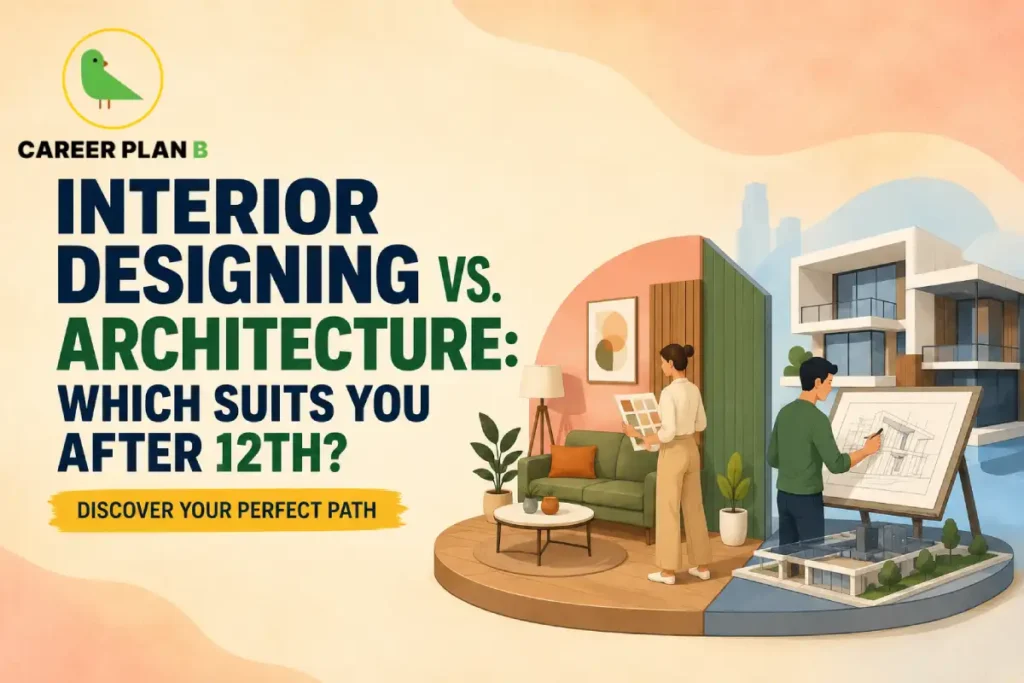
Introduction
“Architects design the building. Interior designers design the experience inside it.” This one-line distinction is the simplest way to understand these two closely related but genuinely different fields — and it is where every Class 12 student comparing them should start.
Architecture and Interior Design both demand creativity. Professionals in both fields design the spaces where people live and work. Demand for these careers continues to grow across India’s expanding cities. But the entrance exams, course duration, legal regulation, and day-to-day work are meaningfully different — and choosing without understanding these differences can cost years of misdirected effort.
This blog breaks down exactly how Architecture (B.Arch) and Interior Design (B.Des or equivalent) compare in India today, so you can make this decision with real information rather than guesswork.
The Core Difference in One Line
An architect is a licensed professional who plans and designs entire buildings and structures — working on structural systems, safety codes, and the building’s relationship with its environment. An interior designer enhances and organises the spaces inside an already-designed structure — layout, materials, lighting, furniture, and how a space actually functions and feels for the people using it.
Architecture is regulated as a licensed profession. Interior design in India, while professionally respected and increasingly formalised, does not currently require the same government-mandated licensing to practise.
Have Any Doubts?
Architecture (B.Arch): The Regulated, Longer Path
Regulation and Legal Framework
Architecture in India is governed by the Council of Architecture (COA), a statutory body constituted by the Ministry of Education under the Architects Act, 1972. Under this Act, COA is required to prescribe the Minimum Standards of Architectural Education and monitor compliance by all approved institutions across the country. As per COA’s (Minimum Standards of Architectural Education) Regulations, 2020, there are approximately 362 institutions in India currently authorised to impart architectural education leading to recognised qualifications.
Critically, only a B.Arch graduate who registers with COA can legally use the title “Architect” and practise independently in India — this is what makes architecture a licensed profession in the true legal sense, unlike interior design.
Source: Council of Architecture ; COA Institution Approval
Eligibility and Entrance Exams
Eligibility: Class 12 with Physics, Chemistry, and Mathematics (PCM) and a minimum of 50% marks is the standard requirement.
Two entrance exam routes exist:
The National Aptitude Test in Architecture (NATA) is the primary entrance exam for B.Arch admissions in India. The Council of Architecture (COA) conducts the exam, and it serves as the mandatory qualifying test prescribed by the COA. It assesses drawing, sketching, perspective, composition, and visual and 3D reasoning skills. Unlike many engineering entrance exams, NATA does not test mathematics or science knowledge in depth. Students from humanities or commerce backgrounds who meet the required PCM eligibility can also appear for the exam. Candidates may attempt NATA up to three times in a year, and the best score is considered.
JEE Main Paper 2 (2A): Conducted by NTA, this is the required route for NITs, IITs (via JEE Advanced AAT), and GFTIs. Unlike NATA, JEE Main Paper 2A has a significant Mathematics component, at the same difficulty level as JEE Main Paper 1, alongside a drawing/sketching section.
Recommended approach: Most counsellors suggest appearing for both exams, since many top colleges accept either score — maximising admission options.
Duration and Curriculum
B.Arch is a 5-year professional degree (compared to the standard 4-year B.Tech), including Architectural Design, Building Construction, Structural Design, Urban Planning, an Interior Design module, and a final-year thesis with mandatory internship. Notably, Interior Design is actually taught as part of the B.Arch curriculum — meaning architects graduate with foundational interior design knowledge, even though most go on to practise as architects specifically.
Top Institutions (NIRF-Ranked)
SPA Delhi (NIRF Rank 1), IIT Roorkee (Rank 2), IIT Kharagpur (Rank 3), NIT Calicut (Rank 4), SPA Bhopal (Rank 5), alongside CEPT Ahmedabad and Sir JJ College of Architecture, Mumbai.
Fee range: Government institutions: ₹50,000–₹1.5 lakh/year; private state colleges: ₹1.5–3 lakh/year; premium private institutions: ₹4–6 lakh/year.
Career Scope After B.Arch
Licensed Architect (independent practice, requiring COA registration), Landscape Architect, Urban Planner, Interior Designer (via the built-in curriculum exposure), roles in manufacturing, consulting, and construction management.
Interior Design (B.Des): The Flexible, Faster Path
No Central Licensing Body (Currently)
Unlike architecture, interior design in India does not have an equivalent to the Council of Architecture mandating professional licensure to practise. This means interior designers can begin professional work — including freelance and independent practice — directly after their degree, without an additional government registration step. This is a meaningful structural difference from architecture, though it also means the field currently relies more heavily on institutional reputation and portfolio strength for professional credibility, since there’s no license enforcing a baseline standard.
Eligibility
Most interior design courses in India accept students from Arts, Commerce, or Science streams — Mathematics is generally not mandatory, making this route significantly more accessible to a broader range of Class 12 students than architecture’s PCM requirement.
Entrance Routes
Admission is typically through institution-specific design entrance tests or aptitude assessments (such as the NID DAT for the National Institute of Design, or individual private design school entrance tests), rather than a single compulsory national exam equivalent to NATA. Many private design colleges also offer merit/portfolio-based direct admission.
Duration
B.Des programmes in Interior Design are typically 4 years, shorter than architecture’s 5-year commitment — a meaningful factor for students wanting faster entry into professional practice.
Industry Scale and Growth
India’s interior design sector was valued at USD 36.89 billion in 2025 and is projected to grow to USD 74.73 billion by 2034, at a CAGR of over 8% — growth described as structural rather than trend-driven, fuelled by urban housing demand, commercial real estate expansion, and rising homeowner expectations for professionally designed spaces. Platforms like Livspace and Homelane have created entirely new employment structures specifically for interior design graduates, beyond traditional studio/firm employment.
Career Scope After B.Des (Interior Design)
Residential and commercial interior designer, roles at platforms like Livspace/Homelane, freelance design consultant, set/exhibition designer, furniture and product design crossover roles, and specialisation-based practice(sustainability-focused design, luxury residential, hospitality interiors).
Side-by-Side Comparison
| Feature | Architecture (B.Arch) | Interior Design (B.Des) |
|---|---|---|
| Duration | 5 years | Typically 4 years |
| Eligibility | Class 12 with Physics, Chemistry, and Mathematics (PCM) and at least 50% marks | Any stream (Arts, Commerce, or Science); Mathematics is often not required |
| Entrance Exam | NATA (mandatory under COA norms) or JEE Main Paper 2 | Institution-specific design aptitude tests (e.g., NID DAT) |
| Regulatory Body | Council of Architecture (COA) under the Architects Act, 1972 | No equivalent central licensing body currently |
| Legal Practice Requirement | COA registration is required to use the title “Architect” and practise independently | No equivalent legal registration is required |
| Core Focus | Structural design, building systems, and urban planning | Space planning, materials, aesthetics, furnishing, and lighting |
| Career Entry Speed | Longer pathway (5-year degree plus COA registration, if applicable) | Typically faster (4-year degree with direct entry into practice) |
| Industry Value (India, 2025) | Closely linked to the growth of the real estate and infrastructure sectors | Part of a market valued at USD 36.89 billion, projected to reach USD 74.73 billion by 2034 |
How to Actually Decide: A Practical Framework
Choose Architecture if: You have a strong Maths and Science background, are genuinely interested in structural and technical aspects of how buildings are engineered and built, are comfortable with a longer academic and licensing commitment, and want to work on large-scale infrastructure, urban development, or landmark building projects.
Choose Interior Design if: You are drawn primarily to aesthetics, spatial experience, and the creative/functional design of how people actually live and work within a space, want faster entry into professional or freelance practice, and do not have (or want to invest in building) a strong Mathematics/Physics foundation.
Neither field is objectively “better.” Both show strong demand in 2026 — driven by active real estate expansion, urban housing demand outpacing supply in tier-1 and tier-2 cities, and post-pandemic redesign of commercial spaces (offices, retail, hospitality). The right choice depends entirely on your academic profile, temperament, and how you personally answer the “building vs. experience inside it” distinction.
A Third Option: B.Arch Graduates Who Specialise in Interior Design
It’s worth noting explicitly: since Interior Design is part of the B.Arch curriculum, and since Architecture graduates are explicitly listed as eligible for Interior Designer roles post-graduation, some students choose the longer, more rigorous B.Arch route specifically to gain both qualifications — a licensed architecture credential plus genuine interior design capability. This is a longer, more expensive path but offers maximum flexibility for students who are undecided between the two fields at the Class 12 stage.
How Career Plan B Helps
Choosing between Architecture and Interior Design — two fields with genuinely different entrance exams, regulatory frameworks, and time commitments — requires honest evaluation of both your academic strengths and your creative interests. Career Plan B offers Personalised Career Counselling to help you weigh these two paths against your specific profile, Psycheintel Career Assessment Tests to clarify whether you’re drawn to structural/technical work or spatial/aesthetic design, and Admission and Academic Profile Guidance for NATA, JEE Main Paper 2, and design school portfolio preparation.
Get In Touch With Us
Frequently Asked Questions
01. Is Mathematics compulsory for Interior Design after Class 12?
No. Most Interior Design courses in India accept students from Arts, Commerce, and Science streams. Mathematics is generally not a mandatory requirement. This makes Interior Design more accessible than Architecture for students without a strong PCM background.
02. Which exam is easier—NATA or JEE Main Paper 2 for B.Arch?
It depends on your strengths. NATA places greater emphasis on drawing and visual reasoning and does not test mathematics in depth. JEE Main Paper 2A includes a substantial Mathematics section with a difficulty level comparable to JEE Main Paper 1. Students with strong creative skills may find NATA more suitable. Candidates can also attempt NATA up to three times a year, with the best score considered.
03. Do I legally need a licence to work as an Interior Designer in India?
No. Interior Design does not currently require a central professional licence in India. Architecture follows a different framework. Architects must register with the Council of Architecture (COA) under the Architects Act, 1972, to practise independently and use the title “Architect.” Interior Design graduates can begin professional or freelance practice without an equivalent legal registration.
04. Can I become an Interior Designer after completing B.Arch instead of a dedicated B.Des?
Yes. Interior Design forms part of the B.Arch curriculum. Architecture graduates are eligible for Interior Designer roles. This route takes longer than a B.Des programme but offers greater flexibility. Graduates gain both a professional architecture qualification and formal training in Interior Design.
05. Which field has better salary potential—Interior Design or Architecture?
Both fields offer strong earning potential. Interior Designers often increase their income through freelance projects, niche specialisations, and platforms such as Livspace and HomeLane. Architects usually follow a more structured career path within firms or infrastructure projects. Your long-term earnings will depend on your specialisation, experience, and client base rather than the profession alone.
Have Any Doubts?
Conclusion
Architecture and Interior Design both lead to rewarding, in-demand careers that shape India’s rapidly growing cities. However, they are not interchangeable. Architecture is a longer, PCM-based profession that requires government licensing and focuses on structural and technical expertise. Interior Design is a shorter, stream-flexible field that currently does not require professional licensing. It focuses on space planning, aesthetics, and user experience. The industry is also growing rapidly, with the market projected to expand from USD 36.89 billion to USD 74.73 billion by 2034.
The right choice depends on your academic strengths and career goals. Consider whether you prefer a longer, regulated professional pathway or a faster route into independent practice. You should also decide whether you want to design buildings or create the spaces and experiences within them.
Still deciding between Architecture and Interior Design? Connect with Career Plan B for a personalised assessment and a clear roadmap for whichever path fits you best.