Team5 · July 29, 2026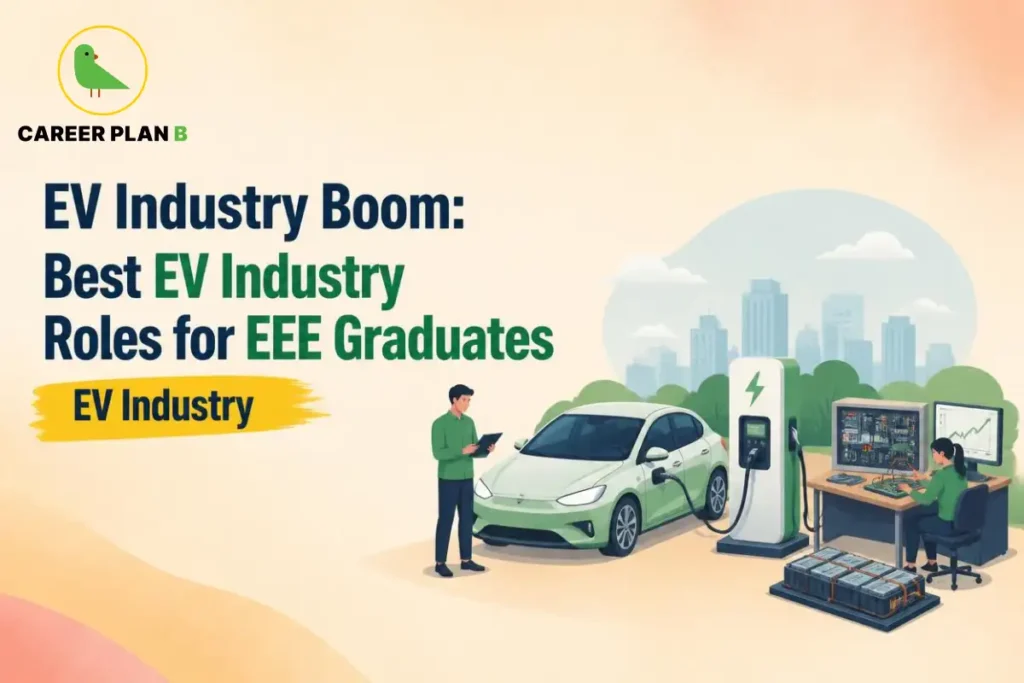
Introduction
India’s roads are going electric and faster than most people expected.
In 2023, India crossed 1.5 million electric vehicle registrations in a single year. By 2030, the government aims to have 30% of all new vehicle sales be electric. Charging stations are appearing on highways. Two-wheeler and three-wheeler EV companies are raising billion-dollar funding rounds. An entire new industry is being built from the ground up, and it runs entirely on the skills that EEE graduates spend four years developing.
If you have a degree in Electrical and Electronics Engineering and you are wondering where your career is headed, the answer may very well be the EV industry.
EV industry roles for EEE graduates are multiplying at a pace that few other engineering sectors can match right now. This blog breaks down exactly which roles are available, what skills you need, and how to position yourself for a strong start in this booming field.
Why the EV Boom Is a Golden Opportunity for EEE Graduates
The electric vehicle is, at its core, an electrical engineering product. Unlike a conventional car that runs on a combustion engine managed largely by mechanical systems, an EV is powered by batteries, controlled by power electronics, driven by electric motors, and monitored by sophisticated embedded software. Every one of those systems sits squarely within the EEE curriculum.
This is why EEE graduate jobs in the EV sector are not just available; they are genuinely well-suited to what these graduates already know.
India’s policy environment is making things even more favourable. The government launched the FAME II scheme, Faster Adoption and Manufacturing of Electric Vehicles, to provide direct subsidies and push EV adoption across segments. Additionally, the Production Linked Incentive scheme for Advanced Chemistry Cell Battery Storage is incentivising domestic battery manufacturing, creating an entirely new industrial ecosystem that will need thousands of electrical engineers.
The result is a job market that is growing faster than the talent supply, which is very good news if you are an EEE graduate entering the workforce today.
Best EV Industry Roles for EEE Graduates
Battery Management System Engineer
The battery pack is the most critical and expensive component of any electric vehicle. A Battery Management System engineer designs and develops the electronics and algorithms that monitor cell voltage, temperature, state of charge, and state of health across hundreds of individual battery cells. This is one of the highest-demand EV industry roles for EEE graduates because it combines power electronics, embedded systems, and thermal management all core EEE subjects.
Entry-level BMS engineers at Indian EV startups and established players typically earn between ₹5–8 LPA, with senior roles going significantly higher.
Power Electronics Engineer
Power electronics in electric vehicles is what converts, controls, and delivers electrical energy throughout the vehicle. The inverter that drives the motor, the onboard charger that converts AC to DC, and the DC-DC converter that powers auxiliary systems all of these are designed by power electronics engineers. For an EEE graduate with strong fundamentals in machines and power converters, this is a natural fit.
EV Charging Infrastructure Engineer
EV charging infrastructure jobs are growing rapidly as India builds out its public and private charging networks. The government’s Bureau of Energy Efficiency is actively driving charging infrastructure standards and deployment targets. Engineers in this space design charging stations, work on grid integration, and ensure safety and interoperability standards are met. This role also connects strongly with the power distribution sector, giving EEE graduates a wide career runway.
Motor Drive and Control Engineer
Electric motors and their drive systems are the mechanical heart of every EV. A Motor Drive and control engineer designs the control algorithms and hardware that translate driver input into precise motor torque and speed. This role requires deep knowledge of electrical machines, control systems, and signal processing, all of which are standard in the EEE curriculum.
Vehicle Electrical Systems Design Engineer
Every wire harness, fuse box, sensor circuit, and lighting system in an electric vehicle needs to be carefully designed and validated. A career in electric vehicle engineering in this stream is essentially a specialised version of the electrical systems design work done in construction or aerospace applied to automotive platforms. EEE graduates with an interest in CAD tools and system-level thinking do particularly well here.
Energy Storage and Grid Integration Engineer
Beyond vehicles, the EV revolution is transforming how energy is stored and distributed. Vehicle-to-grid technology, second-life battery applications, and large-scale battery energy storage systems are all emerging fields that fall under electrical engineering in the automobile industry and energy sectors combined. The Ministry of New and Renewable Energy is actively funding projects in this space, creating opportunities in both private companies and government organisations.
Top Companies and PSUs Hiring EEE Graduates in the EV Sector
The EV hiring landscape in India spans private startups, large automotive groups, and public sector undertakings.
On the private side, companies like Tata Motors EV division, Ola Electric, Ather Energy, Mahindra Electric, and Hero Electric are actively hiring across all EV engineering roles. Battery cell manufacturers like Amara Raja and Exide are also expanding their EV-focused R&D teams.
On the public sector side, BHEL is developing indigenous EV powertrain components and is hiring electrical engineers for this work. NTPC has set up an EV charging network and is expanding into energy storage. BEL is working on EV-related defence and civil applications.
For EEE graduates interested in electric vehicle career opportunities in India across both private and government sectors, the options are broader today than they have ever been.
Salary benchmarks as of 2024:
- Entry level (0–2 years): ₹4.5–8 LPA
- Mid-level (3–6 years): ₹10–18 LPA
- Senior level (7+ years): ₹20–35 LPA and above, especially in product companies
Have Any Doubts?
What Skills Do EEE Graduates Need to Break Into the EV Industry?
Having the degree is the starting point. What separates candidates who land strong EV roles from those who struggle to break in is a combination of technical depth and practical exposure.
Technical skills that matter most:
- Power electronics design converters, inverters, motor drives
- Battery chemistry basics and BMS design principles
- Embedded C programming and microcontroller familiarity
- MATLAB and Simulink for system modelling and simulation
- CAN bus and automotive communication protocols
- PCB design tools like Altium or KiCad
Certifications worth pursuing:
- NPTEL courses on Electric Vehicles and Power Electronics free, government-backed, and industry-recognised
- Courses on battery management and EV powertrains from platforms with AICTE-recognised content
Soft skills that employers look for:
- Ability to work across mechanical, software, and electrical teams simultaneously
- Problem-solving under tight development timelines
- Clear technical documentation and communication
The National Skill Development Corporation also lists EV-related skill programmes under its sectoral focus areas, which can supplement your engineering degree with structured, industry-aligned training.
How Career Plan B Helps
Figuring out which EV role suits your specific strengths, whether that is BMS engineering, power electronics, or charging infrastructure, is not always obvious. Career Plan B offers PsycheIntel Career Assessment Tests and Personalised Career Counselling to help EEE graduates identify the right career stream within the EV industry. Their Career Roadmapping service then lays out a step-by-step plan to help you build the skills, certifications, and experiences that will get you there.
For Latest Information
Frequently Asked Questions (FAQs)
Q1. Are EV industry roles for EEE graduates available at the fresher level?
Yes. Many EV companies in India actively hire fresh EEE graduates for roles in BMS, power electronics, and vehicle electrical systems. Having hands-on project experience or NPTEL certifications in relevant topics significantly improves your chances.
Q2. Is a specialisation or M.Tech required to work in the EV sector?
Not necessarily. A B.Tech in EEE is sufficient for most entry and mid-level roles. However, an M.Tech in Power Electronics or Control Systems can open doors to core R&D positions at companies and research institutes like IITs or CSIR labs.
Q3. What is the difference between working in EV at a start-up versus a PSU?
Startups typically offer faster learning, broader exposure, and performance-linked compensation. PSUs like BHEL or NTPC offer stability, structured growth, and strong benefits. The right choice depends on your personal career priorities.
Q4. How important is software knowledge for EEE graduates in the EV industry?
Very important. Most EV roles require at least working knowledge of MATLAB/Simulink for simulation and embedded C for firmware. Graduates with both hardware and software skills are significantly more employable in this sector.
Q5. Where can I find official information on India’s EV policy and schemes?
The Ministry of Heavy Industries is the primary government body overseeing EV policy in India. The Bureau of Energy Efficiency manages charging infrastructure standards. Both sites carry up-to-date scheme details and notifications.
Conclusion
The electric vehicle revolution is not a future trend; it is happening right now, on Indian roads, in Indian factories, and in the hiring plans of Indian and global companies setting up operations here.
For EEE graduates, this moment is genuinely rare. The skills you built during your degree in power electronics, electrical machines, control systems, and embedded fundamentals are precisely what the EV industry needs most. The roles are well-paying, intellectually challenging, and connected to work that will shape how an entire country moves.
The question is not whether there are opportunities. The question is whether you are positioning yourself to grab them.
Start by understanding which EV role aligns with your strengths. Visit Career Plan B to take a career assessment and get personalised guidance on building your career in the EV industry.