Team Career Plan B · July 20, 2026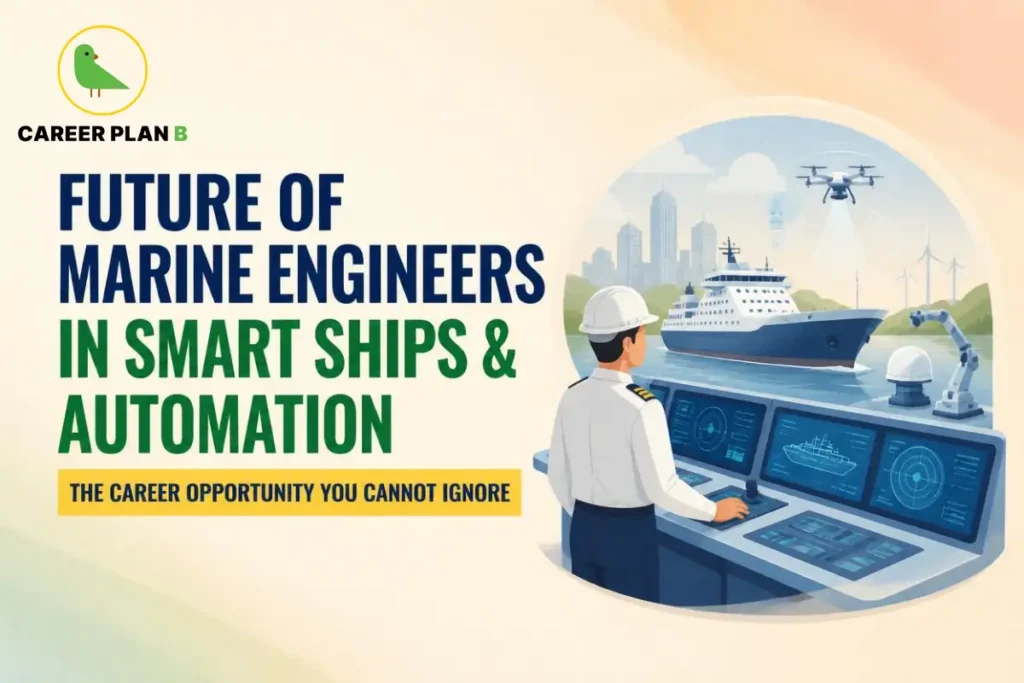
Introduction
A cargo ship crossing the ocean with barely anyone touching the controls sounds like science fiction. It isn’t anymore. This is exactly why so many students and working professionals are asking about the future of marine engineers in smart ships & automation and whether there’s still a place for them on board a vessel that can practically sail itself. Here’s the short answer: The role isn’t disappearing; it’s transforming. Ships are getting smarter, yes, but someone still has to design, monitor, maintain, and troubleshoot the systems that make them smart in the first place. This blog walks through what smart ships actually are, how much of the marine engineer’s job is really changing, which new skills matter most, and where the fresh opportunities in this field are opening up.
What Exactly Are Smart Ships?
A smart ship isn’t just a vessel with better wifi. It’s a vessel wired with sensors, onboard computers, and communication systems that constantly track engine health, fuel efficiency, weather conditions, and navigation data in real time. This is the backbone of smart ship technology: a network of connected systems that talk to each other and, increasingly, to shore-based control centres, too. Some of these ships can already handle basic navigation decisions on their own, adjusting course or speed without a human giving the command. Others rely on remote monitoring, where engineers sitting in an office thousands of kilometres away can check engine performance or flag a fault before it becomes a breakdown at sea. This is digitalization in the maritime industry in action, and it’s moving faster than most people outside the field realize.
Is Automation Replacing Marine Engineers?
It’s the question everyone eventually asks, and it’s a fair one. But automation in shipping doesn’t remove the need for marine engineers; it changes what they spend their time doing.
Sensors can detect a rise in engine temperature. They cannot decide, on their own, whether that rise is a minor fluctuation or the start of a serious mechanical failure. That judgement call still belongs to a trained engineer Marine Engineers in Smart Ships. Automation in shipping industry contexts tends to handle repetitive monitoring and data collection well, but it still struggles with the messy, unpredictable situations that come up at sea: a sudden storm, an unusual vibration, or a system glitch that doesn’t match any programmed scenario.
In fact, regulation is catching up to this reality rather than assuming machines can run the show unsupervised. The International Maritime Organization adopted its first global safety code for autonomous vessels in May 2026, and this framework still places strong emphasis on risk assessment and keeping trained personnel involved in remote operations centres, even as ships gain more independence. So rather than replacing engineers, this shift is redefining where and how they work.
How the Marine Engineer’s Role Is Shifting
Traditionally, a marine engineer’s day revolved around hands-on repair work, fixing engines, checking valves, and physically inspecting machinery. That hasn’t disappeared, but a growing share of the job now involves reading data dashboards, interpreting sensor alerts, and making decisions based on information rather than direct physical inspection alone. There’s also a new layer to the job that didn’t exist a decade ago: cybersecurity awareness. When a ship’s systems are connected to onboard networks and shore-based servers, they become vulnerable to the same kind of digital threats that affect any connected system. A marine engineer today needs at least a working understanding of how to spot and respond to a cyber incident, not just a mechanical one. This blend of mechanical know-how and digital literacy is quickly becoming the norm rather than the exception in autonomous vessels and connected fleets.
New Skills Marine Engineers Will Need
To stay relevant in this shifting landscape, a few specific skills are becoming genuinely important:
- Data interpretation and familiarity with ship monitoring software
- Basic cybersecurity awareness for connected onboard systems
- Understanding of automation and control systems, not just traditional mechanical engineering
- Remote troubleshooting and communication skills for shore-based coordination
- Adaptability to new international safety regulations around autonomous operations
These aren’t replacements for core engineering knowledge; they’re additions to it, layered on top of the fundamentals every marine engineer still needs.
Have Any Doubts?
Career Scope: Where Are the New Opportunities?
The most exciting part of this shift is that it’s opening up entirely new categories of work. Shore-based remote monitoring centres are hiring marine engineers to track vessel performance from land rather than sea, which appeals to those who want the technical work without months away from home. Autonomous ship operators and maritime tech companies are also on the lookout for engineers who understand both ships and software, a combination that’s still fairly rare. For students weighing this as a long-term path, this points to real strength in maritime technology jobs, not because ships need fewer engineers, but because they need engineers who can bridge mechanical expertise with digital systems. The marine engineering career future looks less like a single fixed job title and more like a widening set of specializations within the same core profession.
How Career Plan B Helps
Not sure whether a future built around smart ships and automation is the right direction for you? Career Plan B offers personalized career counselling and PsycheIntel assessment tests to help you understand where your strengths genuinely lie. Their academic profile guidance and career roadmapping can help you plan a path that keeps pace with where maritime technology is actually heading.
For Latest Information
Frequently Asked Questions
- Will marine engineers become obsolete because of automation?
Not likely. Automation changes daily tasks, but trained engineers are still needed to interpret data, handle unexpected situations, and manage systems that machines alone can’t fully judg
- Do I need coding skills to work with smart ships?
Basic familiarity with data systems and software helps a lot, though you don’t need to be a full-fledged programmer. Understanding how these systems work is more important than writing code yourself.
- Are fully autonomous ships already in commercial use?
Not widely yet. Most current systems still involve remote operation centres and human oversight, and international safety regulation continues to evolve alongside the technology.
- What’s the difference between automation and full autonomy in shipping?
Automation typically means machines assist with specific tasks while humans stay in control. Full autonomy means the vessel makes decisions independently, with far less direct human involvement.
- Is shore-based work a real career option for marine engineers now?
Yes. Remote monitoring centres and maritime tech companies increasingly need marine engineers who understand vessel systems, even without spending time at sea.
Conclusion
Smart ships aren’t erasing the need for marine engineers; they’re reshaping what the job looks like day to day. The engineers who thrive in this shift will be the ones who pair strong mechanical fundamentals with comfort around data, automation, and digital systems. If you’re planning a career in this space, now is the time to start building both sets of skills rather than choosing one over the other. The ships of the future may run smarter, but they’ll still need people smart enough to keep them running right.