Team Career Plan B · July 20, 2026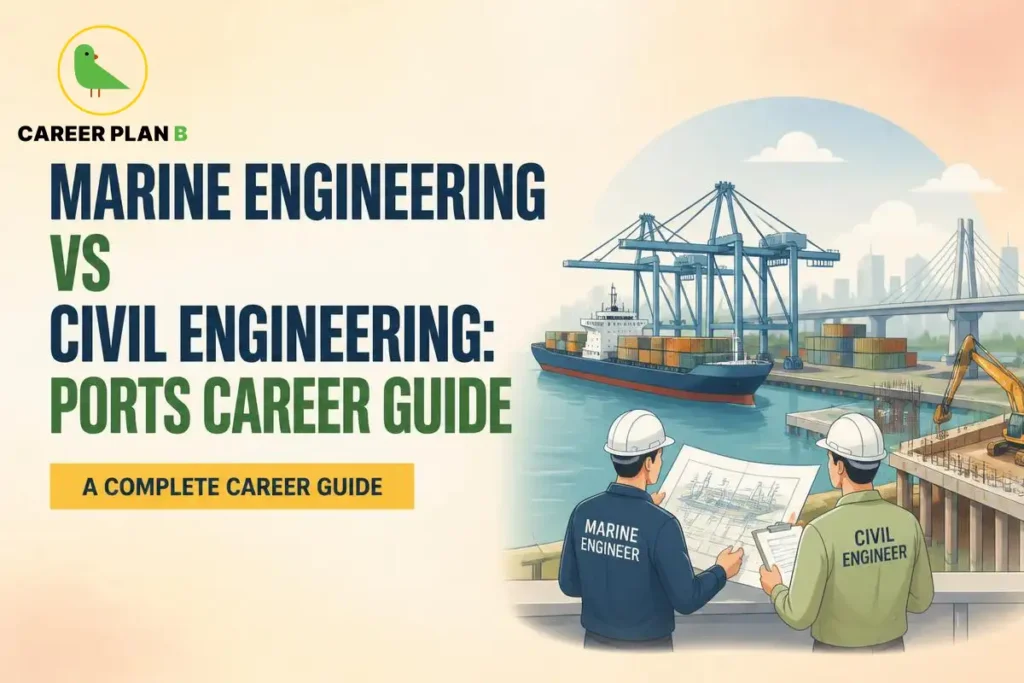
Introduction
Every time a massive container ship glides into a harbour and docks without a hitch, two very different kinds of engineers deserve the credit. This is the heart of the marine engineering vs civil engineering debate that trips up so many students eyeing a career in maritime infrastructure. A modern port is not one machine. It’s two worlds stitched together: the moving world of ships and the fixed world of concrete, steel, and land. One field keeps vessels running smoothly at sea. The other builds the ground they dock on. Confuse the two, and you might end up in a college seat that doesn’t match what you actually pictured yourself doing.
By the end of this blog, you’ll know exactly what separates these two paths: the day-to-day work, the skills each demands, the courses to pursue, and where the money and job security tend to land. Whether you’re weighing this as your engineering career after 12th or considering a lateral switch, this comparison should make your decision a lot clearer.
What Does a Marine Engineer Do in Port Development?
Picture the engine room of a massive cargo ship that’s a marine engineer’s territory. Their job isn’t really about the port structure itself. It’s about everything that moves.
Marine engineers handle the following:
- Ship propulsion systems, engines, and onboard machinery
- Dredgers and specialized floating equipment used to deepen and maintain port channels
- Cargo-handling systems installed on vessels
- Maintenance of tugboats, pilot boats, and other harbour craft
- Safety systems for fuel, ballast, and cooling operations aboard ships
In short, if it has an engine and it floats, a marine engineer is likely involved in keeping it running. Their work in port development careers often centres on the vessels that use the port, not the port’s physical foundation.
What Does a Civil Engineer Do in Port Development?
Now flip the picture. A civil engineer isn’t thinking about what floats; they’re thinking about what stands still and takes the weight.
Civil engineering in ports covers the following:
- Designing and constructing docks, jetties, and berths
- Building breakwaters that shield harbours from rough seas
- Planning terminal buildings, warehouses, and storage yards
- Laying out road and rail connectivity within the port
- Soil testing and foundation work for waterfront structures
Civil engineers essentially create the stage on which the entire port operates. Without their port infrastructure engineering work, there’d be no solid ground for cranes, containers, or ships to dock against in the first place.
Marine Engineering vs Civil Engineering: Key Differences
Here’s a side-by-side look to make the difference between marine and civil engineering crystal clear:
| Aspect | Marine Engineering | Civil Engineering |
|---|---|---|
| Core Focus | Ships, machinery, propulsion | Structures, land, foundations |
| Work Environment | Onboard vessels, engine rooms, dry docks | Construction sites, design offices |
| Core Subjects | Thermodynamics, fluid mechanics, naval systems | Structural design, geotechnics, surveying |
| Typical Employers | Shipping companies, navies, marine consultancies | Port authorities, infrastructure firms, government bodies |
| Physical Setting | Frequently at sea or aboard ships | Mostly land-based, occasional coastal sites |
Which Skills Matter More: Technical or Structural?
Is one field harder than the other? Not really, they just demand different muscles.
Marine engineers need strong technical instincts. They troubleshoot machinery under pressure, often in confined spaces, and need to think on their feet when equipment fails mid-voyage. Civil engineers, meanwhile, lean on structural judgement, calculating loads, understanding soil behaviour, and designing for decades of wear from waves, salt, and weight. There’s overlap too. Both fields require a solid grip on physics, problem-solving under constraints, and comfort working in demanding, often unpredictable environments. If you enjoy hands-on mechanical work, marine engineering might suit you better. If you enjoy planning large-scale, permanent structures, civil engineering could be the stronger fit.
Education Path Courses, Eligibility, Entrance Exams
For marine engineering courses, admission in India typically runs through the Indian Maritime University Common Entrance Test (IMUCET). The Indian Maritime University, a central university under the Ministry of Ports, Shipping and Waterways, offers B.Tech. programmes in Marine Engineering across its campuses. Civil engineering, on the other hand, is widely available through JEE Main and state-level engineering entrance exams, with specializations in structural or geotechnical engineering useful for a career in maritime infrastructure. Students interested in the coastal and harbour engineering side of civil work can also explore research conducted by the Central Water and Power Research Station (CWPRS), Pune, a government institute under the Ministry of Jal Shakti that specializes in port and harbour hydraulic studies. For broader policy and sector information on India’s ports, the Ministry of Ports, Shipping and Waterways.
Have Any Doubts?
Career Scope and Salary Comparison in Port Industry
Both fields hold strong demand, but the nature of that demand differs.
Marine engineers are pulled toward shipping companies, offshore oil rigs, navies, and marine consultancies, often with the opportunity to work internationally aboard vessels. Starting salaries can be attractive, especially with sea-time experience, though the lifestyle involves long stretches away from home. Civil engineers working in port infrastructure engineering typically find roles with port trusts, government infrastructure bodies, EPC contractors, and consultancy firms. The pace is usually more land-based and stable, with growth tied to large-scale port expansion projects, something India has been investing in heavily as trade volumes grow.
How Career Plan B Helps
Choosing between marine and civil engineering isn’t just about salaries; it’s about matching your strengths to the right path. Career Plan B offers personalized career counselling and PsycheIntel career assessment tests to help you understand which field truly fits your aptitude. Their admission guidance and career roadmapping support make navigating [engineering entrance exams] and college selection far less overwhelming.
For Latest Information
Frequently Asked Questions
- Which is better paying: marine or civil engineering?
It depends on the role and employer. Marine engineers with sea time often earn more early on, but civil engineers in senior infrastructure roles can catch up over time.
- Can I switch from civil to marine engineering later?
It’s uncommon and usually requires additional certification, since marine engineering has specific sea service and licensing requirements.
3. Do I need to know swimming for marine engineering?
While not always mandatory for admission, basic swimming and sea-safety training are usually part of onboard certification requirements.
- Which field has more job stability in ports?
Civil engineering roles tied to government port projects tend to offer steadier, land-based stability, while marine engineering offers strong pay but more time away at sea.
- Is civil engineering enough to work in port development, or do I need a specialization?
A specialization in structural, geotechnical, or coastal engineering gives a meaningful edge for civil engineering in ports’ roles.
- What’s the biggest misconception about these two fields?
Many assume both fields do similar work simply because they’re both linked to “ports”. In reality, one is about moving vessels and the other about fixed structures.
Conclusion
At the end of the day, a thriving port needs both worlds: the marine engineers keeping ships running and the civil engineers building the ground beneath them. Neither path is “better”; they simply serve different purposes in the same larger picture of port development careers. If you’re still unsure which suits you, don’t guess your way into a five-year degree. Talk to a career counsellor, take an aptitude assessment, and map out your options before committing. Because whichever path you choose, the ports of tomorrow will need people who chose it for the right reasons, not just because it sounded impressive on a form.