Team Career Plan B · July 14, 2026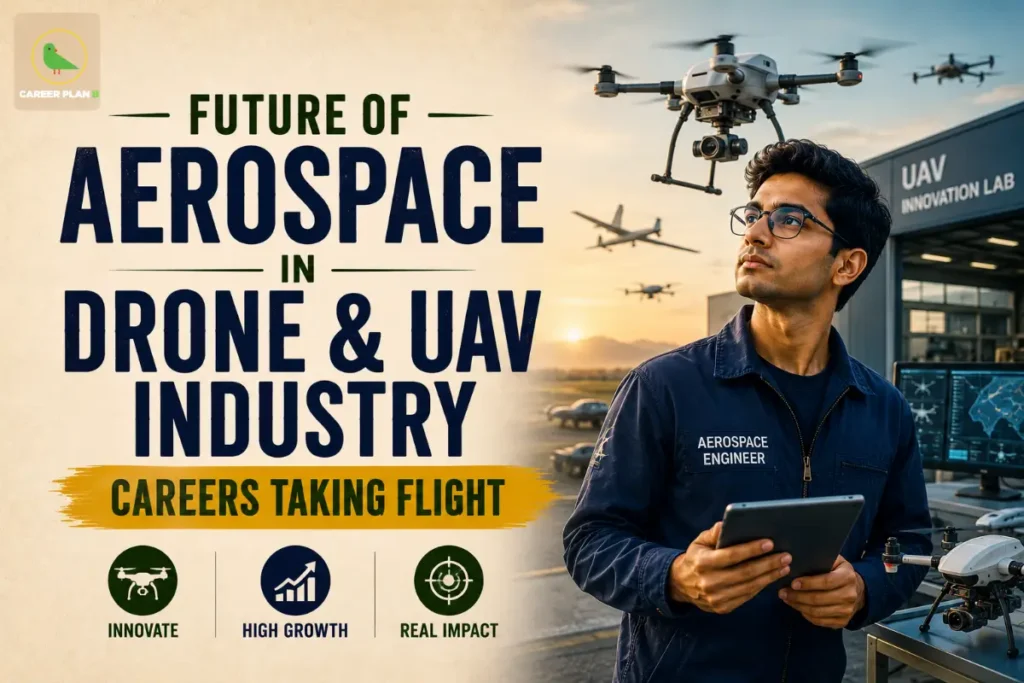
Introduction
Drones are no longer just gadgets for hobbyists. They’re transforming agriculture, logistics, defence, and disaster management across India. The future of aerospace in the drone and UAV industry is one of the most exciting developments in engineering today, blending traditional aircraft design principles with cutting-edge automation and AI. With supportive government policies and rapid market growth, this sector is creating entirely new categories of jobs.
In this blog, we’ll explore how the UAV industry in India is evolving, the career opportunities it offers, and what skills you need to build a future in this fast-growing field.
Why Drones Are Reshaping the Aerospace Industry
India’s drone sector has grown rapidly following regulatory reforms that simplified drone operations and manufacturing. The government’s Production Linked Incentive (PLI) scheme for drones has encouraged domestic manufacturing, while defence forces increasingly rely on UAVs for surveillance and tactical operations. Beyond defence, drones are now widely used in agriculture, infrastructure inspection, and last-mile delivery, making this one of the fastest-growing segments within aerospace.
What Is the UAV Industry, and Where Does Aerospace Fit In?
The UAV industry encompasses the design, manufacturing, and operation of unmanned aerial vehicles, ranging from small commercial drones to sophisticated military-grade systems. Aerospace engineering for drones draws heavily on traditional aircraft design principles, aerodynamics, propulsion, and structural engineering, but also incorporates robotics, embedded systems, and autonomous navigation, making it a genuinely interdisciplinary field.
Key Growth Drivers for the UAV Industry in India
Several factors are fuelling this expansion. Defense modernization has increased demand for surveillance and combat drones, while agricultural applications like crop monitoring and pesticide spraying have opened a massive commercial market. Logistics companies are exploring drone delivery for remote areas, and the government’s PLI scheme for drone manufacturing has incentivized domestic production, reducing reliance on imported UAV technology. Information on policy and incentive schemes is available through the Department for Promotion of Industry and Internal Trade.
Career Opportunities in the Drone and UAV Industry
Drone Design and Aerospace Engineer
These engineers apply core aerospace engineering principles, aerodynamics, structures, and propulsion, specifically to drone airframes, ensuring stability, efficiency, and payload capacity.
UAV Systems/Avionics Engineer
This role focuses on the electronic systems that power navigation, communication, and flight control in drones, similar to avionics work in traditional aircraft but adapted for smaller, often autonomous platforms.
Drone Software and Autonomy Engineer
As drones become more autonomous, software engineers who specialize in navigation algorithms, AI-based obstacle avoidance, and flight automation are increasingly in demand.
Drone Manufacturing and Testing Engineer
These engineers oversee the production process and conduct rigorous testing to ensure drones meet safety and performance standards before deployment.
Drone Pilot/Operations Specialist
Beyond engineering roles, drone pilot and engineering jobs in India also include certified drone operators who manage flight operations for agriculture, surveying, and commercial applications.
Top Organizations and Sectors Hiring
| Organization/Sector | Focus Area |
|---|---|
| DRDO | Defense and military-grade drone projects |
| Private Drone Manufacturers | Commercial and agricultural drones |
| Agri-tech Companies | Crop monitoring and precision farming drones |
| Logistics Companies | Delivery drone development and testing |
| Defense Contractors | UAV components and systems integration |
DRDO drone projects continue to drive significant innovation in this space, particularly for surveillance and tactical applications. Details on ongoing initiatives are available at DRDO.
Salary Trends in the Drone and UAV Industry
| Career Stage | Estimated Annual Salary |
|---|---|
| Entry-level (0–2 yrs) | ₹4–7 LPA |
| Mid-level (3–7 yrs) | ₹8–15 LPA |
| Senior-level (8+ yrs) | ₹16–26 LPA |
These figures vary depending on whether you’re working in defence, commercial, or agricultural drone applications, with defence-focused roles often offering higher compensation due to specialization requirements.
Have Any Doubts?
Skills You Need to Build a Career in This Field
- Strong foundation in aerodynamics and structural design
- Programming skills, especially in Python or C++ for autonomy systems
- Familiarity with sensors, GPS, and navigation systems
- Understanding of drone regulations and airspace management
- CAD and simulation software proficiency
- For drone pilot roles, certification through the Digital Sky platform under the Ministry of Civil Aviation
For drone operation regulations and certification details, refer to Digital Sky. For academic eligibility and programme accreditation, check AICTE. Entry into specialized postgraduate programmes typically requires GATE qualification, with details on the official GATE portal.
What Does the Future Hold?
Will drones eventually become as common as smartphones in commercial and defence applications? All signs point to yes. With continued government support through the PLI scheme, growing defence investment, and expanding commercial applications, drone manufacturing in India is positioned for sustained long-term growth. Export potential is also rising, as Indian-made drones gain traction internationally, creating even more opportunities for engineers and operators in this field.
How Career Plan B Helps
Wondering whether a career in drones and UAV technology suits your interests? Career Plan B‘s PsycheIntel assessment helps students explore careers in the UAV and drone industry by identifying their strengths in engineering, automation, and design. With personalized career counselling and academic profile guidance, Career Plan B helps you build a clear roadmap toward this fast-growing field.
For Latest Information
Frequently Asked Questions
- Is the drone and UAV industry a good career option in India?
Yes, with strong government support and growing applications across defence, agriculture, and logistics, this is one of the fastest-growing segments in aerospace engineering.
- What qualifications are needed to work in the UAV industry?
A degree in aerospace, mechanical, or electronics engineering is typically required, along with specialized skills in robotics, programming, or avionics depending on the role.
- Do I need a license to operate a drone professionally in India?
Yes, commercial drone operation requires registration and certification through the Digital Sky platform under the Ministry of Civil Aviation.
- Which sector offers better pay: defence or commercial drone roles?
Defence-focused drone roles, particularly those involving DRDO projects, generally offer higher compensation due to specialization and security clearance requirements.
- How is the government supporting the drone manufacturing industry?
The PLI scheme for drones, managed under the Department for Promotion of Industry and Internal Trade, incentivizes domestic drone manufacturing and reduces dependence on imports.
Conclusion
The future of aerospace in the drone and UAV industry is bright, driven by defence modernisation, agricultural innovation, and supportive government policy. Whether you’re interested in design, software, manufacturing, or operations, this field offers diverse and growing career paths. If you’re ready to explore whether this exciting field matches your strengths, start with Career Plan B‘s personalized career assessment today.