Team5 · July 30, 2026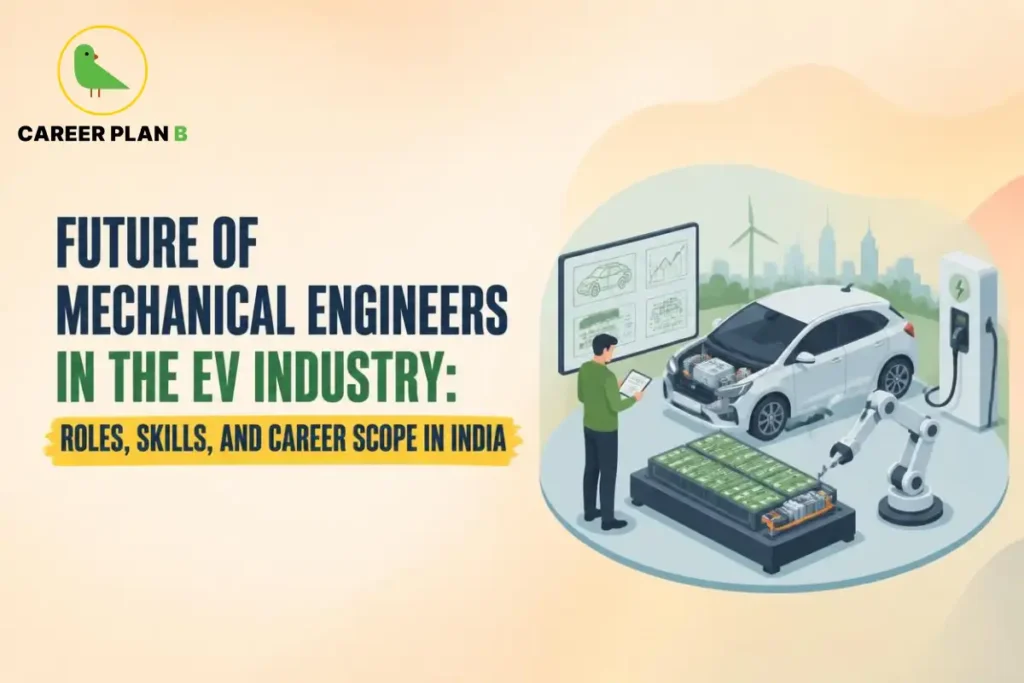
Introduction
Stand on any major Indian road today and count the electric vehicles passing by. Five years ago, that number would have been close to zero. Today, India is one of the fastest-growing EV markets in the world. By 2030, the Government of India aims for electric vehicles to account for a significant share of new sales across two-wheelers, three-wheelers, and passenger cars.
This transformation is changing more than what people drive. It is reshaping the Future of Mechanical Engineers in the EV Industry. It is also redefining the skills, roles, and specialisations that matter most in automotive and manufacturing engineering careers.
Some engineers worry that electrification will make mechanical engineering less relevant. They assume EVs rely mainly on batteries, motors, and software, leaving little room for traditional mechanical expertise. That concern is understandable but misplaced. In reality, electric vehicles are among the most mechanically complex products ever built. They require advanced thermal management, precision structural engineering, lightweight materials, sophisticated drivetrain design, and world-class manufacturing. All of these are core mechanical engineering disciplines.
In this blog, we explain what the EV opportunity looks like for mechanical engineers in India. We cover career opportunities, key skills, top employers, salary ranges, and practical ways to prepare for this rapidly growing industry.
Why the EV Industry Is a Game-Changer for Mechanical Engineers
The shift from internal combustion engine (ICE) vehicles to electric vehicles (EVs) is the biggest structural change in the automotive industry in more than a century. For mechanical engineers, it is both a disruption and an extraordinary opportunity. The outcome depends on how well they prepare for this transition.
In a traditional ICE vehicle, mechanical engineers focus on engine design, fuel systems, exhaust management, and transmission. In an EV, electric motors, battery packs, power electronics, and regenerative braking systems replace these components. However, most of a vehicle’s mechanical systems remain unchanged or become even more important. Chassis design, suspension, body structure, thermal management, aerodynamics, and manufacturing processes still rely on strong mechanical engineering expertise.
What makes the EV industry a game-changer is not that it eliminates mechanical engineering. Instead, it introduces new layers of complexity. These challenges require engineers who can combine traditional mechanical knowledge with emerging EV technologies.
The Government of India’s FAME II (Faster Adoption and Manufacturing of Electric Vehicles) scheme, administered by the Ministry of Heavy Industries, has allocated over ₹10,000 crore to accelerate EV adoption. This investment is driving new manufacturing facilities, increased hiring, and larger R&D budgets across India’s EV ecosystem. As a result, EV manufacturing jobs for engineers in India are expected to grow steadily throughout the decade.
Key Job Roles for Mechanical Engineers in the EV Industry
Understanding the specific roles available is the first step to planning your mechanical engineering career in electric vehicles India. Here is a detailed breakdown of the most in-demand positions:
Battery Pack Design and Thermal Management Engineer
This is one of the most critical and fastest-growing roles in the entire EV sector. Battery packs are the heart of any electric vehicle, and managing their thermal performance is a complex mechanical engineering challenge. These engineers design the structural housing of battery modules, develop cooling systemsliquid cooling plates, heat pipes, and thermal interface materialsand ensure that the battery pack maintains safe and optimal operating temperatures under all driving conditions.
Battery and powertrain engineering careers India are growing at an exceptional pace, with companies like Tata Motors, Ola Electric, and Ather Energy investing heavily in in-house battery engineering teams. This role requires strong foundations in thermodynamics, heat transfer, and material scienceall core mechanical engineering subjects.
EV Powertrain and Drivetrain Engineer
While EVs do not have conventional gearboxes or combustion engines, they do have sophisticated powertrain systems. EV powertrain engineers design and optimise the mechanical integration of electric motors, single-speed reduction gearboxes, differential systems, and driveshafts. They work on efficiency optimisation, noise and vibration reduction, and the mechanical packaging of drivetrain components within the vehicle’s architecture. This role sits at the intersection of mechanical design, dynamics, and electrical systems integration.
Lightweight Structures and Materials Engineer
Range anxietythe fear of running out of battery chargeis one of the biggest challenges in EV design. Every kilogram of vehicle weight reduces range. Lightweight structures and materials engineers work on reducing vehicle weight through advanced materialshigh-strength steel, aluminium alloys, carbon fibre composites, and engineering plasticswithout compromising structural integrity or crash safety. This is a deeply mechanical role that is more important in EV design than it ever was in conventional vehicle engineering.
Vehicle Dynamics and Chassis Engineer
Electric vehicles have very different weight distribution characteristics compared to ICE vehiclesthe battery pack sits low in the floor, creating a low centre of gravity that significantly affects handling and dynamics. Vehicle dynamics engineers in the EV sector work on suspension tuning, steering systems, braking integration with regenerative systems, and overall chassis optimisation for the unique mechanical properties of electric powertrains. This remains one of the most technically demanding and rewarding mechanical engineering roles in the automotive sector.
Manufacturing and Production EngineerEV Lines
As India builds dedicated EV manufacturing facilities, production and manufacturing engineers are needed to design and manage the assembly lines, tooling, and quality systems specific to EV production. This includes battery module assembly, motor installation, high-voltage wiring harness management, and end-of-line testing protocols. EV manufacturing jobs for engineers India are growing rapidly as companies like Tata Motors, Mahindra, and Ola Electric scale their production capacity. This role requires strong knowledge of lean manufacturing, automation, and quality systems.
Mechanical Engineer Skills for the EV Sector
Building the right skill set is the most important investment a mechanical engineer can make to capitalise on the EV opportunity. Here is a breakdown of the mechanical engineer skills for EV sector success:
Core Technical Knowledge to Strengthen
- Thermal Management: Heat transfer, cooling system design, and thermal simulation are essential for battery and powertrain roles
- Structural Analysis and FEA: Finite element analysis for battery enclosures, crash structures, and lightweight components
- CAD and 3D Modelling: SolidWorks, CATIA, and Siemens NX for EV component and system design
- Materials Engineering: Knowledge of lightweight alloys, composites, and battery enclosure materials
- Vehicle Dynamics: Understanding of suspension, braking, and chassis behaviour in EV-specific configurations
- Manufacturing Processes: Familiarity with battery assembly, welding of aluminium structures, and EV-specific production techniques
New Skills to Build for EV Roles
- Battery Management Systems (BMS): Understanding how BMS monitors and controls battery pack performanceeven at a systems levelis increasingly expected of mechanical engineers in battery-adjacent roles
- Electric Motor Basics: Understanding motor typesPMSM, induction motorsand their mechanical integration requirements
- Regenerative Braking Systems: Mechanical integration of regenerative braking with conventional hydraulic braking
- MATLAB and Simulink: For thermal modelling, vehicle dynamics simulation, and system-level EV analysis
- ANSYS Fluent: For CFD-based thermal management simulation of battery packs and power electronics cooling
AICTE-recognised engineering programmes provide the academic foundation for these technical skills. For structured upskilling in EV-specific technologies, NSDC-aligned programmes offer certification courses in electric vehicle technology, battery systems, and EV manufacturing that are industry-recognised and practically focused.
Soft Skills That Matter in EV Roles
- Cross-disciplinary collaboration: EV engineering requires constant coordination between mechanical, electrical, and software teams
- Systems thinking: Understanding how mechanical decisions affect electrical performance and vice versa
- Adaptability: The EV sector moves fasttechnologies, standards, and design approaches change rapidly
- Data-driven problem solving: Using simulation and testing data to make engineering decisions efficiently
Have Any Doubts?
EV Engineer Job Roles and Salary India
Understanding the EV engineer job roles and salary India landscape helps you set realistic expectations and plan your career progression strategically.
Salary Range for Mechanical Engineers in EV Roles India
| Experience Level | Salary Range | Typical Roles |
|---|---|---|
| Fresher (0–2 years) | ₹4 LPA – ₹8 LPA | Graduate Engineer Trainee, Design Engineer |
| Mid-Level (3–6 years) | ₹9 LPA – ₹18 LPA | Senior Design Engineer, Thermal Engineer |
| Senior / Specialist (7+ years) | ₹20 LPA – ₹40 LPA+ | Lead Engineer, Engineering Manager, R&D Head |
EV roles in India currently command a salary premium of approximately 20 to 35 percent over equivalent roles in conventional ICE vehicle engineeringreflecting the acute skill shortage in EV-specific mechanical engineering expertise.
Global EV Salary Comparison
For mechanical engineers working in EV roles abroad, the salary picture is significantly more lucrative:
- United States: $90,000 – $1,50,000 per year (Tesla, Rivian, GM EV, Ford EV divisions)
- Germany: €60,000 – €95,000 per year (BMW EV, Volkswagen ID series, Mercedes EQ)
- United Kingdom: £50,000 – £80,000 per year (Jaguar Land Rover EV, Arrival, LEVC)
- China: RMB 3,00,000 – RMB 6,00,000 per year (BYD, NIO, CATL engineering centres)
This global earning potential makes the FAME scheme and EV career opportunities one of the strongest arguments for mechanical engineers to invest in EV upskilling sooner rather than later.
Electric Vehicle Industry Growth in IndiaThe Opportunity Is Now
The electric vehicle industry growth in India is being driven by a combination of government policy, consumer adoption, and private sector investment that has created a once-in-a-generation engineering career opportunity.
Government Policy Driving EV Growth
- FAME II Scheme: The Faster Adoption and Manufacturing of Electric Vehicles II scheme provides demand incentives for EV buyers and production support for manufacturersdirectly stimulating the market that mechanical engineers will serve
- PLI Scheme for ACC Batteries: The Production Linked Incentive scheme for Advanced Chemistry Cell batteries is attracting battery manufacturing investment into India, creating an entirely new segment of battery engineering jobs
- National Electric Mobility Mission Plan: NITI Aayog’s EV roadmap targets significant EV penetration across vehicle segments by 2030, providing long-term policy certainty for career planning
- PM e-DRIVE Scheme: The government’s latest initiative providing ₹10,900 crore for EV adoption across electric buses, trucks, and two-wheelersfurther expanding the commercial EV market
India’s EV Market Numbers
India’s EV sales have grown dramaticallyfrom under 1 lakh units in 2020 to over 15 lakh units in 2023-24, with projections suggesting continued exponential growth through 2030. This growth directly translates into manufacturing capacity expansion, R&D investment, and engineering hiring across the EV value chain.
Top EV Companies Actively Hiring in India
The leading employers driving EV manufacturing jobs for engineers India include:
- Tata Motors EV Divisionthe market leader in electric passenger vehicles
- Ola Electricbuilding India’s largest EV scooter manufacturing facility
- Ather Energypremium electric two-wheeler company with strong R&D culture
- Mahindra EVrapidly expanding electric SUV portfolio
- Hero Electric and Ampere Vehiclesmass-market electric two-wheelers
- Revolt Motors and Simple Energyperformance-focused EV startups
Top Employers for Mechanical Engineers in India’s EV Sector
Beyond the pure-play EV companies, the employer landscape for mechanical engineers in India’s EV ecosystem is broad and includes established automotive OEMs, Tier-1 suppliers, and global companies expanding their India footprint.
Automotive OEMs
- Tata Motors: Market leader in electric passenger cars with the Nexon EV, Punch EV, and Tiago EVand expanding EV portfolio
- Mahindra and Mahindra: Launching the BE and XEV series of electric SUVs with significant in-house EV engineering
- Hero MotoCorp: Investing in electric two-wheelers with dedicated EV engineering teams
- Bajaj Auto: Chetak electric scooter and expanding EV portfolio
EV Startups
- Ola Electric: Building India’s most ambitious EV manufacturing ecosystem including in-house cell manufacturing
- Ather Energy: Known for its strong engineering culture and R&D investment in premium electric scooters
- Simple Energy: High-performance electric scooter startup with ambitious product roadmap
- Euler Motors: Electric three-wheeler commercial vehicles
Tier-1 Suppliers and Component Manufacturers
- Bosch India: EV powertrain components, battery management systems, and e-axle systems
- Sona BLW Precision Forgings: Differential gears, motor housings, and EV drivetrain components
- Minda Industries: EV-specific switches, sensors, and electrical systems
- Bharat Forge: Lightweight structural components and EV chassis parts
Global EV Companies with India Presence
- BYD India: Chinese EV giant expanding its India manufacturing and engineering operations
- Hyundai and Kia EV divisions: Ioniq and EV6 engineering support centres in India
- Continental India and ZF India: EV systems engineering and development centres
Have Any Doubts?
How to Transition Into EV as a Mechanical Engineer
If you are currently working in conventional automotive or manufacturing engineering and want to move into EV rolesor if you are a student preparing to enter the EV sector directlyhere is a practical upskilling roadmap:
Step 1: Strengthen Your EV Fundamentals Start with a solid understanding of EV architecturehow battery packs, electric motors, power electronics, and control systems work together. Several NSDC-aligned EV technology certification programmes provide structured introductions to EV systems for mechanical engineers.
Step 2: Build Thermal Management Skills Battery thermal management is the most in-demand mechanical engineering skill in the EV sector. Invest in learning ANSYS Fluent for thermal simulation and study heat exchanger design and cooling system engineering in the context of battery packs and power electronics.
Step 3: Learn Lightweight Materials and Design Take focused coursework or self-study in lightweight materialsaluminium alloys, AHSS steel, and composite materialsand understand how they are used in EV body structures, battery enclosures, and structural components.
Step 4: Get Hands-On with EV-Relevant CAD and Simulation Ensure your proficiency in CATIA or SolidWorks is current and focused on EV component design. Add MATLAB/Simulink skills for vehicle dynamics and thermal modelling. FEA skills in ANSYS Structural are highly valued for battery enclosure and crash structure design roles.
Step 5: Target the Right Companies and Roles Use your upskilled profile to target battery engineering, thermal management, powertrain, or EV manufacturing roles at the companies listed above. Entry into an EV startup often provides faster learning curves and broader exposure than a large OEM role.
AICTE-recognised postgraduate programmes in Automotive Engineering or Energy Systems can also provide a structured academic pathway for engineers looking to formalise their EV specialisation.
How Career Plan B Helps
The shift to electric vehicles is creating some of the most exciting mechanical engineering career opportunities India has ever seenbut navigating this transition requires a clear plan, not just enthusiasm. Career Plan B offers personalised career counselling, PsycheIntel Career Assessment Tests, and structured Career Roadmapping to help mechanical engineers identify which EV specialisation suits their strengthswhether thermal management, powertrain design, lightweight structures, or EV manufacturingand build a concrete, step-by-step plan to enter and grow in India’s fast-moving electric vehicle industry.
For Latest Information
Frequently Asked Questions
- Is mechanical engineering still relevant in the EV industry?
Absolutelyand more than ever. The future of mechanical engineers in the EV industry is strong because electric vehicles require advanced thermal management, lightweight structural design, sophisticated drivetrain engineering, and complex manufacturing processesall of which are core mechanical engineering disciplines. The shift from ICE to EV does not reduce the need for mechanical engineers; it changes and expands what they work on.
- What are the best mechanical engineering roles in the EV sector in India?
The most in-demand mechanical engineering roles in India’s EV sector include battery pack design and thermal management engineer, EV powertrain and drivetrain engineer, lightweight structures and materials engineer, vehicle dynamics and chassis engineer, and EV manufacturing and production engineer. Battery and powertrain engineering careers India are currently among the highest-paying and fastest-growing within the broader EV ecosystem.
- How does the FAME II scheme create career opportunities for mechanical engineers?
The FAME scheme and EV career opportunities are directly connected. FAME II’s ₹10,000 crore investment in demand incentives and manufacturing support is accelerating EV adoption across vehicle segments in India. This drives OEMs and startups to expand production capacity and R&D teamswhich translates into direct hiring of mechanical engineers for design, thermal management, manufacturing, and quality roles across the EV value chain.
- What skills should a mechanical engineer build to get into EV roles?
The most important mechanical engineer skills for EV sector roles include battery thermal management, FEA and structural analysis for battery enclosures and lightweight components, CAD proficiency in CATIA or SolidWorks, MATLAB and ANSYS simulation skills, and a working understanding of BMS and electric motor mechanical integration. NSDC-aligned EV technology certification programmes and AICTE-recognised postgraduate engineering courses provide structured pathways to build these skills formally.
Conclusion
The future of mechanical engineers in the EV industry is not uncertainit is one of the clearest and most promising career trajectories available to engineering professionals in India today. The electric vehicle revolution is creating roles that demand exactly what mechanical engineers are trained to dodesign complex systems, solve thermal challenges, engineer lightweight structures, and build world-class manufacturing processes.
India’s policy support through FAME II, the PLI scheme, and the National EV Mission is ensuring that this opportunity is not a short-term trend but a decade-long structural shift. The engineers who upskill now, build EV-relevant expertise, and position themselves in this ecosystem early will be the ones who define the next generation of Indian automotive engineering.
If you are a mechanical engineer trying to figure out where you fit in this EV revolution and how to get there, Career Plan B can help with personalised assessments, expert career counselling, and a roadmap built around your strengths, your goals, and the real demands of India’s fast-growing electric vehicle industry.
The roads are going electric. Make sure your career is ready for the ride.