Team6 · July 15, 2026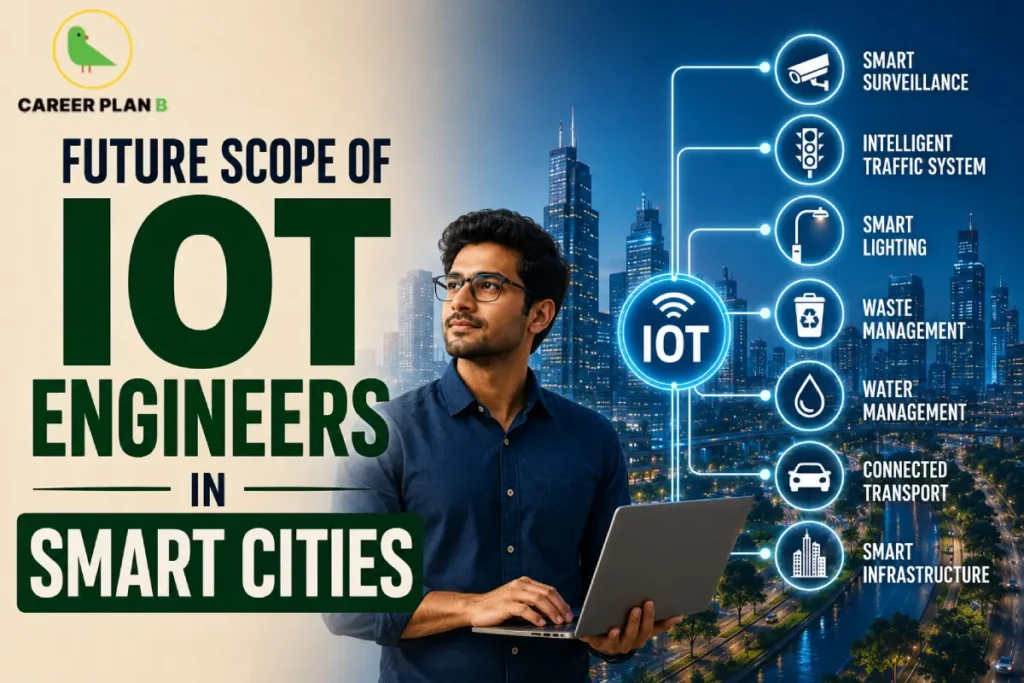
Introduction
Imagine a city that talks to you, traffic lights that adjust in real time based on congestion and waste bins that automatically alert collectors when they are full. Streetlights that dim when no one is around and brighten the moment they detect movement. Water pipelines that flag leaks before they become floods. This is not science fiction; this is the smart city, and it is being built right now by IoT engineers.
The future scope of IoT engineers in smart cities is not just promising; it is transformative. As urban populations grow and governments worldwide race to make cities more efficient, sustainable, and liveable, the professionals who connect physical infrastructure to intelligent digital systems are becoming indispensable.
The global smart city market was valued at approximately $511 billion in 2022 and is projected to exceed $2.5 trillion by 2030, according to data referenced by the International Telecommunication Union. At the heart of every smart city system, every sensor, every connected device, and every data pipeline is an IoT engineer.
In this blog, we explore what this career looks like inside a smart city, which skills matter most, what opportunities exist in India and globally, and how you can position yourself to be part of this urban revolution.
What Is a Smart City and Why Does It Need IoT Engineers?
A smart city uses digital technology, data, and connected infrastructure to improve the quality of life for its residents, optimise the use of resources, and enhance the efficiency of urban services. The backbone of every smart city is IoT in smart city infrastructure: the network of sensors, devices, and communication systems that collect and exchange real-time data across the city.
IoT engineers are the professionals who design and deploy this backbone. They decide how a traffic sensor communicates with a central traffic management system, how a smart electricity grid monitors and balances loads across neighbourhoods, and how emergency services receive real-time alerts from connected public safety systems.
Without IoT engineers, a smart city is just a city with expensive hardware sitting idle. Real-world examples of IoT-powered smart city systems already in operation include:
- Adaptive traffic signal control systems that reduce commute times
- Smart parking systems that guide drivers to available spots in real time
- Environmental monitoring networks that track air quality and noise levels
- Integrated command and control centres that manage multiple city services from a single dashboard
These Internet of Things urban solutions are not future possibilities; they are active deployments in cities across India and the world today, creating direct and growing demand for skilled IoT engineers.
Key Roles of IoT Engineers in Smart Cities
The IoT applications in smart cities span every department of urban governance. Here is where IoT engineers are making the most significant impact:
Traffic and Mobility Management IoT engineers deploy and manage connected sensors, cameras, and communication systems that feed real-time traffic data to city control centres. Adaptive signal systems, smart highways, and connected public transport networks all rely on IoT engineering expertise.
Energy and Utilities Management Smart grids, connected street lighting, and automated energy monitoring systems reduce waste and lower costs for city governments and residents alike. IoT engineers design the systems that make energy distribution intelligent and responsive.
Public Safety and Surveillance Connected CCTV networks, gunshot detection systems, and emergency response platforms use IoT infrastructure to give law enforcement and emergency services faster, more accurate situational awareness. IoT engineers build and maintain the communication and data layers that keep these systems running.
Water and Waste Management Smart water meters detect leaks and monitor consumption in real time. IoT-enabled waste bins optimise collection routes and reduce unnecessary pickups. Both systems rely on embedded sensors, communication protocols, and cloud-based data management – core competencies of IoT engineers.
Environmental Monitoring Air quality sensors, noise monitors, and climate-tracking devices help city planners make evidence-based decisions about urban development and public health. IoT engineers design and integrate these monitoring networks into city-wide data platforms.
Smart City Projects in India Creating IoT Opportunities
India is one of the world’s fastest-growing smart city markets. As a result, smart city projects in India are creating strong demand for IoT professionals across multiple sectors.
The Government of India’s Smart Cities Mission, launched in 2015, aims to transform 100 cities with smart infrastructure, integrated command and control centres, and citizen-focused digital services. This initiative has already created thousands of IoT-related projects and employment opportunities across participating cities. As more cities adopt connected technologies, the demand for skilled IoT engineers is expected to grow even further.
Cities leading the adoption include the following:
- Surat recognised internationally for its smart traffic and flood monitoring systems
- Pune deploying integrated city management platforms with IoT-powered utilities
- Bhopal implementing smart water and waste management solutions
- Indore leveraging IoT for environmental monitoring and sanitation management
Beyond the Smart Cities Mission, Digital India is accelerating the adoption of digital infrastructure across urban and rural regions. This nationwide initiative is expanding IoT engineer job opportunities far beyond the 100 designated smart cities.
At the same time, the Ministry of Electronics and Information Technology (MeitY) has introduced a National IoT policy framework to strengthen India’s IoT ecosystem. The framework promotes the adoption of IoT across key sectors, including smart cities, healthcare, agriculture, manufacturing, and public services. As government investment continues to grow, the demand for skilled IoT engineers is expected to rise across the country.
Have Any Doubts?
IoT Engineer Skills Required for Smart City Roles
Breaking into smart city technology careers requires a specific blend of technical depth and domain awareness. Here is what employers and city technology departments look for:
Technical Skills
The IoT engineering skills for smart cities go beyond standard IoT development:
- Embedded Systems and Hardware: Proficiency with microcontrollers, sensors, and edge devices, the physical layer of every smart city system
- Networking and Communication Protocols: Deep knowledge of MQTT, LoRaWAN, Zigbee, 5G, and NB-IoT, the communication standards used across smart city infrastructure
- Cloud Platforms and Data Management: Experience with AWS IoT, Microsoft Azure IoT, or Google Cloud IoT for storing, processing, and visualising city-scale data
- Cybersecurity: Smart city systems are high-value targets. IoT engineers must understand how to secure devices, networks, and data against attacks
- Data Analytics and Visualisation: The ability to derive actionable insights from large volumes of sensor data is increasingly expected at mid- and senior levels
Domain Knowledge
- Basic understanding of urban planning, public infrastructure, and government procurement processes
- Familiarity with national digital standards and frameworks set by bodies like MeitY and the Bureau of Indian Standards
- Awareness of smart city project workflows, including vendor management, system integration, and long-term maintenance
IoT Engineer Salary in Smart City Roles
The demand for IoT professionals in smart city projects is reflected in competitive salary packages, particularly for engineers with domain-specific experience:
| Experience Level | India (Per Annum) | Global / USA (Per Annum) |
|---|---|---|
| Entry Level (0–2 years) | ₹4 – ₹7 LPA | $70,000 – $90,000 |
| Mid-level (3–6 years) | ₹8 – ₹18 LPA | $95,000 – $130,000 |
| Senior Level (7+ years) | ₹18 – ₹30 LPA | $135,000 – $175,000+ |
Engineers specialising in cybersecurity for IoT, AIoT integration, or 5G-enabled smart city systems command the highest premiums in the current market.
According to the U.S. Bureau of Labour Statistics, employment in computer and information technology roles, including IoT engineering, is projected to grow 15% through 2032, significantly faster than the national average for all occupations. In India, government investment through the Smart Cities Mission and Digital India continues to drive sustained IoT engineer job opportunities across the public and private sectors.
Future Scope: What Lies Ahead for IoT Engineers in Smart Cities?
The future scope of IoT engineers in smart cities is shaped by three powerful converging trends:
5G-Enabled Smart Infrastructure The rollout of 5G networks is dramatically expanding the capabilities of smart city systems, enabling faster, lower-latency communication between billions of connected devices. India’s Department of Telecommunications (https://dot.gov.in/) is actively rolling out 5G infrastructure nationwide, directly accelerating the deployment of next-generation smart city applications and the demand for IoT professionals who can build on them.
AIoT: Artificial Intelligence Meets IoT The integration of AI with IoT systems is creating self-learning urban infrastructure traffic systems that predict congestion before it forms, energy grids that optimise themselves overnight, and public safety platforms that detect anomalies in real time. IoT engineers who understand both AI and connected hardware will be at the frontier of this evolution.
Edge Computing in Urban Systems As smart cities generate staggering volumes of data, processing it all in centralised cloud servers becomes impractical. Edge computing processing data close to where it is generated is becoming the new standard for smart city architecture. IoT engineers with edge computing expertise are among the most sought-after professionals in this space.
Green and Sustainable City Technology Governments and city planners are increasingly focused on using IoT to reduce carbon emissions, optimise energy use, and build climate-resilient infrastructure. This sustainability mandate is opening up entirely new categories of IoT applications in smart cities and the engineers who can deliver them.
How Career Plan B Helps
Understanding the future scope of IoT engineers in smart cities is the first step. The next step is learning how to build the right skills and position yourself for success. Career Plan B offers personalised career counselling for emerging technology fields, including IoT and smart city technology careers.
Through Psycheintel career assessment tests, Career Plan B identifies your strengths and matches them with the most suitable IoT specialisation. Whether you are a student choosing an engineering stream, a fresher preparing for your first job, or a professional planning to transition into smart city roles, Career Plan B provides a structured career roadmap. You receive a personalised, step-by-step plan instead of generic advice.
Get In Touch With Us
For Latest Information
Frequently Asked Questions (FAQs)
1. What qualifications do I need to work as an IoT engineer in smart city projects?
A B.Tech or B.E. in Electronics Engineering, Computer Science, Electrical Engineering, or Information Technology is the standard entry requirement. Specialised certifications in IoT platforms, cloud computing, or networking significantly strengthen your profile for smart city roles specifically.
2. Are there government job opportunities for IoT engineers in India?
Yes. Smart city Special Purpose Vehicles (SPVs) set up under the Smart Cities Mission hire IoT professionals directly. Additionally, government technology agencies and system integrators working on Digital India projects regularly recruit IoT engineers.
3. Is cybersecurity important for IoT engineers working in smart cities?
Absolutely. Smart city infrastructure is critical public infrastructure, making it a high-value target for cyberattacks. IoT engineers working in this space are expected to have a solid understanding of device security, network security, and data protection standards.
4. Which Indian cities offer the most IoT engineer job opportunities right now?
Bengaluru, Pune, Hyderabad, Chennai, and Mumbai lead in private sector IoT hiring. For government and smart city-specific roles, cities actively implementing Smart Cities Mission projects, including Surat, Bhopal, Indore, and Ahmedabad, offer strong direct opportunities.
5. How is 5G going to impact IoT engineer job opportunities in smart cities?
5G dramatically expands what smart city IoT systems can do, enabling real-time communication across far more devices simultaneously. This will create an entirely new wave of infrastructure projects requiring IoT engineers who understand 5G architecture, low-latency application design, and large-scale device management.
Conclusion
The future scope of IoT engineers in smart cities is no longer a distant vision. It is a rapidly growing reality driven by government investment, technological innovation, and the need for smarter urban infrastructure. IoT engineers are transforming cities through intelligent traffic management, environmental monitoring, energy optimisation, and advanced public safety systems.
India alone has 100 cities undergoing transformation through the Smart Cities Mission. This initiative is backed by billions in government funding and a strong commitment to digital infrastructure. Globally, the smart city market is also expanding rapidly and is expected to become one of the world’s largest technology sectors.
The opportunities are enormous. The demand for skilled IoT engineers is growing steadily. Engineers who build the right skills, gain hands-on experience, and stay updated with emerging technologies will be well positioned to lead the next generation of smart city innovations.
Ready to build your path into IoT and smart city engineering? Visit Career Plan B for personalised career counselling, strength assessments, and a roadmap designed specifically around your goals.