Careerplanb · June 9, 2026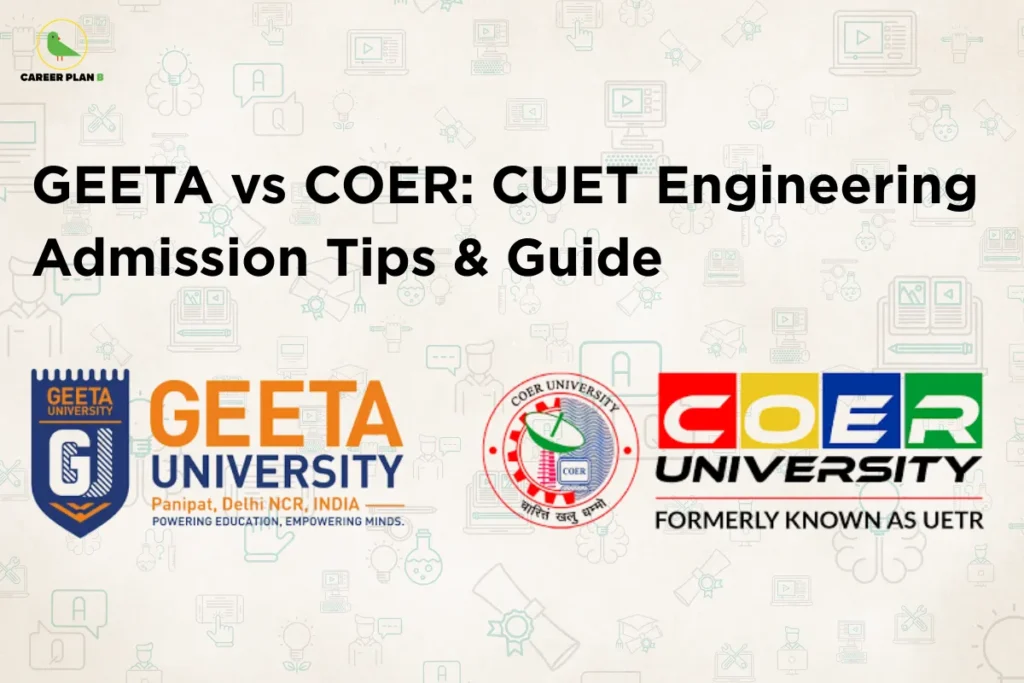
Introduction
Choosing the right engineering college today is not just about marks—it’s about making informed decisions. With the growing importance of centralized exams, students are actively searching for the best CUET Engineering Admission Tips to secure a seat in a good university. But the real challenge begins when multiple options like GEETA and COER come into the picture.
If you are confused about how to apply, which university to choose, or how to plan your strategy, you are not alone. Many students and parents are navigating this new admission landscape and looking for reliable CUET Engineering Admission Tips to avoid costly mistakes. This blog will simplify your decision-making and help you move forward with clarity.
Understanding CUET Engineering Admission Landscape
The Common University Entrance Test (CUET), conducted by the National Testing Agency, has become a standardized gateway for admissions into multiple universities across India.
Through CUET, engineering aspirants can apply to various private and state universities offering B.Tech programs. The goal is simple—create a fair, transparent, and merit-based admission system. For official details, you can explore the CUET portal here: https://cuet.nta.nic.in/
For Personalized Guidance
What Makes GEETA University a Strong Choice for Engineering?
Geeta University, located in Panipat, Haryana, is a multidisciplinary private university known for its industry-oriented approach and skill-based education. Its engineering programs are designed to align with current industry trends, offering specializations in core and emerging fields like Computer Science, AI, and Mechanical Engineering.
With modern labs, smart classrooms, and strong industry collaborations, the university emphasizes hands-on learning through projects, internships, and technical training. This practical exposure helps engineering students develop job-ready skills and prepares them for real-world industry challenges.
Courses & Specializations
- B.Tech (Engineering) – Offered in core and emerging fields like CSE, Civil, Mechanical, and AI-based specializations
- BBA (Management) – Industry-focused business program with specializations like Marketing, HR, and Business Analytics
- BCA (Computer Applications) – Focuses on software development, programming, and IT skills
- B.Sc (Allied Health / Science) – Includes Nutrition, Microbiology, Forensic Science, and healthcare-related fields
Overall, the program equips students with industry-relevant skills and a strong foundation for future engineering careers.
Campus Infrastructure
The campus infrastructure is designed to support experiential learning, not just theoretical knowledge. Smart classrooms, well-equipped laboratories, and dedicated innovation labs create an environment where students actively engage with concepts through practical application. The focus on project-based learning ensures that students don’t just study engineering—they build, test, and innovate within real-world scenarios.
Industry Exposure
The university places strong emphasis on bridging the gap between academics and industry. Through regular workshops, live projects, internships, and strategic industry tie-ups, students gain hands-on exposure that goes beyond textbooks. This practical insight helps engineering aspirants understand real workplace expectations early on, giving them a competitive edge in placements and career growth.
Why Consider COER University for CUET Engineering?
COER University is a well-known private institution in Uttarakhand with a legacy of technical education since 1998. It offers programs across engineering, management, agriculture, sciences, and paramedical fields, aiming to provide multidisciplinary education.
The university focuses on skill-based learning through collaborations like NPTEL and IIT Bombay initiatives, giving students access to certified courses in programming, software tools, and emerging technologies.
Courses & Specializations
- B.Tech (Engineering) – CSE, Civil, Mechanical, Electrical, IT, ECE
- BCA (Computer Applications)
- BBA (Management)
- B.Com (Commerce)
They offer diverse, industry-focused specializations that cater to evolving career demands across technical and healthcare domains.
Academic Structure
COER is designed to build strong fundamentals while gradually introducing advanced and industry-relevant concepts. The curriculum is regularly updated to align with evolving technology trends, ensuring students stay relevant in fields like AI, data science, and core engineering. Continuous assessment through assignments, projects, and internal evaluations helps track student progress beyond traditional exams.
Practical Learning
The university emphasizes hands-on learning through well-equipped labs, project-based assignments, and participation in technical events. Students are encouraged to work on real-time projects, hackathons, and innovation challenges, which enhance problem-solving and teamwork skills. Access to centres of excellence and skill-development programs further strengthens practical exposure, making learning more application-driven.
Placement Support
COER’s dedicated Training & Placement Cell provides structured career support through aptitude training, soft skills development, mock interviews, and resume-building sessions. The university also organizes industry interactions, guest lectures, and internship opportunities to prepare students for real-world roles. While placement opportunities vary by branch, the consistent focus is on improving employability and bridging the gap between academics and industry expectations.
GEETA vs COER – Quick Overview
| Feature | GEETA University | COER University |
| Location | Haryana | Uttarakhand |
| Courses | B.Tech (Multiple Specializations) | B.Tech + Emerging Technologies |
| Focus | Industry-oriented learning | Practical & technical training |
| Infrastructure | Modern labs, innovation centers | Established campus facilities |
CUET Engineering Admission Tips You Should Not Ignore
1. Understand CUET Subject Mapping
Different universities have different subject requirements. Ensure you select Physics, Chemistry, and Mathematics (PCM) if you are targeting engineering programs.
2. Focus on PCM Strength
Your CUET score largely depends on your core subjects. Strengthening your PCM basics can significantly improve your chances of admission.
3. Check University Eligibility Carefully
Not all universities have the same crit
5. Don’t Ignore Backup Options
eria. Always verify eligibility from official websites before applying. Missing this step is one of the most common mistakes.
4. Prioritize Colleges Based on Career Goals
Ask yourself—do you want strong placements, research exposure, or skill-based learning? Your answer will guide your college choice.
Even with a good score, competition can be intense. Apply to multiple universities to keep your options open.
These CUET Engineering Admission Tips can make the difference between a stressful admission season and a smooth one.
For Personalized Guidance
Which College Should You Choose?
Choose GEETA if:
- You prefer modern infrastructure with advanced labs and smart learning environments.
- You are looking for strong industry exposure through internships, workshops, and collaborations.
- You want a learning approach that emphasizes innovation, practical application, and emerging technologies.
- You aim to build a career aligned with industry demands and job-ready skills.
Choose COER if:
- You value strong academic fundamentals with a structured engineering curriculum.
- You prefer hands-on practical training through labs, workshops, and live projects.
- You are looking for a balanced approach between theory and application.
- You want to build a solid technical base before specializing in your career path.
Ultimately, the right choice depends on your learning preference—whether you lean towards industry-driven exposure or foundational technical depth.
Common Mistakes Students Make in CUET Engineering Admissions
Avoiding mistakes is just as important as following the right strategy.
- Ignoring eligibility criteria
- Choosing incorrect subject combinations
- Applying late or missing deadlines
- Not researching universities properly
Many students also fail to align their CUET preparation with their target colleges. If you want deeper clarity, explore [CUET subject combinations] for better planning.
How Career Plan B Helps
Career Plan B supports students making engineering admission decisions through structured guidance:
- Personalized Career Counselling: Helps students align their CUET subject choices with their interests, strengths, and long-term engineering career goals.
- Psycheintel & Career Assessment Tests: Provides insights into aptitude, analytical ability, and problem-solving skills to guide the right engineering path.
- Admission & Academic Profile Guidance: Assists students in understanding CUET requirements while building a strong academic profile for engineering admissions.
- Career Roadmapping: Offers a structured long-term plan that helps students make confident and informed decisions about their engineering journey.
Get In Touch With Us
Frequently Asked Questions
1. Is CUET compulsory for engineering admissions?
No, not all engineering colleges require CUET. However, many universities now accept CUET scores for B.Tech admissions.
2. Which is better: GEETA or COER?
It depends on your priorities. GEETA focuses on industry exposure, while COER emphasizes technical fundamentals.
3. What subjects are required for CUET B.Tech?
Physics, Chemistry, and Mathematics (PCM) are generally required for engineering programs.
4. Can I apply to multiple universities through CUET?
Yes, CUET allows you to apply to multiple participating universities with a single exam.
5. How important is the CUET score for engineering admissions?
Your CUET score plays a key role, but universities may also consider eligibility criteria and other factors.
Conclusion
Choosing between universities like GEETA and COER is not just about comparison—it’s about clarity. With the right approach and well-planned CUET Engineering Admission Tips, students can simplify their journey and make confident decisions. Every step, from subject selection to application, plays a crucial role in shaping your engineering future.
Take time to research, understand your goals, and apply strategically. Admissions are not just about getting into a college—they are about choosing the right path. Start early, stay informed, and remember that the right guidance can turn confusion into confidence.