Team2 · June 9, 2026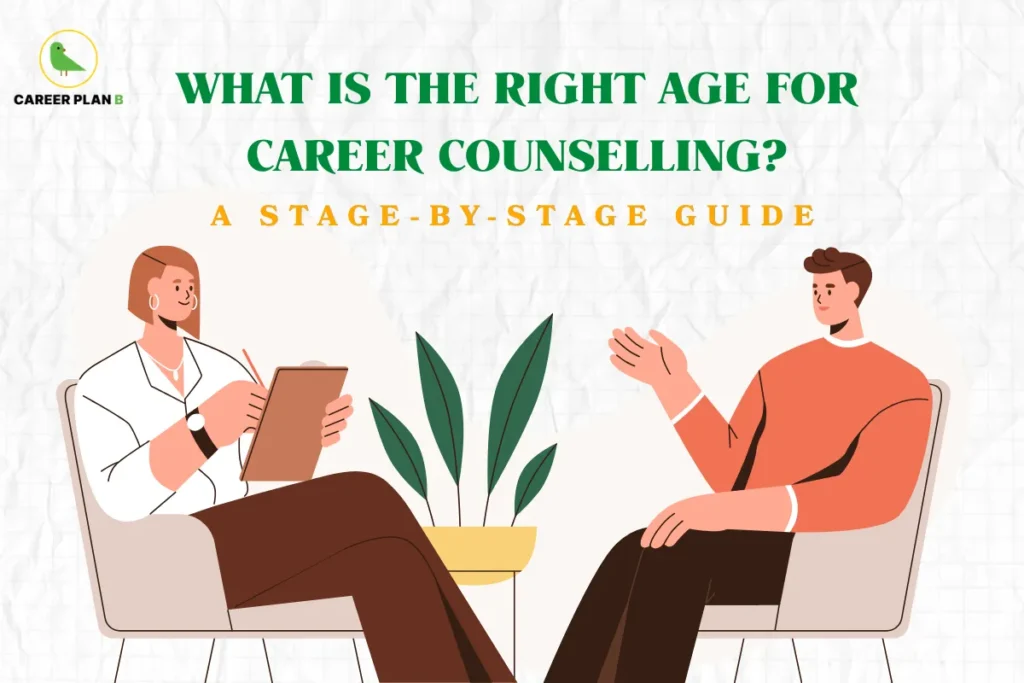
Introduction
Here’s a question we get constantly: “My child is in Grade 8. Isn’t it too early for career counselling?”
Or the flip side: “My child is in Grade 12. We should have done this two years ago!”
And from adults: “I’m 35. Is it too late for career counselling?”
The answer is: There is no single “right age for Career Counselling”. But there are optimal stages.
Think of career counselling not as a one-time event, but as interventions at different life stages. Grade 8 looks different from Grade 12, which looks different from mid-career. Each stage has its own challenges, its own decisions, and its own value for counselling.
This article walks you through the entire lifespan, showing when career counselling is most valuable and what it looks like at each stage.
Stage 1: Grade 8-9 (Age 13-15) — Exploration and Self-Discovery
When to start career counselling:
As early as Grade 8.
What Happens at This Stage:
Your child is starting to think about their future. It’s mostly vague anxiety (“What do I want to be when I grow up?”). But underneath that is the beginning of real career thinking.
This stage is too early for major decisions. They’re not choosing streams yet. But it’s the perfect time for exploration.
What Career Counselling Does:
- Helps them understand their own strengths, interests, and personality
- Introduces them to different career fields (not just engineering/medicine/teacher)
- Builds confidence in self-knowledge
- Removes anxiety about the future by making it less vague
What Parents Often Ask: “Isn’t this just general life guidance? Shouldn’t they figure this out naturally?”
The Answer: Some do. Most don’t. And the earlier they understand themselves, the better their decisions in Grade 10.
Red Flag for Extra Support: If your child has no clue of what they’re good at, gets anxious about their future, or seems completely lost about career options.
Stage 2: Grade 10 (Age 15-16) — Stream Selection Decision
When to start career counselling:
April-June of Grade 10 (before stream selection).
What Happens at This Stage:
This is the first major fork in the road. Science, Commerce, or Arts. Two-year commitment. Shapes college options.
Most students make this choice based on peer pressure, parent expectations, or random guesses. This is where counselling makes the biggest difference.
What Career Counselling Does:
- Comprehensive psychometric assessment (like PsycheIntel)
- Real stream comparison (not just “Science is prestigious”)
- Conversation with parents to align expectations
- Clear recommendation based on actual data
What Parents Often Ask: “My child has good grades. Shouldn’t they just do the ‘hardest’ stream?”
The Answer: High grades don’t mean aptitude for a specific stream. A student might score 90% overall but struggle with Physics. Counselling helps match actual strengths to streams.
Red Flag for Extra Support: If your child is uncertain, experiencing anxiety about the choice, or if parents and child disagree on the stream.
Stage 3: Grade 12 (Age 17-18) — College and Course Planning
When to start career counselling:
August-October of Grade 11 or early Grade 12.
What Happens at This Stage:
Stream choice is made. Now comes the bigger decision: Which college? Which course? Engineering or medicine or B.Com? Which entrance exam? Which colleges to target?
This is the highest-stakes decision so far. College shapes your first job, your peer network, your opportunities.
What Career Counselling Does:
- Helps evaluate college options based on fit, not just ranking
- Discusses realistic entrance exam targets and prep requirements
- Maps college choice to actual career outcomes
- Helps parents understand the college decision
What Parents Often Ask: “Should my child aim for IIT? Or focus on getting into a good private college?”
The Answer: Depends on the student. IIT is harder but opens doors. Private colleges are easier but require higher fees. Counselling helps evaluate this trade-off based on your child’s profile and your family’s financial situation.
Red Flag for Extra Support: If your child is considering multiple completely different paths (engineering vs. psychology vs. design), if parents have strong opinions that conflict with the child’s interest, or if the student is experiencing high anxiety about entrance exams.
Stage 4: Graduates (Age 22-25) — First Job and Specialisation
When to start career counselling:
Last semester of college or immediately after graduation.
What Happens at This Stage:
You have a degree. Now what? Job hunting feels overwhelming. You are not sure what roles you’re qualified for. You’re getting offers but you’re not sure if they’re good. You’re wondering about further education (MBA, MS, etc.).
What Career Counselling Does:
- Helps you understand what you’re actually qualified for (beyond your degree)
- Clarifies whether MBA/MS makes sense for your goals
- Guides job search strategy (not just applying everywhere)
- Helps evaluate job offers beyond just salary
What Graduates Often Ask: “I have a computer science degree. Do I have to work as a software engineer?”
The Answer: No. You have options. Product management, data science, consulting, startups, finance. Counselling helps you find the right fit.
Red Flag for Extra Support: If you’re completely lost about what to do with your degree, if you’re getting conflicting advice from friends and family, if you’re turning down good offers because you’re not sure if they’re “right.”
Stage 5: Early Career (Age 25-30) — Role and Industry Fit
When to start career counselling:
If you’re in a job that doesn’t feel right, or if you’re unsure about your next move.
What Happens at This Stage:
You’re a few years into your first job. You’re starting to understand what you actually like and dislike about work. Maybe you love your role but hate your company. Maybe the opposite. Or maybe you’re realizing your entire field is wrong for you.
What Career Counselling Does:
- Helps you diagnose whether the problem is the job, the company, or the field
- Guides internal moves or lateral transitions (easier than complete career changes)
- Helps you build skills strategically for your next role
What Young Professionals Often Ask: “I’m in a good company with good salary, but I’m bored. Should I stay for stability or take a risk?”
The Answer: Depends on your situation. Counselling helps you evaluate the trade-off between stability and fulfillment.
Red Flag for Extra Support: If you’re consistently unhappy across multiple roles in the same field, if you’re getting burned out regularly, if you have no clear sense of what your next move should be.
Stage 6: Mid-Career (Age 30-40) — Pivot, Growth, or Realization
When to start career counselling:
When you realize you’re in the wrong field, when you want to grow but don’t know how, or when you’re facing a major decision (promotion, location change, career change).
What Happens at This Stage:
You’ve been in your field for 8-15 years. You know what works and what doesn’t. You might have been promoted or might have changed companies. But something is off.
Maybe you’re burned out. You may realize you should have chosen a different path or you’ve changed as a person and what once excited you doesn’t anymore. Maybe you’re stuck and don’t see growth.
What Career Counselling Does:
- Helps you assess whether change is needed or just a new environment
- Maps transferable skills for career changes
- Creates realistic transition plans (not fantasies)
- Helps you navigate major decisions strategically
What Mid-Career Professionals Often Ask: “I’ve spent 10 years in finance. But I want to do something more meaningful. Is a complete career change realistic at my age?”
The Answer: Yes, if you plan it strategically. You’re not starting from zero. You have skills and experience. Counselling helps you leverage those in a new field.
Red Flag for Extra Support: If you’re experiencing significant burnout, if you’ve been thinking about a change for years, if you’re stuck in the wrong field because of financial constraints, if major life decisions are coming (kids, career change, location move).
Stage 7: Late Career (Age 40-50+) — Encore Careers and Legacy
When to start career counselling:
When you’re thinking about what comes next, either in your career or beyond.
What Happens at This Stage:
You’re not retiring yet, but you’re starting to think about it. Maybe you want to move into teaching, mentoring, or advisory roles. Maybe you want to start a social impact venture or maybe you want to transition to something you’ve always been passionate about.
What Career Counselling Does:
- Helps you think about meaningful work in your later career
- Guides transitions to mentoring, advisory, or impact-focused roles
- Helps you plan for post-career engagement
What Late-Career Professionals Often Ask: “I’ve been successful in my field, but I want to do something more meaningful before I retire. Is it too late?”
The Answer: Not at all. This is often the perfect time. You have credibility, experience, and financial stability. You can take calculated risks you couldn’t earlier.
Red Flag for Extra Support: If you’re feeling unfulfilled despite external success, if you want to make a big change but you’re not sure how, if you’re thinking about retirement but the idea terrifies you.
Have Any Doubts?
Summary: When Career Counselling Matters at Each Stage
| Stage | Age | Primary Focus | Value |
|---|---|---|---|
| Grade 8-9 | 13-15 | Exploration | Foundation-building |
| Grade 10 | 15-16 | Stream Selection | High impact on next 2 years |
| Grade 12 | 17-18 | College/Course Choice | Shapes first 4-6 years |
| Graduation | 22-25 | First Job Direction | Sets career trajectory |
| Early Career | 25-30 | Role/Industry Fit | Course correction possible |
| Mid-Career | 30-40 | Pivot/Growth | Highest change potential |
| Late Career | 40+ | Legacy/Encore | Fulfillment focus |
Is There a “Too Early” or “Too Late”?
Too Early? Grade 8 might sound early, but it’s not. It’s exploration, not commitment. Earlier exploration leads to better decisions later.
Too Late? Never. Career counselling helps at every stage. At 50, it helps you think about your next chapter. At 60, it helps you plan meaningful work beyond traditional employment.
The only “too late” is when you’re dead. And even then, you can influence your legacy.
Red Flags at Any Age: When Career Counselling Is Urgent
Regardless of age, seek counselling immediately if:
- You’re Experiencing Significant Unhappiness: Persistent unhappiness with your career path is a signal something needs to change.
- You’re Making a Major Decision With Limited Information: Career change, MBA, location move, job acceptance — these deserve professional input.
- You’ve Been Stuck for Years: If you’ve been in a holding pattern, unable to move forward, counselling can help you break through.
- Your Life Circumstances Have Changed Dramatically: Major life events (marriage, kids, health issues, financial changes) might require rethinking your career.
- You Have No Sense of Direction: If you’re feeling lost or directionless, that’s a sign you need clarity.
- Your Values and Work Are Misaligned: If what you do for work conflicts with what you believe, that’s a significant problem worth addressing.
How Career Plan B Helps at Each Stage
We have programs tailored to each stage:
- Grade 8-9: Exploration and interest mapping through PsycheIntel.
- Grade 10: Comprehensive stream selection counselling with parental involvement.
- Grade 12: College evaluation, entrance exam strategy, course selection.
- Graduates: First job search strategy, MBA/MS evaluation, role exploration.
- Early Career: Role fit assessment, industry switch guidance, skill development planning.
- Mid-Career: Comprehensive career change counselling, transition planning, growth strategy.
- Late Career: Encore career planning, mentoring strategy, legacy planning.
Get In Touch With Us
FAQs
- “My child is in Grade 6. Is that too early?”
A bit early for major decisions, but not for exploration. Waiting until Grade 10 is fine. Starting in Grade 8 is optimal. Grade 6 is premature.
- “I’m 45 and I’ve never had career counselling. Is it too late?”
Not at all. It might be especially valuable because you have years of experience to reflect on and potentially 20+ years of career left to reshape.
- “My child is in Grade 11 and we’re just thinking about counselling. Have we missed the window?”
Not at all. Late is better than never. You can still make a good college choice with counselling. Better to decide in Grade 11 than to muddle through Grade 12 without clarity.
- “Should I get counselling or should my child?”
Depends on the stage. For teens, usually the child with parental involvement. For adults, the individual.
- “How long should career counselling take?”
Depends on the stage and decision. 1-2 sessions for a specific question. 3-5 sessions for a major decision. Ongoing support for significant changes.
Ready to Seek Counselling at Your Stage?
Wherever you are in your career journey: Grade 8, Grade 12, first job, mid-career crisis, planning for retirement; Career Plan B has someone who can help.
You don’t need to wait for a crisis. You don’t need to have everything figured out. The important thing you just need is to recognize that where you are matters, and you might benefit from clarity.
Get Started
📍 Gurugram Office
B-36, 37, 38, Second Floor
IDC Area, Industrial Development Area
Sector 14, Gurugram, Haryana 122001
Career counselling isn’t a one-time thing. It’s a stage-appropriate journey. Whatever your age, there’s a right time to seek guidance. This is it.