Deepti · July 17, 2026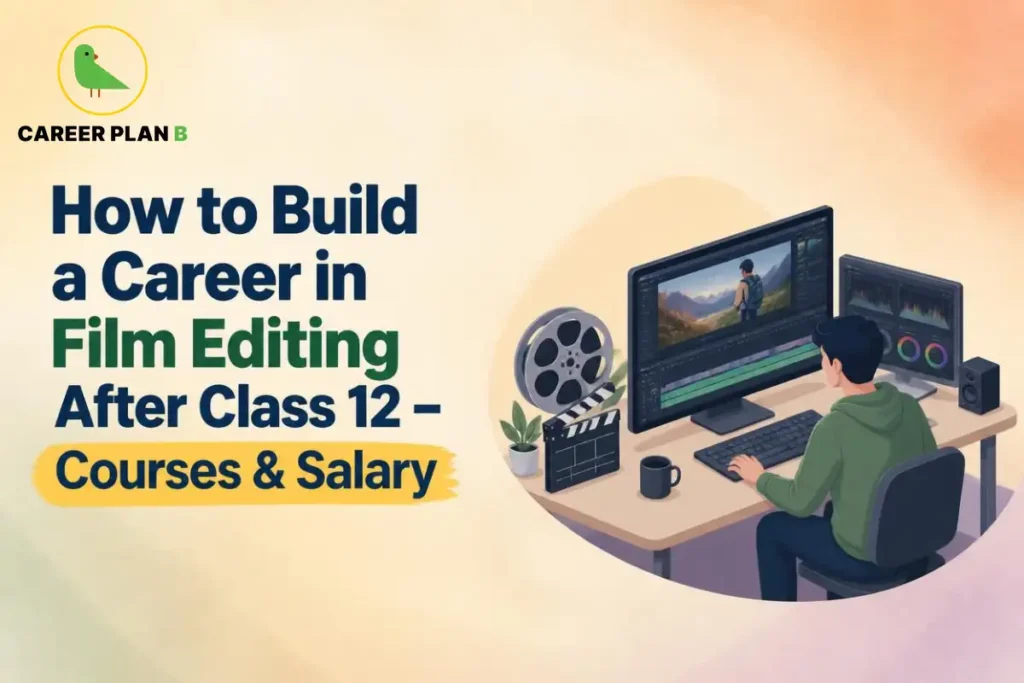
Introduction
Every gripping film scene, in truth, is shaped twice: once by the camera, and again by the editor. Editors decide pacing, rhythm, and emotional impact long after shooting wraps up.
Film editing has grown rapidly alongside India’s booming OTT industry, creating consistent demand for skilled editors. However, building this career requires a clear understanding of which courses actually lead somewhere.
This blog explains how to build a career in film editing after Class 12, covering realistic course options, required skills, and salary expectations. Therefore, if you enjoy storytelling through visuals, this guide will help you plan your next step.
What Does a Film Editor Actually Do?
A film editor assembles raw footage into a coherent, emotionally engaging final product. This involves selecting takes, adjusting pacing, and synchronising sound with visuals.
Beyond creative judgment, editors must master specific software tools like Adobe Premiere Pro, DaVinci Resolve, or Avid Media Composer. Consequently, technical fluency matters just as much as storytelling instinct in this profession.
Course Options After Class 12
Direct entry into premier institutes like the Film and Television Institute of India (FTII), Pune — an autonomous institute under the Ministry of Information and Broadcasting — is not immediately possible after Class 12. FTII’s PG Diploma in Editing requires a bachelor’s degree and clearing the FTII Joint Entrance Test (JET).
However, several realistic pathways exist for Class 12 students:
- Certificate courses in editing software: Short-term, skill-specific programmes covering tools like Premiere Pro or DaVinci Resolve
- Diploma in Film/Video Editing: One to two-year diploma programmes offered by media and film institutes
- Bachelor’s degree in film production or mass communication: A broader three-year foundation, useful before pursuing FTII’s postgraduate editing diploma later
- FTII’s short-term certificate courses: Occasional shorter programmes, such as screenwriting or appreciation courses, that don’t require a prior degreeFor Personalized Guidance
Building Toward FTII or SRFTI Later
Students genuinely committed to premier institutes should plan a two-stage journey. First, complete a relevant bachelor’s degree, ideally in film studies, mass communication, or a related creative field.
Afterward, prepare specifically for the FTII JET or the equivalent entrance process at the Satyajit Ray Film and Television Institute (SRFTI), Kolkata — both government-run institutes under the Ministry of Information and Broadcasting. This two-stage approach, while longer, leads to India’s most respected editing credentials.
Skills That Matter for a Film Editing Career
Beyond technical software skills, successful editors typically develop:
- Strong narrative sense: Understanding pacing, tension, and emotional beats
- Attention to detail: Catching continuity errors and audio-visual mismatches
- Collaboration skills: Working closely with directors and sound designers
- Adaptability: Editing across genres, from feature films to short-form OTT content
Comparison Table: Institutes for Film Editing Training
| Institute | Course | Entry Requirement |
|---|---|---|
| Film and Television Institute of India (FTII), Pune | PG Diploma in Editing | Bachelor’s degree + FTII JET entrance |
| Satyajit Ray Film and Television Institute (SRFTI), Kolkata | PG Diploma in Editing | Bachelor’s degree + entrance test |
| FTII, Pune | Short-term certificate courses | Class 12 pass, no prior degree required |
Note: Course structures and entrance requirements change periodically. Verify current details directly on each institute’s official website. (Source: Film and Television Institute of India, autonomous institute under Ministry of Information and Broadcasting)
How Career Plan B Helps
Planning a film editing career after Class 12 requires patience, since premier institutes expect a prior degree. Career Plan B offers Personalised Career Counselling to map out a realistic multi-stage plan toward FTII or SRFTI.
Additionally, Psycheintel and career assessment tests confirm whether detail-oriented, technical creative work suits you. Admission and Academic Profile Guidance and Career Roadmapping then help sequence your degree, certifications, and entrance preparation effectively.
Get In Touch With Us
Frequently Asked Questions
Q1. Can I join FTII’s editing course directly after 12th?
No, FTII’s PG Diploma in Editing requires a bachelor’s degree from a recognised university, along with clearing the FTII Joint Entrance Test.
Q2. What should I do right after Class 12 if I want to become a film editor?
Consider a diploma in film/video editing, a certificate course in editing software, or a bachelor’s degree in film production, mass communication, or a related field, as a foundation.
Q3. Is a formal degree necessary to work as an editor?
Not always many editors build careers through strong portfolios and freelance work, though formal training generally accelerates skill development and industry connections.
Q4. What is the realistic salary range for a film editor in India?
Entry-level editors often start with modest freelance or assistant-editor pay, which typically grows substantially with a strong portfolio and network. Exact figures vary widely by project, city, and platform, so official wage data remains limited for this freelance-heavy field.
Q5. Which software skills should I learn first?
Adobe Premiere Pro and DaVinci Resolve are widely used industry standards, making them a practical starting point before exploring more specialised tools like Avid Media Composer.
Conclusion
A career in film editing after Class 12 requires patience, since India’s premier institutes like FTII expect a prior degree and a competitive entrance score. That said, a clear two-stage plan — building foundational skills first, then pursuing advanced training — makes this goal genuinely achievable.
Meanwhile, the growing OTT industry continues creating fresh opportunities for trained editors across genres and formats. If storytelling through visuals excites you, Career Plan B can help you sequence the right courses and entrance preparation for your specific timeline.
Every unforgettable film moment was shaped by someone who once sat exactly where you are now, learning to cut.