Careerplanb · June 20, 2026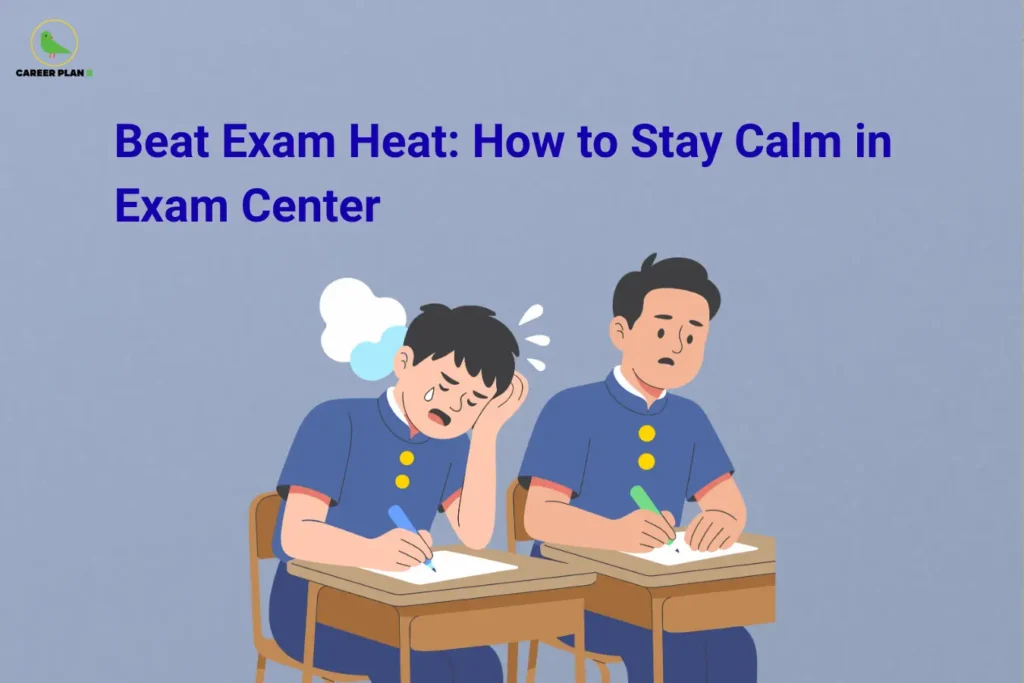
Introduction
Imagine this. You’ve studied for months. You know your syllabus. You’ve given mock tests. But the moment you sit in that exam center chair and the timer starts, everything feels like it’s slipping away. Your heart races. Your palms sweat. And suddenly, the answer to a question you revised yesterday feels miles away. Sound familiar? If yes, you are not alone, not even close.
CUET is one of the most competitive entrance exams in India, and the pressure that comes with it is very real. A 2025 study surveying over 1,600 students across eight major Indian cities found that nearly 70% of students experience moderate to high levels of anxiety and exam day is where that anxiety tends to peak. But here’s the good news: knowing how to stay calm in the exam center is a skill, and just like any other skill, you can learn it.
Why Does the CUET Exam Feel So Overwhelming?
Let’s be honest — CUET isn’t just another test. It opens the doors to central universities across India, and for many students, it feels like their entire future is riding on a single session of 60 minutes. Entrance exams like CUET have added to the stress landscape for students, with lakhs competing for limited seats in top institutions. That kind of competition is bound to get inside your head.
The Pressure Is Real — And So Is the Science Behind It
When you feel anxious before an exam, your body does something very automatic. It activates what’s called the “fight-or-flight” response — a surge of adrenaline and cortisol that was originally designed to help humans escape danger. When this happens, your heart rate increases, your breathing becomes rapid and shallow, and your brain shifts into survival mode rather than the higher-order thinking you actually need in an exam hall.
In short, your body is trying to protect you but it ends up working against you. The goal, then, isn’t to eliminate nervousness completely. A little bit of it actually sharpens focus. The goal is to manage it so it doesn’t take over.
For Personalized Guidance
Before You Even Enter the Exam Center — Prep Like a Pro
Most students think exam day preparation starts the morning of. But the truth is, what you do the night before matters just as much as what you do inside the hall.
The Night Before Matters More Than You Think
The night before your CUET paper, resist the urge to cram. Your brain doesn’t absorb new information well when it’s already full and tired. Instead, here is what actually helps:
- Lay out everything you need — your admit card (downloaded from cuet.nta.nic.in), a valid photo ID, passport-size photographs, and a transparent water bottle.
- Sleep for at least 7 to 8 hours. This isn’t a luxury — sleep directly impacts memory recall and focus.
- Eat a light but proper dinner. Avoid anything too oily or heavy that might make you feel sluggish the next morning.
- Keep your phone away at least an hour before bed. Scrolling through “CUET tips” at midnight does more harm than good.
Think of it this way—a cricketer doesn’t practice on the pitch the night before a match. Instead, they rest, prepare their kit, and get proper sleep. You should do the same.
What to Carry, What to Leave Behind
NTA has issued an official advisory for candidates regarding dress code and permissible items at CUET (UG) 2026 examination centers. You can check the full advisory directly on the NTA official website to make sure you’re compliant.
As a general rule:
Carry these:
- Printed admit card (two copies, on white A4 paper)
- Original photo ID (Aadhaar, PAN, Passport, or Voter ID)
- 2 to 3 passport-size photographs matching the one on your admit card
- A simple, transparent water bottle
- A wristwatch without smart features (check NTA’s advisory for confirmation)
Leave these at home:
- Mobile phones, smartwatches, Bluetooth devices
- Calculators or electronic gadgets
- Any notes, books, or printed study material
- Jewellery with metal components that could trigger security checks and cause unnecessary delays
Arriving without the right documents is a nightmare scenario. Don’t let that be you.
How to Stay Calm in the Exam Center
This is the part everyone wants to know. You’re inside the hall. The clock is about to start. How do you manage exam anxiety right then and there?
The First 5 Minutes Are Everything
Before the timer officially begins, you usually get a few minutes to go through the instructions on screen. Most students rush through this or ignore it entirely because they’ve read the rules before. Don’t. Use those minutes deliberately:
- Read the instructions slowly, even if you already know them. It gives your mind something calm and structured to do.
- Take a look around the room — not to compare yourself with others, but just to ground yourself in the space.
- Remind yourself: “I have prepared for this. I am ready.”
That internal voice matters more than you think.
Breathing Tricks That Actually Work
This one sounds simple, and that’s exactly why people underestimate it. Research confirms that diaphragmatic breathing activates the parasympathetic nervous system, which promotes relaxation and helps regulate the body’s stress response — even in high-stakes exam situations.
Here’s a technique you can use sitting right at your exam desk:
The 4-7-8 Method:
- Breathe in through your nose for 4 counts
- Hold your breath for 7 counts
- Exhale slowly through your mouth for 8 counts
- Repeat 3 to 4 times
Studies show that breathing exercises including box breathing and diaphragmatic techniques used for even just five minutes can lead to lower anxiety levels and better test performance. Five minutes. That’s it.
What to Do When Your Mind Goes Blank
It happens to almost everyone at some point. You’re reading a question, and suddenly — nothing. A complete blank. Here is what you should do instead of panicking:
- Skip the question for now and mark it for review. CUET’s CBT (Computer-Based Test) format allows you to navigate between questions.
- Move on to the next question. Often, answering other questions triggers recall.
- Take two or three slow, deep breaths between questions.
- Don’t read the question over and over in panic; that loop only makes it worse. Come back to it fresh.
Remember: skipping a question temporarily is strategy, not surrender.
Managing Exam Anxiety While the Clock Is Ticking
Is There a “Right” Way to Manage Time Inside the Hall?
Yes — and it starts with not watching the clock obsessively. That timer at the top of your screen is there to help you, not haunt you. Here’s a practical approach for CUET’s 60-minute paper:
| Time Block | What to Do |
| First 5 minutes | Read instructions, breathe, settle in |
| Minutes 5–45 | Attempt all questions you know confidently |
| Minutes 45–55 | Return to skipped or doubtful questions |
| Last 5 minutes | Review, check marked answers, don’t change unless sure |
Stick to this rhythm, and the exam feels a lot less chaotic.
Don’t Let One Question Derail You
Here’s something worth remembering — CUET has multiple sections and subjects across its paper structure. One difficult question does not define your score. One bad section does not end your chances. The exam is designed with a range of difficulty levels. Your job is to get through as many as possible calmly, not to get every single one perfect.
Think of it like a buffet. You don’t stress over the one dish you don’t like. You simply move to the next one.
After the Exam — How to Reset
Once you’ve submitted, close that chapter at least for a few hours. Stepping outside and immediately comparing answers with friends is one of the fastest ways to spiral into unnecessary stress about something you can no longer change.
Instead, do something that genuinely relaxes you. Eat something you like. Call someone who makes you laugh. Take a walk. If you have another CUET subject paper coming up in the next few days, give yourself the evening off completely. You will perform better in the next paper if your mind gets time to reset.
Learn more about managing exam stress and building a focused study routine small habits between papers matter as much as preparation.
How Career Plan B Helps
Career Plan B helps students navigate CUET with clarity, confidence, and emotional support at every stage of the journey:
- Personalized Career Counselling: Helps students manage academic pressure, reduce anxiety, and make informed decisions about their future.
- Psycheintel & Career Assessment Tests: Identifies strengths, aptitude, personality traits, and suitable academic and career pathways.
- Admission & Academic Profile Guidance: Supports students in building a strong academic profile and planning their admissions strategically.
- Career Roadmapping: Helps students create a structured long-term plan aligned with their academic and professional aspirations.
- End-to-End Guidance: Assists students before exams, during the admission process, and beyond so they move forward with clarity, confidence, and the right support system.
For Latest Information
Frequently Asked Questions
Q1. Is it normal to feel nervous inside the CUET exam center?
Absolutely. In fact, a moderate level of nervousness is normal and can even improve focus. The problem only begins when anxiety becomes overwhelming. The tips in this blog is especially the breathing techniques designed to keep that nervousness at a manageable, productive level.
Q2. What if I forget my admit card on the day of the exam?
The admit card is mandatory for entry. NTA has made it clear that candidates must carry their admit card to the examination center, and entry is not permitted without it. Always keep two printed copies ready the night before.
Q3. Can I drink water during the CUET exam?
Yes, a transparent water bottle is generally permissible. However, always verify this against the latest official guidelines on nta.ac.in before your exam day, as specific rules may vary.
Q4. What should I eat on the morning of the CUET exam?
Keep it light and familiar something you eat regularly. Avoid experimenting with new foods. A balanced meal with enough carbohydrates for energy works well. Avoid skipping breakfast, as low blood sugar can worsen anxiety and reduce concentration.
Q5. How do I stop overthinking during the exam?
Bring your attention back to the question in front of you, nothing else. If your mind wanders to “what if I fail,” that’s a cue to use your breathing technique. Ground yourself in the present moment. The exam is happening right now. Focus on that.
Conclusion
Staying calm in an exam center isn’t about being fearless, it’s about being prepared, both mentally and practically. You’ve done the hard work in the weeks leading up to CUET. The exam hall is just where you show it. A little nervousness means you care, and that’s never a bad thing. What matters is that you don’t let it take the wheel.
Take a breath, trust your preparation, and go one question at a time. That’s all it ever takes. And if you ever feel like you need more support, whether it’s managing exam stress, figuring out which universities to apply to, or mapping out your career path, know that help is always available. You don’t have to figure it all out alone.