Careerplanb · June 18, 2026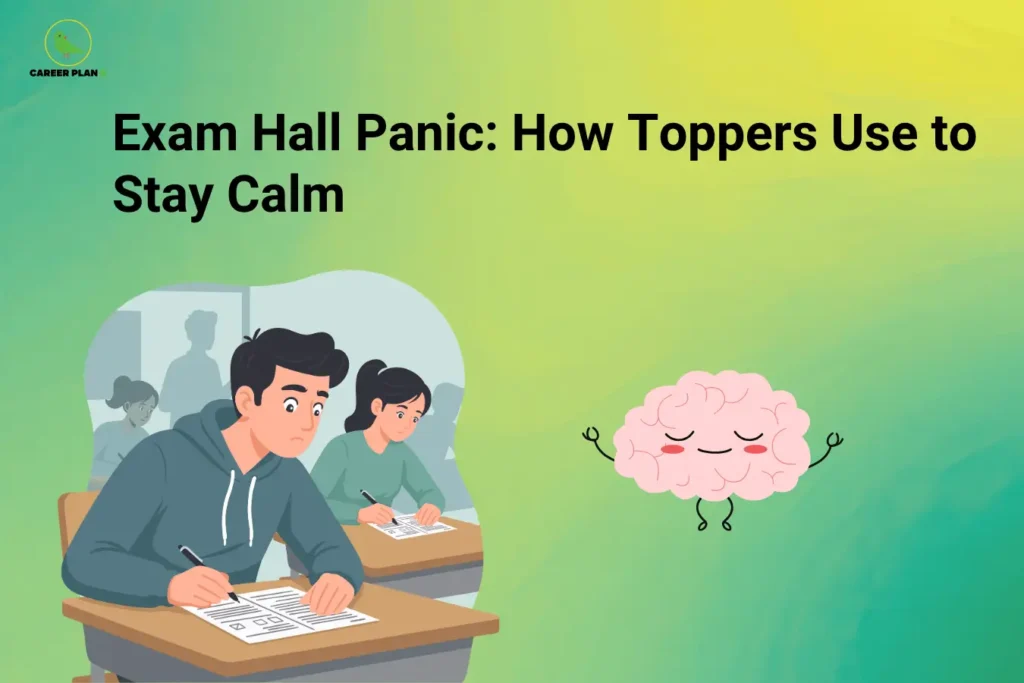
Introduction
You walk into the exam hall. The clock is ticking. Your heart is racing. Your mind suddenly goes blank even though you studied for months. Sound familiar? If you are preparing for CUET 2026, exam hall panic is something almost every student has faced or will face. You are not alone, and more importantly, you are not weak for feeling this way.
The good news? Toppers feel the nerves too. What sets them apart is not that they do not feel exam hall panic — it is that they know exactly what to do when it hits. This blog breaks down their real strategies, the science behind staying calm in exams, and how you can walk into your CUET 2026 exam hall feeling ready, not rattled.
What Is Exam Hall Panic — And Why Does It Hit So Hard?
Exam hall panic is not just “feeling nervous.” It is that sudden wave of dread, sweaty palms, a racing heart, and a mind that refuses to cooperate — right when you need it most.
Here is what is actually happening inside your brain: when you feel threatened (yes, an exam can feel like a threat), your brain triggers the fight-or-flight response. Your body releases cortisol and adrenaline. Blood flows away from the thinking part of your brain — the prefrontal cortex — and toward your muscles. In simple words, your brain literally becomes less sharp at the moment you need it to be sharpest.
According to research published by the American Psychological Association, test anxiety affects nearly 40% of students and can significantly impact academic performance. For CUET 2026 aspirants, this number feels real — with over 13 lakh students expected to appear, the pressure is enormous.
CUET 2026 adds its own unique stress points: multiple exam shifts, uncertainty around slot allocation, and a very tight time window per section. This combination can easily push exam anxiety from manageable to overwhelming, especially in those first few minutes inside the hall.
What Do Toppers Do Differently? (It Is Not What You Think)
Most students assume toppers are calm because they are extra smart or they studied more. That is rarely the full truth. Toppers have simply built better habits — habits that manage mental pressure during exams, not avoid it.
They Accept the Nervousness Instead of Fighting It
One of the biggest mistakes students make is telling themselves “stop being nervous” — which, ironically, makes it worse. Toppers do the opposite. They acknowledge it. They think: “I am nervous. That means I care. That is okay.”
This approach, known as anxiety reappraisal, has been backed by research from Harvard Business School. Dr. Alison Wood Brooks found that telling yourself “I am excited” instead of “calm down” actually improves performance under pressure — because excitement and anxiety are physiologically similar emotions. You are not eliminating the feeling; you are redirecting it.
They Follow a Pre-Exam Ritual
Toppers do not wing the morning of the exam. They follow a consistent pre-exam routine — same breakfast, same playlist, same light revision habit. Rituals create a psychological sense of control, which directly reduces exam stress management challenges.
It does not have to be elaborate. Even something as simple as reading your short notes, drinking water slowly, and taking three deep breaths before entering the hall can signal your brain: “We have done this before. We are ready.”
They Control the Controllables
Toppers do not spend energy worrying about things outside their control — like which shift they get, how other students are doing, or whether the question paper will be tough. They focus only on what they can control: their breathing, their approach to each question, and their time management.
This mindset shift is a core part of staying calm in exams — and it is a skill, not a personality trait. Anyone can learn it.
The First 10 Minutes Inside the Exam Hall — A Topper’s Playbook
The first 10 minutes inside the exam hall set the tone for everything that follows. Here is exactly what smart students do:
- Sit down and breathe first — before touching the paper. Two slow, deep breaths. This is not wasted time; it is an investment.
- Read the instructions carefully — even if you think you know them. This slows your reading pace and calms a racing mind.
- Scan the entire paper quickly — get a bird’s eye view. Spot the sections that feel familiar. This builds confidence before you begin.
- Start with what you know — do not tackle the hardest question first. Early wins build momentum and settle concentration during exams.
- Keep your eyes on your own paper — looking around the hall triggers comparison anxiety. Your only competition is the clock.
- Do not panic if others start writing fast — many students write rough work or just fill in bubbles randomly early on. Ignore it.
- Mark and move — if a question stumps you, mark it and move forward. Do not let one question hijack your entire session.
Breathing, Body, and Brain — The Science of Staying Calm
This might sound too simple to be true — but breathing is one of the most powerful tools for exam stress management. Here is why it actually works.
When you breathe slowly and deeply, you activate your parasympathetic nervous system — the “rest and digest” mode that counteracts the fight-or-flight panic response. Your heart rate drops. Blood flows back to your prefrontal cortex. Your thinking becomes clearer.
Try the Box Breathing technique:
- Inhale for 4 counts
- Hold for 4 counts
- Exhale for 4 counts
- Hold for 4 counts
- Repeat 3 to 4 times
Another effective method is the 4-7-8 breathing technique — inhale for 4 seconds, hold for 7, exhale for 8. It works especially well in the few minutes before the paper is distributed.
Body posture matters too. Sitting upright — shoulders back, feet flat on the floor has been shown in research by social psychologists to influence how confident and in control you feel. Slouching signals defeat to your own brain. Sitting tall signals readiness.
CUET 2026-Specific Stressors and How to Handle Them
CUET 2026 comes with its own set of anxiety triggers that are worth addressing directly.
- Multiple shifts and slot uncertainty
Many students spiral into stress not knowing which shift they will get, or worrying their shift is “harder.” The truth? NTA normalizes scores across shifts. Your percentile is what matters, not the raw score comparison. Focus on your own performance, not the shift lottery. - Section switching pressure
CUET has multiple sections — Domain Subjects, General Test, and Languages. Switching mental gears between sections mid-exam can feel jarring. Practice timed mock tests that mirror this format so your brain is trained for it before exam day. The National Testing Agency’s official mock test portal is a great resource for this. - Time pressure per section CUET sections are time-bound and the clock moves fast. The antidote is not speed — it is strategy. Practice skipping and returning. Know your strong topics and hit those first. Do not let a single tough question drain five minutes.
- Day-before anxiety
The night before the exam is when exam anxiety peaks for most students. Keep it light — do a brief revision, eat a good meal, sleep on time. Avoid cramming new topics. Your brain needs rest to consolidate everything it has already learned.
How Career Plan B Helps
Career Plan B helps students prepare for CUET 2026 with clarity, confidence, and a student-focused approach:
- Personalized Career Counselling: Helps students build strategic academic and career plans based on their goals, interests, and strengths.
- Psycheintel & Career Assessment Tests: Identifies aptitude, personality, and suitable academic and career pathways through psychometric analysis.
- Admission & Academic Profile Guidance: Supports students in building a strong academic profile and making informed admission decisions.
- Career Roadmapping: Helps students create a structured long-term plan aligned with their future academic and professional aspirations.
- End-to-End Guidance: Assists students throughout CUET preparation, admissions, and career planning so exam day feels purposeful instead of overwhelming.
For Latest Information
Frequently Asked Questions
Q1. Is it normal to feel panic even after thorough preparation?
Absolutely. Exam hall panic has little to do with how well-prepared you are. It is your body’s natural stress response. Even the highest scorers experience it. The difference is in knowing how to manage it — and that is a learnable skill.
Q2. What should I do if I go blank during the CUET exam?
Stop. Do not push harder — that increases panic. Put your pen down, take two slow deep breaths, and look at a neutral spot for 10 seconds. Then go back to the easiest question you can find on the paper. Momentum is everything.
Q3. How early should I arrive at the exam centre to avoid anxiety?
Aim to reach your centre at least 45 to 60 minutes before the reporting time. Rushing to the hall is one of the fastest ways to spike exam anxiety. Familiarity with the surroundings helps your nervous system settle down.
Q4. Can practicing mock tests really reduce exam hall panic?
Yes — significantly. Mock tests under timed, exam-like conditions train your brain to associate that pressure with a familiar, manageable experience. The more you simulate, the less the real thing feels foreign.
Q5. Does sleep really affect exam performance that much?
More than most students realise. Sleep is when your brain consolidates memory and emotional regulation. Poor sleep before CUET 2026 can directly worsen concentration during exams and amplify mental pressure during exams. Aim for 7 to 8 hours the night before.
Conclusion
Exam hall panic is real, it is common, and it does not mean you are not ready. What toppers know and what you now know too is that managing exam anxiety is a skill built in the days, weeks, and months before the exam, not just in those final panicked seconds before the paper lands on your desk. The strategies in this blog are not shortcuts; they are habits worth building right now, today.
CUET 2026 is a big moment — but it is one moment in a much larger journey. You have put in the work. Trust it. Walk into that hall with your head up, your breathing steady, and the quiet confidence of someone who has prepared with purpose. You have got this — and the calm you are looking for is already inside you, waiting to show up when it counts.