Team Career Plan B · September 8, 2026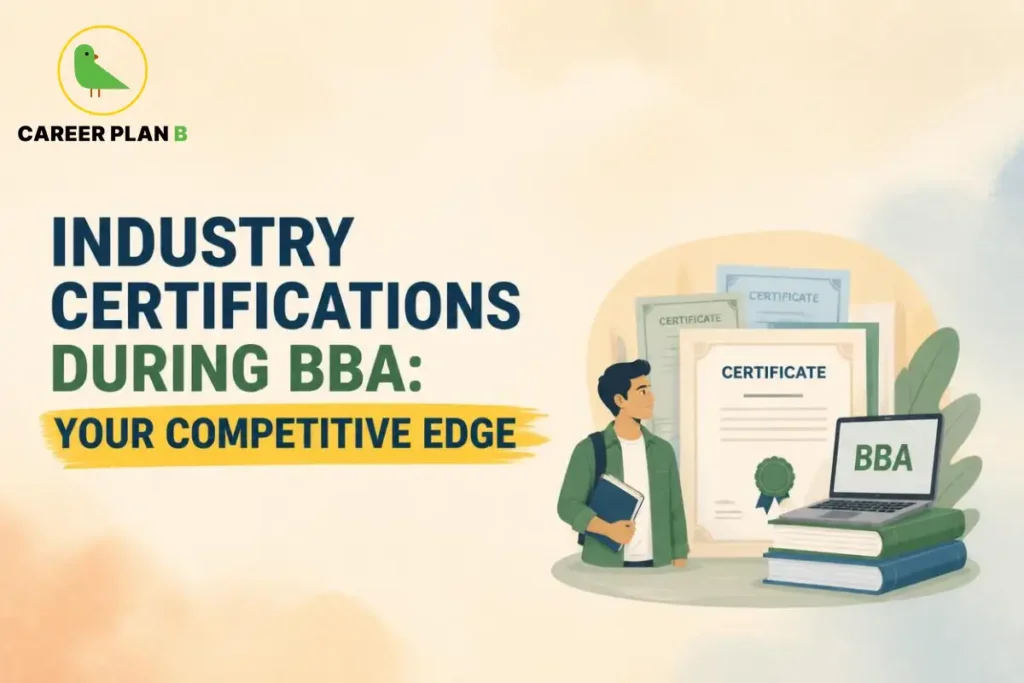
Introduction
Your BBA degree opens doors, but here’s the truth: a degree alone isn’t enough anymore. Employers want more. They want proof that you can do the job from day one. This is where industry certifications during BBA become your secret weapon.
Think of your degree as the foundation of a house. Certifications? They’re the premium finishes that make it stand out on the market. According to recent hiring trends, 78% of employers actively seek candidates with both formal education and industry-recognized certifications.
In this guide, we’ll explore which certifications matter most, how to pick the right ones, and how to balance them with your BBA coursework. Let’s dive in.
Why Industry Certifications Matter During BBA
You’re already investing three years in your BBA. Why add more?
Because professional certifications for BBA students aren’t extras—they’re smart multipliers. Here’s why they matter:
- You Stand Out in a Crowded Field
Thousands of students graduate with a BBA every year. Certifications prove you’ve gone the extra mile. When you’re competing against 50 other applicants, those credentials catch a recruiter’s eye first. - Employers See Commitment
A certification shows you’re serious about your field. You invested time and money into specialized skills. That tells employers: “This person is invested in growing.” - You Earn More
Studies show that certified professionals earn 10-15% more than those without certifications. Over a career, that’s significant money. - You Gain Real Skills, Fast
Industry certifications teach practical, job-ready skills. Your BBA gives you theory; certifications give you application.
Read More:- Skills Gained During BBA: Your Complete Career Advantage
Top Industry Certifications for BBA Students
Not all certifications are equal. Here are the ones that matter most in 2024:
Finance & Accounting Certifications
If you’re eyeing finance or accounting roles:
CFA Level 1
The Chartered Financial Analyst designation is the gold standard in finance. Many students complete Level 1 during their BBA.
- Why pursue it: Opens doors to investment banking, wealth management, and finance roles
- Official link: www.cfainstitute.org
CA Foundation (India-focused)
If you’re in India, the Chartered Accountant Foundation is highly respected.
- Why pursue it: Essential for accounting careers; improves job prospects dramatically
- Official link: www.icai.org
Digital Marketing & E-Commerce Certifications
For those interested in marketing and digital strategy:
Google Digital Marketing Certificate
One of the most affordable and respected certifications available.
- Why pursue it: Covers SEO, SEM, email marketing, and social media
HubSpot Inbound Marketing Certification
Free, comprehensive, and highly valued by employers.
- Why pursue it: Shows mastery of modern marketing techniques
- Official link: www.hubspot.com/certification
Business Management & Operations
IIBM (Indian Institute of Business Management) Certification
Offers credentials in management, HR, and operations.
- Why pursue it: Industry-recognized in South Asia; boosts management career prospects
- Official link: www.iibm.org.in
Data Analytics & Business Intelligence
Google Data Analytics Certificate
The age of big data means data skills are everywhere.
- Why pursue it: High demand, practical skills, reasonable cost
Microsoft Excel Certification
Don’t underestimate this one. Excel mastery is a superpower in business.
- Why pursue it: Every business role uses Excel; advanced skills set you apart
- Official link: www.microsoft.com/learning
How to Choose the Right Certification for You
Feeling overwhelmed? Here’s how to narrow it down:
- Ask yourself: Where do I want to work?
Finance roles need different certifications than marketing roles. Research your target industry and see what credentials they value. Use job postings as your guide—they’ll show you exactly what employers want. - Check the time and cost commitment
Some certifications take 100 hours; others take 400. Some cost ₹5,000; others cost ₹50,000. Be realistic about what fits your schedule and budget. It’s better to complete one certification fully than to start three and finish none. - Look for employer recognition
Not all certifications are equal. Choose ones that are recognized by major employers in your field. Check LinkedIn and job sites to see which certifications appear most frequently in job descriptions. - Start with one, maximum two
Avoid the trap of pursuing every certification. Quality beats quantity. Master one certification, build it into your resume, then consider a second one after your second year.
For Personalized Guidance
Balancing Certifications With Your BBA Coursework
Here’s the real challenge: How do you do both?
- Use summer breaks strategically
Don’t wait until you’re juggling five courses and a certification simultaneously. Use summer breaks to complete intensive certification programs. You’ll have fewer distractions and can focus fully. - Choose online, self-paced programs
Most modern certifications are online. Pick programs with flexible schedules so you can study when your BBA coursework is lighter. - Communicate with your college
Some colleges give credit for certain certifications or allow you to adjust your schedule. Talk to your academic advisor. Many are supportive of students pursuing professional credentials. - Aim for 5-7 hours per week
You don’t need 20 hours. Consistent, focused study of 5-7 hours per week compounds over months. That’s realistic alongside a full course load.
How Career Plan B Helps
Confused about which certification fits your goals?
Career Plan B provides personalized career counselling to identify the courses/certification that align with your strengths and ambitions.
Through Psycheintel Career Assessment Tests, we match your profile with credentials that will genuinely advance your career.
Our Career Roadmapping services help you plot a realistic timeline: which certification to pursue now, which later.
Plus, our Admission and Academic Profile Guidance ensures your certifications integrate seamlessly with your BBA, maximizing their impact.
We make the decision simple so you can focus on learning.
Get In Touch With Us
FAQs
Q1: Which certification should BBA students prioritize?
It depends on your career goal. Finance students should consider CFA Level 1; marketing students should look at Google’s Digital Marketing Certificate. Choose based on your target industry, not trends.
Q2: Can I realistically complete a certification while studying BBA?
Yes, absolutely. Most certifications take 100-200 hours total. Spread over 6 months at 5-7 hours per week, it’s manageable. The key is choosing the right time (like summer breaks) and not overcommitting.
Q3: How much does a typical certification cost?
Costs vary widely. Google certifications cost ₹3,000-5,000. CFA Level 1 costs around ₹10,000. IIBM certifications range from ₹5,000-15,000. Budget accordingly, but remember: it’s an investment in your future.
Q4: Will a certification guarantee me a job?
No certification guarantees anything alone. But combined with your BBA, good grades, and internship experience, certifications significantly improve your chances.
Q5: When should I start pursuing certifications?
Ideally, during summer after your first or second year. This gives you time during BBA and lets you highlight certifications in final-year internships and placements.
Q6: Are online certifications as valued as classroom certifications?
Yes, increasingly so. Google, HubSpot, and other providers offer online certifications that are highly respected. The key is that the credential issuer is recognized—not whether it’s online or offline.
Conclusion
Your BBA is important. But industry certifications during BBA transform it into a superpower.
Here’s what we know: Students who combine their degree with one or two well-chosen certifications graduate with clarity, confidence, and competitive advantage. They know their field. They have proof. Employers notice.
You don’t need ten certifications. You need one or two that matter in your chosen field. Start now. Pick one. Commit. Finish it. Watch what happens to your career prospects.
Ready to take the next step? Talk to a career counselor today. Let’s figure out which certification will unlock your potential. Your future self will thank you.