Team6 · July 9, 2026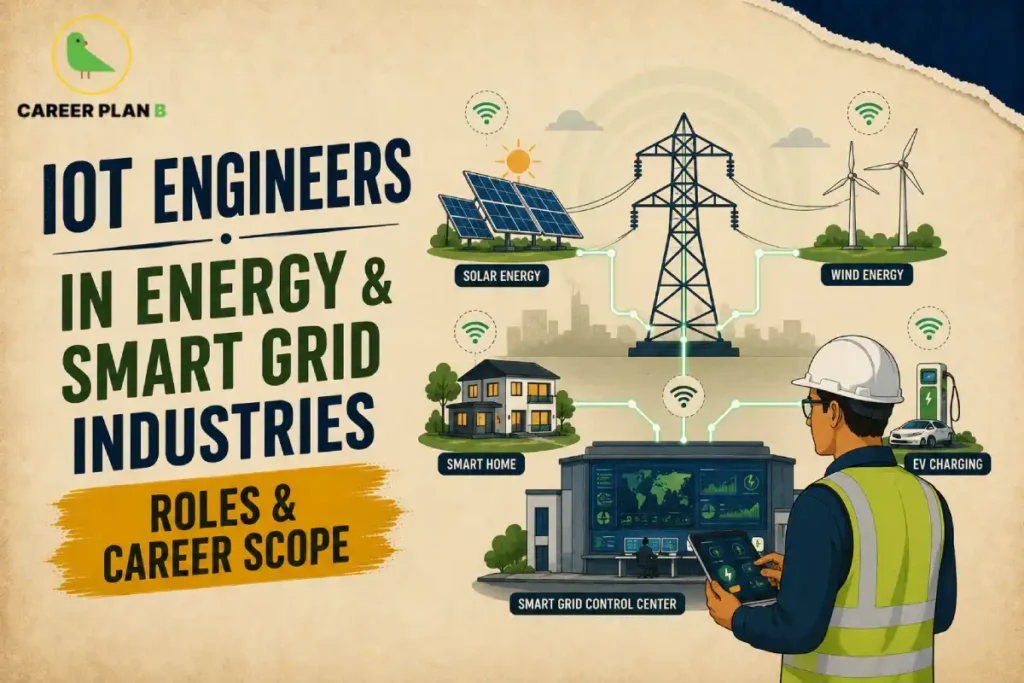
Introduction
Imagine a power grid that can predict a fault before it happens, automatically reroute electricity during a blackout, track every unit of energy consumed in real time, and seamlessly integrate solar panels from thousands of rooftops all without a single human manually intervening.
That is not a distant vision. That is what a smart grid powered by IoT looks like, and India is actively building it right now.
India’s National Smart Grid Mission (NSGM) has already deployed millions of smart meters across the country, with a target of covering 250 million consumers under the smart metering programme by 2026. Globally, the smart grid market is projected to grow from $30 billion in 2023 to over $100 billion by 2030. Every single node in this transformation, every sensor, every meter, every edge device and data pipeline needs an engineer who understands both electronics and connected systems.
This is precisely why IoT engineers in the energy and smart grid industry are among the most in-demand professionals in both the government and private energy sectors today. If you are an ECE or electronics engineer wondering where your future lies, the energy sector might just be the most important answer you have not considered yet.
This blog covers the full picture from what IoT engineers actually do in the energy sector to career scope, top recruiters, salary expectations, and the skills that get you hired.
What Is a Smart Grid and Why Does It Need IoT Engineers?
A traditional power grid is largely a one-way system; electricity flows from a power plant to your home, and the utility company has limited visibility into what is happening at the consumer end. A smart grid changes this completely.
A smart grid is an electricity network that uses digital communication, sensors, automation, and data analytics to monitor and manage the flow of electricity in real time from the generation source all the way to the end consumer. It can detect outages instantly, balance load dynamically, integrate renewable energy smoothly, and even communicate with your home appliances.
And at the core of every smart grid is IoT in smart grid technology: a dense network of connected sensors, smart meters, edge computing devices, and communication systems that collect, transmit, and act on data continuously.
This is why IoT engineers are not just useful in smart grid development; they are absolutely essential. Without professionals who understand sensor integration, wireless communication protocols, embedded systems, and cloud data platforms, a smart grid is just a concept on paper.
What Does an IoT Engineer Do in the Energy Sector?
An IoT engineer in the energy sector, often called a ‘smart energy systems engineer’, is responsible for designing, deploying, and maintaining the connected infrastructure that makes intelligent energy systems work.
Core responsibilities include:
- Designing and deploying IoT sensor networks for power equipment monitoring
- Integrating smart meters with Advanced Metering Infrastructure (AMI) systems
- Developing edge computing solutions for real-time data processing at substations
- Working with communication protocols like MQTT, Zigbee, LoRaWAN, and PLC for device connectivity
- Building and maintaining SCADA (Supervisory Control and Data Acquisition) systems for grid monitoring
- Connecting IoT devices to cloud platforms like AWS IoT or Azure IoT Hub for centralised data management
- Developing dashboards and analytics tools for energy consumption monitoring
- Ensuring cybersecurity of connected grid infrastructure
The role demands a strong blend of embedded systems knowledge, networking fundamentals, and an understanding of power systems, making ECE graduates with a focus on IoT naturally well-placed for these positions.
Have Any Doubts?
Key Applications of IoT in Smart Grid and Energy Systems
The IoT applications in power systems span every stage of the electricity value chain from generation to transmission to distribution to consumption.
1. Advanced Metering Infrastructure (AMI) and Smart Meters
Smart meters are the most visible application of IoT in the energy sector. They communicate energy consumption data in real time to utilities, enabling accurate billing, remote disconnection, tamper detection, and demand analysis. India’s smart meter rollout is being coordinated by the Ministry of Power under the Revamped Distribution Sector Scheme (RDSS).
2. Demand Response and Load Management
IoT-enabled demand response systems help utilities communicate with large consumers, factories, commercial buildings, and even homes. They encourage users to reduce or shift electricity consumption during peak demand periods. This lowers the need for expensive peak-hour power plants. It also helps stabilise grid frequency and improves overall grid efficiency.
3. Renewable Energy Integration
Solar panels and wind turbines generate variable power depending on weather conditions. IoT sensors continuously monitor generation levels and feed data into grid management systems, allowing operators to balance supply and demand in real time a critical function as India scales up its renewable energy capacity under targets set by the Ministry of New and Renewable Energy (MNRE).
4. Predictive Maintenance of Power Equipment
IoT sensors installed on transformers, switchgear, and transmission lines continuously monitor temperature, vibration, and electrical parameters. Advanced analytics detect anomalies before they become failures, dramatically reducing downtime and maintenance costs.
5. EV Charging Infrastructure Management
As electric vehicles proliferate, IoT engineers are building smart charging networks that communicate with the grid, managing charging schedules, preventing overloads, and even feeding energy back into the grid from EV batteries during peak demand.
Career Scope for IoT Engineers in the Energy Sector
The career scope for IoT engineers in the energy sector is expanding rapidly, fuelled by India’s ambitious energy transition goals and a global pivot toward intelligent power infrastructure.
India has set a target of 500 GW of renewable energy capacity by 2030, a goal that requires massive investment in grid modernisation and smart energy management. The National Smart Grid Mission (NSGM), operating under the Ministry of Power, Government of India, is the central policy framework driving this transformation. Its ongoing projects include smart metering, distribution automation, and advanced grid communication systems, all of which require IoT engineers at every level.
The Revamped Distribution Sector Scheme (RDSS), with an outlay of over ₹3 lakh crore, is specifically focused on upgrading India’s distribution infrastructure, including smart metering and IT-OT integration, creating thousands of jobs in the energy IoT space. Official details are available at Ministry of Power – RDSS.
India’s renewable energy mission is coordinated by MNRE (Ministry of New and Renewable Energy), which regularly publishes updates on solar, wind, and green hydrogen projects, all of which need IoT-enabled monitoring and management systems.
Globally, countries in Europe, the Middle East, and Southeast Asia are investing heavily in smart grid modernisation, creating strong opportunities for Indian IoT engineers with energy domain expertise to pursue international careers.
Top Recruiters for IoT Engineers in Energy and Smart Grid
The smart grid job opportunities in India are spread across government organisations, large private companies, and a growing ecosystem of cleantech startups.
Government and Public Sector Recruiters
- Power Grid Corporation of India Limited (PGCIL) India’s central transmission utility, actively modernising grid infrastructure with IoT-based monitoring and automation systems. One of the top PSU employers for smart grid engineers.
- NTPC Limited India’s largest power generation company, deploying IoT solutions across its thermal, solar, and hydro plants for predictive maintenance and performance optimisation.
- POSOCO (Power System Operation Corporation of India) The agency responsible for real-time grid operation across India. POSOCO works extensively with IoT-based data acquisition and grid management systems.
- Bureau of Energy Efficiency (BEE) Under the Ministry of Power, BEE drives energy efficiency programmes that increasingly rely on IoT-based energy monitoring and management systems.
- State DISCOMs (Distribution Companies) State electricity distribution companies across India are implementing smart metering and distribution automation projects under RDSS, creating large-scale hiring needs for IoT and smart grid engineers.
Private Sector Recruiters
- Siemens India works across smart grid automation, energy management systems, and industrial IoT. One of the most active private recruiters in the energy IoT space.
- ABB India Offers roles in grid automation, substation control systems, and IoT-enabled power management.
- Schneider Electric India recruits heavily for energy management IoT careers across smart buildings, microgrids, and distribution automation.
- Honeywell India works on building energy management systems and industrial IoT for power and utilities.
- L&T Power and L&T Technology Services Active in smart grid projects across India, with roles in IoT integration, SCADA, and energy data analytics.
Cleantech and Smart Energy Startups
India’s cleantech startup ecosystem, backed by initiatives like Startup India is producing innovative companies in solar energy monitoring, EV charging networks, demand response platforms, and energy analytics all built on IoT foundations. Startups like Tata Power Solar, Fourth Partner Energy, and Amara Raja Energy are among those building IoT-heavy energy platforms.
IoT Engineer: Roles and Salary in Energy Sector
Here is a realistic look at IoT engineer roles and salary in the energy sector for Indian graduates:
| Job Role | Fresher Salary | Experienced (3–5 yrs) |
|---|---|---|
| Embedded IoT Engineer | ₹5 – ₹9 LPA | ₹12 – ₹25 LPA |
| IoT Solutions Engineer | ₹6 – ₹10 LPA | ₹15 – ₹30 LPA |
| Smart Grid Engineer | ₹5 – ₹9 LPA | ₹14 – ₹28 LPA |
| SCADA Engineer | ₹4.5 – ₹7.5 LPA | ₹12 – ₹22 LPA |
| Energy Data Analyst | ₹4 – ₹7 LPA | ₹10 – ₹20 LPA |
| PSU Smart Grid (GATE) | ₹55k – ₹70k/mo | ₹90k – ₹1.5L/mo |
Private sector roles at companies like Siemens, ABB, and Schneider Electric offer competitive salaries with strong growth trajectories, especially for engineers who combine IoT expertise with domain knowledge of power systems. PSU roles through GATE offer exceptional stability and government-scale project exposure.
Skills Every IoT Engineer Needs for Energy and Smart Grid Roles
Breaking into energy management IoT careers require a focused combination of technical skills and domain knowledge that most engineering curricula only partially cover.
Technical skills that matter most:
- Embedded C and Python for firmware development and data processing on edge devices
- IoT Communication Protocols MQTT, Zigbee, LoRaWAN, Modbus, and DNP3 for energy-specific device communication
- SCADA and PLC systems: foundational knowledge of industrial control systems widely used in power utilities
- Cloud IoT Platforms: hands-on experience with AWS IoT Core or Microsoft Azure IoT Hub for data ingestion and analytics
- understanding of distribution networks, load flow, and grid operation gives IoT engineers a significant advantage over pure software engineers in energy roles
- Cybersecurity for IoT is a critical skill as smart grid systems become increasingly targeted by cyberattacks
Certifications that add strong value:
- NPTEL courses on Smart Grid Technology and IoT from IITs available at NPTEL
- IEEE courses and resources on smart grid standards via IEEE Smart Grid
- AWS Certified IoT Specialty or Microsoft Azure IoT Developer certifications
- Energy Auditor certification from Bureau of Energy Efficiency (BEE) adds domain credibility for energy sector roles
Practical experience tips:
- Build projects using Raspberry Pi or ESP32 with energy monitoring sensors
- Simulate smart meter data pipelines using MQTT and cloud dashboards
- Participate in energy hackathons organised under the Smart India Hackathon via SIH Official
How Career Plan B Helps
The energy and smart grid sector requires a very specific combination of IoT expertise and power systems knowledge, and navigating this path alone can be overwhelming. Career Plan B helps ECE and electronics engineering students identify the right specialisation through psychometric and career assessment tests, build a targeted plan through career roadmapping sessions, and receive personalised career counselling from experts who understand the energy industry. Whether you are targeting PGCIL, Siemens, or a cleantech startup, Career Plan B ensures your career strategy is as smart as the grid you want to help build.
For Latest Information
Frequently Asked Questions (FAQs)
Q1. Is the energy sector a good career option for IoT engineers?
With India’s massive smart metering rollout, renewable energy expansion, and grid modernisation programmes, the energy sector is one of the fastest-growing employers of IoT engineers today. The combination of government investment and private sector growth makes it a very stable and rewarding career path.
Q2. Do I need a background in electrical engineering to work in smart grid IoT roles?
ECE graduates with strong IoT, embedded systems, and communication fundamentals are well-suited for most smart grid roles. However, developing a basic understanding of power systems and grid operations significantly improves your employability and career growth in this domain.
Q3. What is the National Smart Grid Mission, and how does it create jobs?
National Smart Grid Mission (NSGM), under the Ministry of Power, is India’s policy framework for modernising the electricit</span>y grid using digital technology. Its projects, including smart metering, distribution automation, and renewable energy integration, directly create thousands of roles for IoT and smart grid engineers across PSUs, private companies, and technology vendors.
Q4. How important is GATE for a smart grid IoT career?
GATE is essential if you are targeting PSU roles at PGCIL, NTPC, or POSOCO, which recruit engineers through GATE scores. It also opens doors to M.Tech. programmes in power systems or energy technology at IITs, which can significantly accelerate your career in the energy IoT domain.
Q5. Are there global opportunities for IoT engineers in the energy sector?
Yes, significantly. Countries in Europe, the Middle East, and Southeast Asia are heavily investing in smart grid modernisation. Germany, the UAE, and Singapore, in particular, have strong demand for smart energy systems engineers with IoT expertise, making this one of the more internationally portable specialisations in ECE.
Conclusion
The energy grid that powers India and the world is undergoing its most fundamental transformation in a century. It is moving from a passive, one-directional infrastructure to an intelligent, responsive, data-driven network. And IoT engineers in the energy and smart grid industry are the professionals making this transformation possible.
From smart meters and renewable energy integration to predictive maintenance and EV charging networks, every part of this modern energy ecosystem relies on IoT technology. These innovations are transforming how electricity is generated, distributed, and managed. Career opportunities are expanding rapidly. Government investment continues to grow, and global demand for skilled IoT engineers is rising every year.
However, success in this field requires more than enthusiasm. You need the right technical skills, industry knowledge, and specialisation. A well-planned career strategy aligned with industry trends can help you stand out and build a successful future.
Start building that plan today. Visit Career Plan B and take the first step toward a smart energy career that is truly powered by purpose.