Team6 · July 9, 2026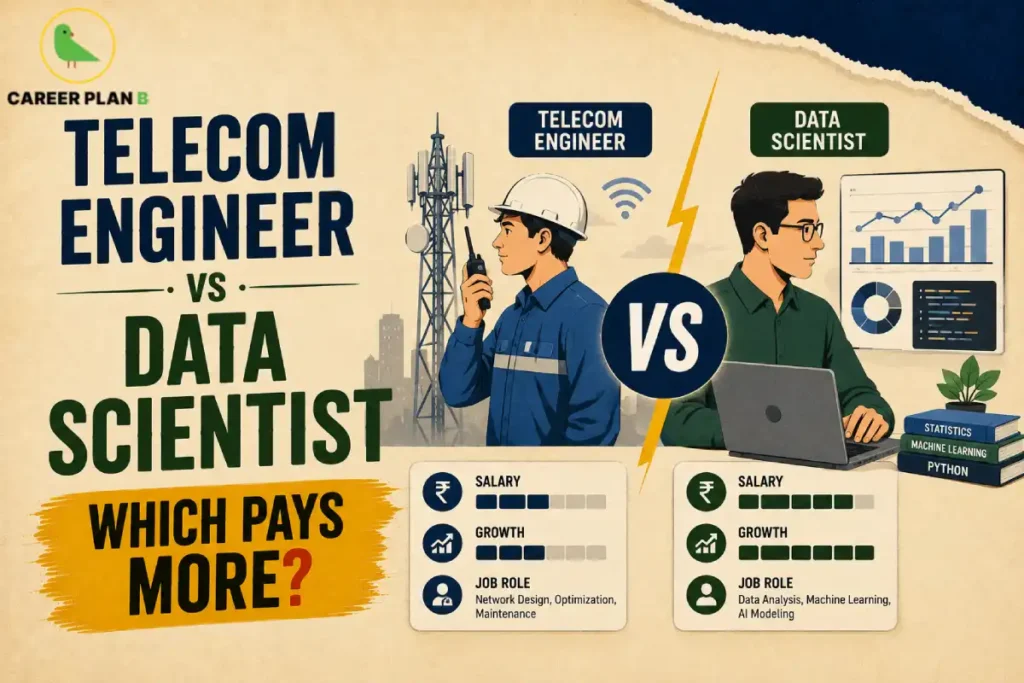
Introduction
Two careers. Two exciting opportunities. Both are shaping the future of technology. Both offer strong salaries and long-term growth. But when it comes to earning potential, career scope, and future opportunities, which path comes out on top—Telecom Engineer or Data Scientist?
The Telecom Engineer vs Data Scientist debate is one of the most relevant career conversations happening among ECE and engineering graduates today. On one side, you have the telecom engineer, the professional powering India’s 5G revolution, satellite networks, and defence communication systems. On the other hand, you have the data scientist, the professional turning raw data into business intelligence, driving decisions across every industry from banking to healthcare to e-commerce.
India’s telecom sector serves over 1.2 billion subscribers and is investing billions in 5G infrastructure. At the same time, the country’s data science and AI market is projected to reach $6 billion by 2025, according to NASSCOM. Both fields are booming, but they pay differently, grow differently, and demand very different skill sets.
This blog gives you a complete, honest comparison of Telecom Engineer vs Data Scientist covering salary, career scope, job opportunities, required skills, and which path might be the better fit for you. If you are trying to decide between these two careers, read this before you make your move.
Who Is a Telecom Engineer and What Do They Do?
A telecom engineer is a specialist in the design, development, and management of communication networks and systems. They are the professionals behind everything from your mobile network and broadband connection to satellite communication systems and defence radio networks.
Core responsibilities of a telecom engineer include:
- Designing and optimising wireless and wired communication networks
- Working on 5G network architecture, RF planning, and spectrum management
- Developing and testing communication protocols LTE, NR, VoLTE, Wi-Fi standards
- Managing network infrastructure for telecom operators and equipment vendors
- Working on satellite communication, microwave links, and fibre optic networks
- Collaborating with defence and space organisations on secure communication systems
Key tools and technologies: MATLAB, network simulation tools like NS3 and OPNET, protocol analysers, RF test equipment, and antenna design software.
Telecom engineers work across mobile operators like Jio, Airtel, and BSNL, equipment giants like Ericsson, Nokia, and Huawei, and government organisations like ISRO, DRDO, and the Department of Telecommunications.
Who Is a Data Scientist and What Do They Do?
A data scientist extracts meaningful insights from large, complex datasets using statistics, machine learning, and programming to solve real-world business problems. They are the professionals helping companies understand their customers, predict trends, and automate decision-making.
Core responsibilities of a data scientist include:
- Collecting, cleaning, and processing large structured and unstructured datasets
- Building and deploying machine learning and deep learning models
- Performing statistical analysis and predictive modelling
- Creating data visualisation dashboards for business stakeholders
- Working with big data platforms and cloud environments
- Developing NLP, computer vision, or recommendation system applications
Key tools: Python, R, SQL, TensorFlow, PyTorch, Scikit-learn, Apache Spark, Power BI, and Tableau.
Data scientists work across virtually every industry: fintech, healthcare, e-commerce, telecom, manufacturing, and government, making it one of the most cross-sectoral roles in the technology ecosystem.
Telecom Engineer vs Data Scientist: Key Differences at a Glance
| Parameter | Telecom Engineer | Data Scientist |
|---|---|---|
| Core Focus | Networks, signals, connectivity | Insights, ML models, patterns |
| Primary Skills | RF engineering, protocols, hardware | Python, statistics, ML, SQL |
| Top Industries | Telecom, Defense, Space | Fintech, E-commerce, Healthcare, AI |
| Avg. Fresher Salary | ₹4 – ₹7 LPA | ₹6 – ₹14 LPA |
| Top Tools | MATLAB, NS3, Wireshark | Python, TensorFlow, PyTorch, SQL |
Telecom Engineer Salary in India and Globally
Understanding telecom engineer salary in India requires looking at both the government and private sectors because the gap between the two is significant.
India Salary Breakdown:
| Experience Level | Private Sector (Annual) | Govt. / PSU (Monthly In-Hand) |
|---|---|---|
| Fresher (0–2 yrs) | ₹4 – ₹10 LPA | ₹45,000 – ₹70,000 |
| Mid-Level (3–5 yrs) | ₹12 – ₹25 LPA | ₹75,000 – ₹1,10,000 |
| Senior (6–10 yrs) | ₹25 – ₹50 LPA | ₹1,10,000 – ₹1,60,000 |
| Specialist (10+ yrs) | ₹50 – ₹90+ LPA | ₹1,70,000 – ₹2,50,000+ |
In the private sector, companies like Ericsson, Nokia, Qualcomm, and Samsung offer the highest telecom engineering salaries, especially for 5G and embedded communication specialists.
Global Salary Comparison:
- USA: $85,000 – $160,000 per year
- UAE / Middle East: AED 15,000 – AED 35,000 per month
- Europe (Germany, Sweden): €55,000 – €95,000 per year
India’s telecom sector is governed by the Department of Telecommunications (DoT), Government of India and regulated by TRAI (Telecom Regulatory Authority of India). Both portals regularly publish spectrum auction updates, policy changes, and 5G rollout progress, all of which directly impact hiring trends and salary benchmarks in the sector.
Data Scientist Salary in India and Globally
The data scientist salary in India has been on a consistent upward trajectory driven by the explosion of AI adoption across industries and a significant shortage of skilled professionals.
India Salary Breakdown:
| Experience Level | Annual Salary Range (INR) |
|---|---|
| Fresher (0–2 yrs) | ₹4 – ₹10 LPA |
| Mid-Level (3–5 yrs) | ₹12 – ₹25 LPA |
| Senior (6–10 yrs) | ₹30 – ₹55 LPA |
| Principal / Lead (10+ yrs) | ₹60 – ₹90+ LPA |
The highest-paying industries for data scientists in India are fintech, e-commerce, healthcare technology, and AI product companies, with startups and unicorns like Flipkart, Razorpay, and Zepto competing aggressively for top talent.
Global Salary Comparison:
- USA: $110,000 – $180,000 per year (senior roles at FAANG exceed $250,000)
- UK: £55,000 – £90,000 per year
- Singapore: SGD 80,000 – SGD 140,000 per year
India’s data science and digital economy growth is directly supported by initiatives under MeitY (Ministry of Electronics and Information Technology) including the IndiaAI Mission and the National Data Governance Framework, both of which are expanding the ecosystem for data professionals across government and private sectors. NASSCOM, the industry body for India’s tech sector, regularly publishes data science hiring trend reports accessible via their official portal.
Career Scope: Telecom Engineer vs Data Scientist
Career Scope for Telecom Engineers
The career scope for telecom engineers is being reshaped by two major forces: India’s 5G rollout and the government’s push for indigenous telecom technology.
India’s 5G network deployment, one of the fastest in the world, is creating massive demand for RF engineers, network optimisation specialists, and protocol developers. The PM Gati Shakti National Broadband Mission and the BharatNet project, both overseen by DoT are connecting rural India with high-speed broadband, generating sustained demand for telecom infrastructure engineers at every level.
The government’s push for indigenous 5G technology through initiatives like the Telecom Technology Development Fund (TTDF), managed by TRAI is creating R&D opportunities for telecom engineers at startups, academic institutions, and public sector organisations.
Beyond 5G, satellite communication is a booming frontier. With the opening of India’s space sector to private players and organisations like ISRO pushing satellite broadband available at ISRO telecom engineers with satellite systems expertise are in particularly high demand.
Data Science Career Opportunities
The data science career opportunities in India are among the broadest of any technology role precisely because data is generated in every industry.
India’s National AI Strategy and the IndiaAI Mission under MeitY are building a national AI ecosystem that will significantly expand government-sector data science roles from the National Informatics Centre (NIC) to smart city platforms and digital health systems.
In the private sector, every major industry – banking, insurance, retail, logistics, healthcare, and agriculture – is investing in data science capabilities. The rise of generative AI has further accelerated hiring, with companies racing to build AI teams capable of fine-tuning large language models, building RAG systems, and deploying AI products at scale.
Which Has Better Job Opportunities: Telecom or Data Science?
When comparing telecom vs. data science, which is better purely on job volume? Data science currently has the edge primarily because it applies across every industry, while telecom engineering is more sector-specific.
Job volume comparison (India, 2024–2025):
- Data scientist and ML engineer roles: 95,000+ active openings annually (NASSCOM estimates)
- Telecom engineer roles: 35,000–50,000 active openings annually but growing sharply with 5G
However, job volume is not the full picture. Telecom engineers face less competition per role because the skill set is more specialised. Data science, while offering more openings, is also attracting graduates from every engineering background, making it a more competitive field to break into without a strong portfolio.
The emerging hybrid opportunity: One of the most exciting career paths in both fields is the Telecom Data Scientist a professional who combines network engineering knowledge with machine learning expertise to build predictive models for network optimisation, anomaly detection, and traffic forecasting. Companies like Ericsson, Nokia, and Jio are actively building teams with this combined skill set and paying a premium for it.
Have Any Doubts?
Skills Required: Telecom Engineer vs Data Scientist
Understanding telecom engineer vs data scientist skills and roles helps you identify where your natural strengths align.
Telecom Engineer – Core Skills:
- RF and antenna engineering, spectrum analysis
- Communication protocols LTE, 5G NR, Wi-Fi, Bluetooth
- Network design and simulation tools NS3, OPNET, MATLAB
- Embedded systems and real-time signal processing
- Optical fibre and transmission systems knowledge
Data Scientist – Core Skills:
- Programming in Python and R for data analysis and ML
- Statistical modelling, probability, and hypothesis testing
- Machine learning frameworks: TensorFlow, PyTorch, Scikit-learn
- SQL and big data tools: Spark, Hadoop, Hive
- Data visualization: Power BI, Tableau, Matplotlib
Overlapping skills that benefit both careers:
- Python used for network automation in telecom and for ML in data science
- Signal processing is fundamental to telecom and increasingly applied in ML for audio, radar, and communications
- Statistics and probability are essential for both network performance analysis and machine learning model building
Certifications that strengthen each path:
- Telecom: NPTEL courses on Wireless Communication and 5G from IITs NPTEL; Cisco and Ericsson certifications
- Data Science: NPTEL courses on Machine Learning and Data Analytics NPTEL; Google, IBM, and AWS data science certifications
How Career Plan B Helps
Choosing between a telecom engineering career and a data science career is not just a salary decision; it is a decision about your strengths, interests, and long-term professional identity. Career Plan B helps you make this choice with complete clarity through psychometric and career assessment tests that reveal your natural aptitude for technical domains, personalised career counselling from industry experts, and career roadmapping sessions that lay out a step-by-step plan tailored to your goals. Whether you are leaning toward 5G networks or machine learning models or the exciting intersection of both, Career Plan B ensures your decision is backed by self-awareness, not guesswork.
For Latest Information
Frequently Asked Questions (FAQs)
Q1. Which career pays more in India: telecom engineer or data scientist?
At the fresher and mid-level stages, data scientists typically earn slightly more, ranging from ₹5 to ₹20 LPA, compared to telecom engineers at ₹3.5 to ₹14 LPA in the private sector. However, senior telecom specialists, especially in 5G, satellite, and defence communication, command very competitive salaries that are comparable to experienced data scientists’. The gap narrows significantly with experience and specialisation.
Q2. Can an ECE graduate become a data scientist?
Absolutely. ECE graduates have strong foundations in mathematics, signal processing, and programming, all of which are core to data science. With focused upskilling in Python, machine learning, and statistics through NPTEL courses, online certifications, or dedicated data science programmes, ECE graduates can transition into data science roles effectively.
Q3. Is telecom engineering still a good career with the rise of data science?
Yes, very much so. Telecom engineering is evolving, not declining. The 5G rollout, satellite broadband expansion, and indigenous telecom technology development under DoT are creating strong new opportunities. Telecom engineers who also develop data science skills are particularly well-positioned for the next decade.
Q4. Which field has better global opportunities: telecom or data science?
Both have strong global demand, but in different geographies. Data science roles are abundant across the USA, UK, Singapore, and Canada with very high salaries. Telecom engineering roles are particularly strong in the Middle East, Europe (Sweden, Germany, and Finland, home to Ericsson and Nokia), and Southeast Asia. Data science has a slight edge in terms of global volume and salary at the top end.
Conclusion
The Telecom Engineer vs Data Scientist debate does not have a single winner because the right answer depends entirely on who you are, what you enjoy doing, and where you want to be in ten years.
If you are fascinated by networks, wireless systems, 5G infrastructure, and communication technology and want to work on the systems that literally connect the world, telecom engineering is a deeply rewarding and financially strong career path.
If you are drawn to data, algorithms, prediction, and the power of turning numbers into insights that drive decisions across every industry, data science offers one of the highest salary ceilings and widest career canvases in technology today.
Whatever your direction, make sure it is built on genuine self-awareness, not just salary comparisons. Visit Career Plan B today and get the personalised guidance you need to choose the career that is truly built for you.