Team6 · August 12, 2026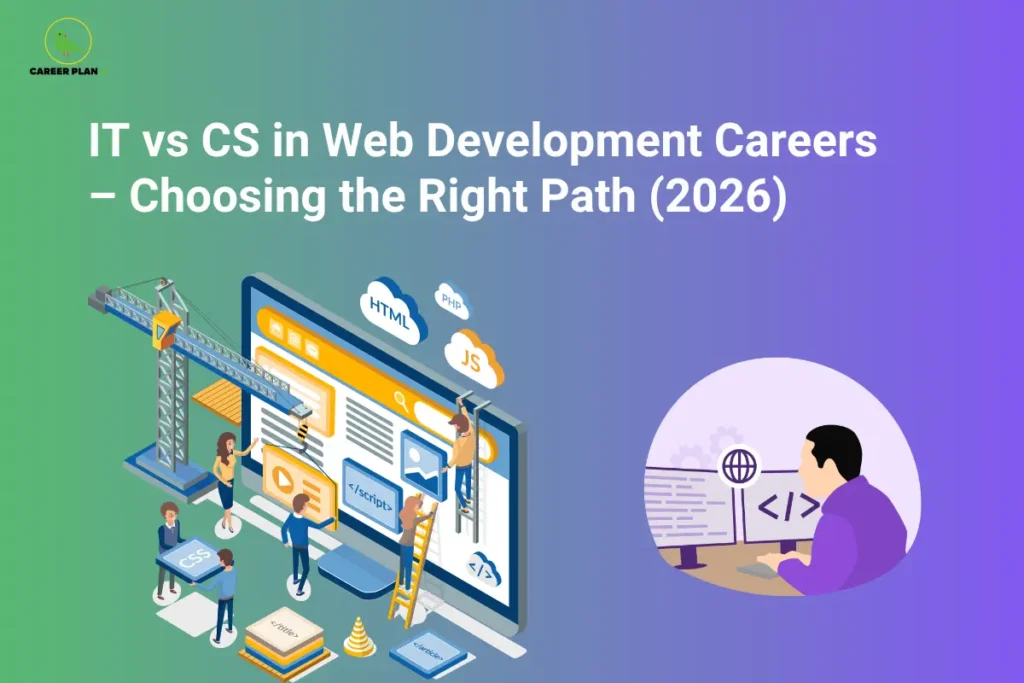
Introduction
If you’re wondering IT vs CS in web development careers, you’re not alone. Web development remains one of the most attractive tech fields for both Information Technology (IT) and Computer Science (CS) graduates but the reasons may differ based on your academic background, technical strengths, and career goals. In an era where online presence is essential for businesses of all sizes, web developers professionals who design, build, and maintain websites and web applications are in steady demand. According to the U.S. Bureau of Labor Statistics, employment of web developers and digital designers is projected to grow about 7–8 percent from 2024 to 2034, much faster than the average for all occupations, with thousands of job openings each year. This sustained demand highlights that web development careers for IT graduates and web development careers for CS students are both viable and rewarding paths. (Bureau of Labor Statistics)
In this blog, we’ll explore how IT and CS backgrounds affect your journey in web development, the skills and tools you’ll need, typical salary expectations based on verified data, how you can grow your career, and how Career Plan B can help you navigate your development path confidently.
What Makes Web Development Attractive for IT and CS Graduates?
Web development careers thrive on a mix of creativity, logic, and problem‑solving. For IT graduates, the appeal often lies in applying practical knowledge of systems, networks, and databases to real‑world applications. You may already understand server configurations, cloud deployments, and basic scripting all of which are useful when building backend systems or deploying web applications.
For CS students, a strong foundation in algorithms, data structures, and software design makes front‑end and back‑end programming feel familiar and logical. CS teaches you how to break down complex problems and create efficient solutions, which is highly valuable when building dynamic, scalable web applications using languages like JavaScript, Python, or Java.
Both IT and CS backgrounds can lead to roles such as front‑end developer, back‑end developer, or full‑stack developer, where you work with a variety of tools and frameworks to create seamless user experiences. What ties both paths together is the ongoing need for developers who can build responsive, secure, and high‑performance web platforms in an increasingly digital world.
How IT and CS Training Shape Web Development Roles
When comparing IT vs CS in web development careers, it helps to understand how typical course work prepares you for technical responsibilities.
IT programs often emphasize infrastructure, networks, system administration, and basic scripting. These are particularly useful when managing server‑side logic, deployment pipelines, and understanding how web applications interact with operating systems and cloud environments. An IT graduate transitioning into web development might find back‑end work, database integration, and cloud deployment especially intuitive.
Computer Science programs, meanwhile, focus on software design, algorithms, data structures, and programming paradigms. This strong computational emphasis is advantageous when writing complex application logic, optimizing performance, or architecting interactive front‑end experiences with frameworks like React or Angular.
Ultimately, both IT and CS paths can converge into full‑stack development roles, where mastery over both infrastructure and application logic sets you up for leadership positions like lead developer or web architect.
Key Skills You Need in Web Development
To excel in web development regardless of your background, certain core skills are indispensable. All web developers must understand the basic building blocks of a website: HTML for structure, CSS for styling, and JavaScript for interactivity. These languages are universal regardless of whether you come from IT or CS.
CS graduates often extend these basics by learning algorithms, object‑oriented programming, and more advanced frameworks. They might also find it easier to dive into software design patterns and large‑scale code organization.
IT graduates can complement their foundational strengths in systems with skills in server‑side development, database management (SQL/NoSQL), and deployment tools. Familiarity with cloud platforms like AWS or Azure including services for storage, hosting, and serverless computing equips you for modern workflows where web applications run globally with high reliability.
Additionally, mastering tools like Git for version control, DevOps basics for automated deployment, and UX/UI understanding for user‑centered design makes you a versatile professional capable of handling a wide range of web development challenges.
Certifications That Strengthen Your Development Career
While a degree builds foundational knowledge, web development certifications can significantly boost credibility and demonstrate practical expertise to employers. For both IT and CS graduates, certifications validate your hands‑on skills and can help your resume stand out in competitive markets.
For IT students, cloud certifications such as AWS Certified Developer – Associate or Microsoft Azure Developer help demonstrate your ability to deploy and manage web applications in modern cloud environments. These are especially valuable when web applications need scalable infrastructure support.
CS students might focus on certifications like Certified Full‑Stack Web Developer, or technology‑specific credentials such as JavaScript/React Certification or Node.js Developer Certification. These certificates signal your proficiency in core web technologies and frameworks used in real projects.
By combining certifications with portfolio projects, live websites, web apps, or contributions to open source you show both theoretical knowledge and practical experience to potential employers.
Have Any Doubts?
Salary Expectations for Web Developers (Verified Data)
Understanding salary potential is crucial when comparing IT vs CS in web development careers. According to the U.S. Bureau of Labor Statistics, the median annual wage for web developers and digital designers was around $90,930 in May 2024, with higher medians reported for related roles like web and digital interface designers. Employment for these professionals is expected to grow about 7 percent through 2034, faster than the average for all occupations, driven by e‑commerce expansion and mobile web use. (Bureau of Labor Statistics)
This salary benchmark reflects broad opportunities across front‑end, back‑end, and full‑stack roles. The range can vary widely depending on experience, specialization, and region. For instance, developers with cloud integration expertise or full‑stack capabilities often negotiate higher compensation due to their ability to handle both client‑side and server‑side responsibilities.
Career Growth and Long‑Term Opportunities
One of the reasons IT vs CS in web development careers continues to be a popular debate is how each background can fuel different growth trajectories. Entry‑level web developers whether from IT or CS — often start by focusing on specific areas: front‑end interfaces or back‑end logic. As you gain experience, taking on full‑stack development roles opens opportunities in leadership and design thinking.
Seasoned developers may move into roles like Senior Web Developer, Lead Developer, or Web Architect, where you oversee complex systems, mentor teams, and make high‑level decisions on technology stacks. Some professionals branch into mobile app development, DevOps engineering, or cloud solutions architecture, integrating broader infrastructure responsibilities with development expertise.
With continuous learning, web development can be a gateway to advanced technical leadership, a path equally accessible to both IT and CS graduates.
How Career Plan B Helps
Deciding between IT vs CS in web development careers and planning your path forward can feel confusing without guidance. Career Plan B helps you map a strategic career roadmap by providing personalized career counselling, Psycheintel and career assessment tests to identify strengths, certification guidance, and practical advice on real‑world skills. This tailored support helps IT and CS graduates understand which roles align with their background and how to build a plan that accelerates growth in web development with confidence.
For Latest Information
Frequently Asked Questions (FAQs)
Q1. Which background is better for web development: IT or CS?
Both backgrounds provide strong foundations: IT graduates excel in systems and deployment, while CS graduates often master programming and design. Your best choice depends on interests and career goals.
Q2. Do I need certifications to succeed?
Certifications enhance your profile and show practical expertise, but hands-on projects and portfolios are equally important.
Q3. What is the job outlook for web developers?
Web development jobs are expected to grow about 7 percent from 2024–2034, much faster than average, with roughly 14,500 openings annually.
Q4. Can IT graduates transition into front‑end roles?
Yes. With practice in core languages like HTML, CSS, and JavaScript, IT graduates can thrive in front‑end and full‑stack roles.
Q5. Is web development still relevant in 2026?
Absolutely. As businesses continue to expand digital experiences and mobile web usage grows, web development remains central to the tech ecosystem.
Conclusion
When comparing IT vs CS in web development careers, there’s no one‑size‑fits‑all answer. IT graduates bring strengths in systems, deployment, and infrastructure, while CS graduates often thrive in algorithmic thinking and software design. Both paths lead to rewarding careers in web development, and the best choice aligns with your interests, strengths, and long‑term goals. By building key skills, pursuing relevant certifications, crafting a strong portfolio, and planning strategically with Career Plan B, you can launch and grow a successful career in web development. Whether you’re building responsive sites, dynamic web applications, or scalable platforms, web development remains a future‑ready and high‑growth field in 2026 and beyond.