Team5 · July 30, 2026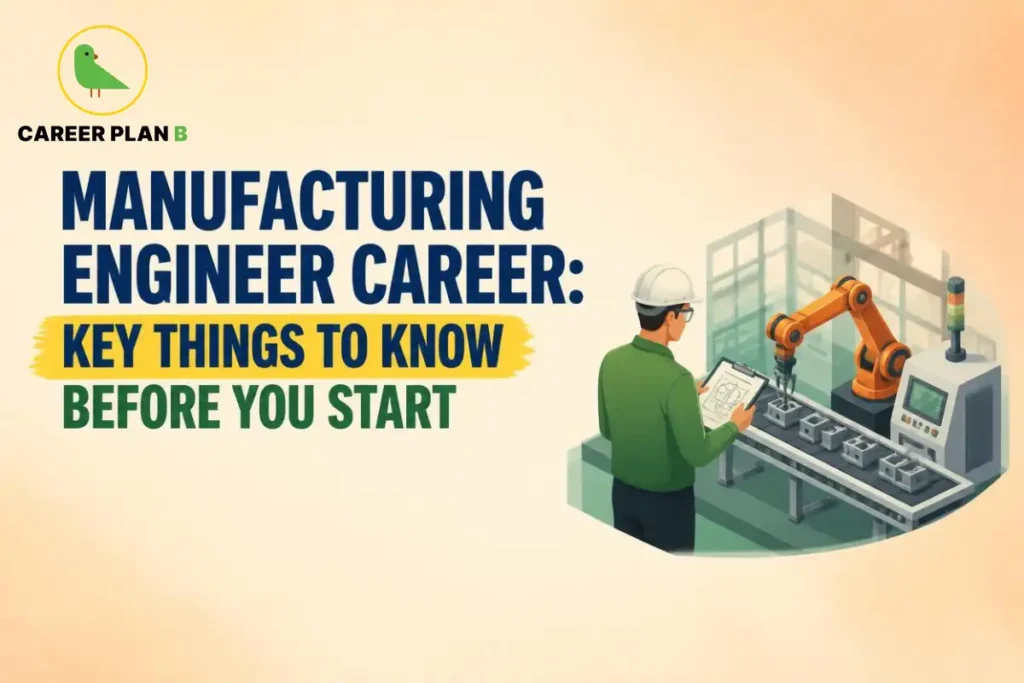
Introduction
Every product you use, the phone in your hand, the car you ride in, and the medicines you take exist because a manufacturing engineer made sure they could be built efficiently, safely, and at scale. Yet despite being one of the oldest and most essential engineering disciplines, a manufacturing engineer career is widely misunderstood. Many students picture it as a job spent standing on a noisy factory floor. The reality is far more dynamic. Today, manufacturing engineers are driving smart factories, leading automation projects, and sitting at the heart of India’s industrial growth story.
What Does a Manufacturing Engineer Actually Do?
Understanding what a manufacturing engineer does is the first step before choosing this career.
At its core, a manufacturing engineer is responsible for designing, optimising, and overseeing the processes used to produce goods. They bridge the gap between a product’s design and its actual production, ensuring that what looks good on paper can be built efficiently, consistently, and cost-effectively in the real world.
Their day-to-day responsibilities typically include:
- Designing and improving production processes and workflows
- Selecting and managing machinery, tools, and equipment
- Identifying and eliminating inefficiencies on the production line
- Ensuring quality control and compliance with safety standards
- Collaborating with design engineers, supply chain teams, and factory managers
They work across industries including automotive, aerospace, pharmaceuticals, consumer electronics, food and beverage, and heavy machinery.
How Manufacturing Engineering Has Changed in the Industry 4.0 Era
Industrial automation and engineering have fundamentally transformed this career. Smart sensors, robotics, AI-driven quality control, and real-time data analytics are now standard tools on modern production floors. A manufacturing engineer today is as likely to be programming a robotic cell as they are to be redesigning a physical workflow.
Things You Must Know Before Choosing a Manufacturing Engineer Career
It Is More Than Just the Factory Floor
The biggest misconception about a career in manufacturing and production is that it is purely hands-on, shop-floor work. In reality, manufacturing engineers spend significant time on process design, data analysis, cross-functional meetings, vendor management, and continuous improvement projects. It is a strategic role as much as a technical one.
You Will Work at the Intersection of Design and Production
Manufacturing engineers serve as the vital link between what product designers envision and what production teams can actually deliver. You will regularly work with design engineers to ensure products are manufacturable, a skill known as Design for Manufacturability (DFM). This requires both technical knowledge and strong communication skills.
Problem-Solving Is Your Biggest Daily Tool
Every production line faces bottlenecks, defects, and inefficiencies. A manufacturing engineer’s primary value lies in identifying root causes and implementing lasting solutions. If you enjoy diagnosing problems and building systems that prevent them from recurring, this career will feel deeply satisfying.
Continuous Learning Is Non-Negotiable
Manufacturing technology evolves rapidly. Industrial automation and engineering concepts that were cutting-edge five years ago are now baseline expectations. Engineers who stay current with lean manufacturing, Six Sigma, automation, and smart factory technologies will always remain relevant and competitive.
Expect to Work in Teams Always
Manufacturing engineering is never a solo pursuit. You will constantly collaborate with design teams, quality assurance, supply chain managers, and factory operators. Strong interpersonal skills and the ability to communicate technical ideas clearly are just as important as your engineering knowledge.
What Skills Does a Manufacturing Engineer Career Demand?
Building the right manufacturing engineering skills early will set you apart in a competitive job market.
Technical Skills:
- CAD and CAM software: SolidWorks, AutoCAD, CATIA
- Lean Manufacturing and Six Sigma methodologies
- Process simulation and optimisation tools
- ERP systems: SAP, Oracle
- Knowledge of GD&T (Geometric Dimensioning and Tolerancing)
- Understanding of CNC machining, robotics, and automation systems
- Quality management systems ISO 9001, IATF 16949
Soft Skills:
- Analytical thinking and structured problem-solving
- Strong written and verbal communication
- Project management and time management
- Cross-functional collaboration
- Adaptability to new technologies and processes
Educational Pathways: How Do You Qualify?
Relevant Degrees:
- B.Tech or B.E. in Mechanical Engineering, Production Engineering, Industrial Engineering, or Manufacturing Technology
- M.Tech in Manufacturing Systems Engineering or Advanced Manufacturing
- Diploma programmes in Manufacturing and Production Technology
Top Indian Institutions:
- Indian Institute of Technology, Madras
- Indian Institute of Technology, Bombay
- For AICTE-approved institutions offering manufacturing and production engineering programmes across India
Have Any Doubts?
Manufacturing Engineer Job Opportunities and Salary Snapshot
Manufacture engineer job opportunities are among the most consistently available in the engineering sector, spanning both established conglomerates and fast-growing startups.
Industries Actively Hiring:
- Automotive: Tata Motors, Maruti Suzuki, Mahindra, Honda
- Aerospace and Defence: HAL, DRDO, Boeing India
- Pharmaceuticals: Sun Pharma, Cipla, Dr. Reddy’s
- Consumer Electronics: Samsung, LG, Dixon Technologies
- Heavy Engineering: Larsen and Toubro, Thermax, BHEL
Manufacturing Engineer Salary: India vs Global
| Role | Average Salary (India) | Global Range |
|---|---|---|
| Junior Manufacturing Engineer | ₹3.5–7 LPA | $55,000–$75,000 |
| Process Engineer | ₹6–12 LPA | $75,000–$100,000 |
| Senior Manufacturing Engineer | ₹10–18 LPA | $95,000–$130,000 |
| Manufacturing Manager / Lead | ₹15–28 LPA | $110,000–$160,000 |
How Career Plan B Helps
A manufacturing engineer career involves many choices, from selecting the right specialisation to identifying industries that match your strengths and long-term goals. Career Plan B offers personalised career counselling, the PsycheIntel psychometric and career assessment tool, and structured career roadmapping to help you determine whether manufacturing engineering skills align with your natural aptitude and ambitions. Whether you are a student choosing between engineering branches or a professional looking to advance within a career in manufacturing and production, Career Plan B gives you the clarity and direction to make confident, informed decisions.
For Latest Information
Frequently Asked Questions
- Which engineering degree is best for a manufacturing engineer career?
A B.Tech. in mechanical engineering or production engineering is the most common and widely accepted entry point. Industrial engineering and mechatronics are also excellent choices.
- Is a manufacturing engineer career a good option in India?
Absolutely. With the Make in India initiative and India’s push to become a global manufacturing hub, demand for skilled manufacturing engineers across automotive, aerospace, electronics, and pharmaceutical sectors is growing steadily year on year.
- How is industrial automation and engineering changing this career?
Industrial automation and engineering are reshaping the role significantly.
- Can I switch into manufacturing engineering from a different background?
Yes. Professionals from mechanical, electrical, or industrial engineering backgrounds can transition into manufacturing roles by upskilling.
- What is the long-term salary growth in a manufacturing engineer career?
Manufacturing engineer salary growth is strong, especially for those who move into senior process, quality, or plant management roles.
Conclusion
A manufacturing engineer career is not what most people imagine; it is far broader, more strategic, and more future-orientated than the stereotypes suggest. From mastering manufacturing engineering skills to leveraging the future of manufacturing technology, this career offers intellectual challenge, strong compensation, and genuine impact across every industry that makes physical products.
If you are someone who loves solving real-world problems, bridging creativity with practicality, and building systems that work at scale, this career was designed for you.
Not sure if manufacturing engineering is the right fit for your strengths and goals? Visit Career Plan B for personalised counselling, career assessments, and a roadmap tailored entirely to you.