Team Career Plan B · July 18, 2026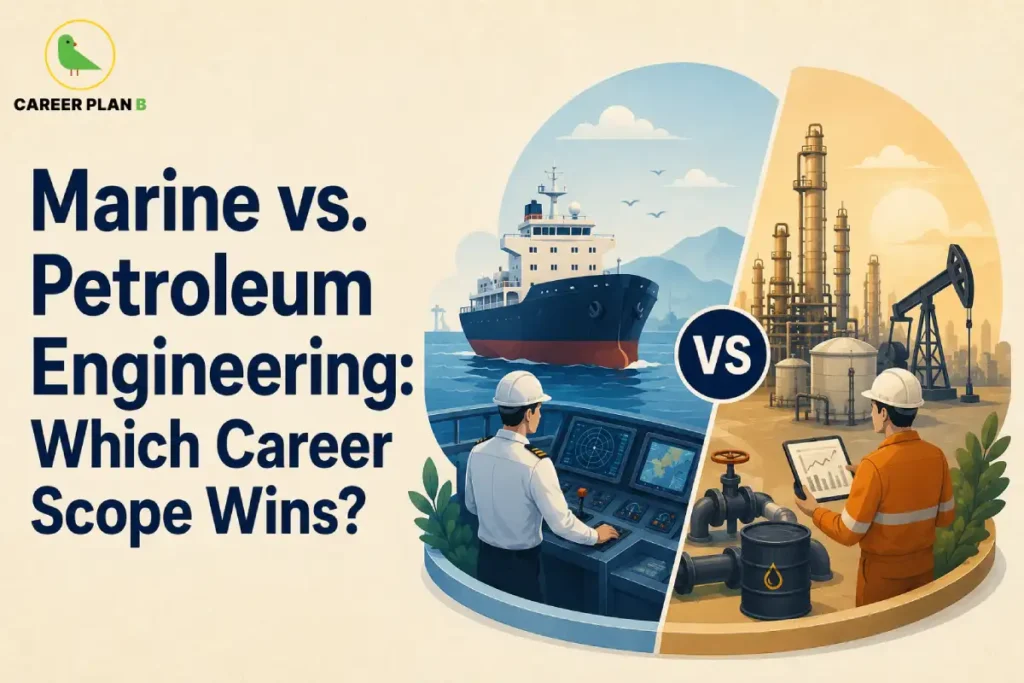
Introduction
Energy and shipping quietly run the entire world. Every phone you charge, every product you buy, and every litre of fuel you pump depends on people working in these two industries. Yet very few students actually understand what marine and petroleum engineers do on a daily basis, which is exactly why ‘marine engineering vs petroleum engineering’ has become one of the most searched career comparisons among students choosing engineering after 12th. Both fields involve heavy machinery. A often mean offshore work. Both promise strong salaries and global exposure. On the surface, they look similar enough to confuse even sharp students. But dig one layer deeper, and you’ll find they’re built on completely different foundations: marine engineering is about moving goods and people across oceans, while petroleum engineering is about finding, extracting, and processing the energy that powers everything else.
What Is Marine Engineering?
Marine engineering deals with the design, operation, and maintenance of everything that keeps a ship running engines, boilers, generators, pumps, refrigeration systems, and electrical setups onboard vessels. A typical marine engineer career scope starts right after graduation with sea time as a trainee engineer, followed by a structured rank progression: 4th Engineer, 3rd Engineer, 2nd Engineer, and eventually Chief Engineer, the highest-ranking engineering officer on a ship. This climb usually takes 8-10 years and requires clearing Certificate of Competency (CoC) exams at each stage.
Many marine engineers eventually transition to shore-based roles in ship management companies, marine surveying, port operations, or maritime consultancy after several years at sea. In India, marine engineering education, licensing, and certification are regulated by the Directorate General of Shipping (DG Shipping), the official government authority responsible for maritime training standards and seafarer certification.
What Is Petroleum Engineering?
Petroleum engineering focuses on locating, extracting, and processing oil and natural gas. It has three major sub-fields:
- Drilling engineering – planning and executing the actual drilling of wells
- Reservoir engineering – studying underground reservoirs to maximize extraction efficiency
- Production engineering – managing the flow of oil/gas from well to surface facilities
Petroleum engineers typically work at onshore drilling sites, offshore rigs and platforms, or refineries or in corporate roles focused on research and planning. Offshore postings often mean rotational schedules weeks on the rig, followed by weeks off. In India, exploration and production activities are regulated by the Directorate General of Hydrocarbons (DGH), the official technical regulatory body under the Ministry of Petroleum and Natural Gas, which oversees licensing, exploration policy, and reservoir management standards.
Marine Engineering vs Petroleum Engineering: Key Differences
| Factor | Marine Engineering | Petroleum Engineering |
|---|---|---|
| Work Environment | Ships (engine room) | Rigs, platforms, refineries |
| Study Duration | 4 years (B.E./B.Tech. Marine) | 4 years (B.E./B.Tech Petroleum) |
| Entry Route | IMU CET, DG Shipping-approved institutes | JEE, state entrance exams, GATE (for PSUs) |
| Physical Demands | High (long sea duty, isolation) | High (hazardous rig environment) |
| Rotation Pattern | Months at sea, then shore leave | Rig rotation, or fixed office hours (desk roles) |
| Industry Dependency | Global trade volume | Oil & gas demand, energy policy |
Which Pays More? Marine vs Petroleum Engineering Salary
Marine engineering salary in India tends to be strong right from the entry level. A 4th engineer can often out-earn many freshers in other engineering fields, thanks to sea allowances and favourable tax treatment on income earned during international voyages.
Petroleum engineering salary in India varies more widely depending on the employer. PSU roles (ONGC, OIL) offer stable, respectable pay with strong benefits, while private multinational drilling and service companies can offer significantly higher packages, especially for specialized reservoir or drilling engineers with international offshore experience.
At a senior level, petroleum engineering often has a higher pay ceiling; specialized reservoir engineers and drilling supervisors with 10+ years of experience can earn substantially more than a chief engineer at sea. But marine engineering usually offers faster salary growth in the early years due to rank-based pay jumps.
Have Any Doubts?
Future Scope: Which Branch Has Better Growth?
Is Petroleum Engineering Still Worth It in the Renewable Energy Era?
This is the question every prospective student asks. While renewable energy is growing, global oil and gas demand hasn’t disappeared; it’s still projected to remain significant for the next couple of decades. Petroleum engineering’s future scope does face long-term pressure from the energy transition, but the field is adapting, with engineers increasingly working on carbon capture, gas exploration, and hybrid energy projects.
Will Automation Replace Marine Engineers?
Ships are becoming more automated, and some routine engine-room tasks are now monitored remotely. This is gradually reducing crew sizes on newer vessels. However, human oversight remains essential for safety-critical systems, so demand for skilled marine engineers isn’t disappearing; it’s shifting toward more technically skilled roles.
Lifestyle and Work Environment
- Marine engineers spend extended periods at sea with limited connectivity but enjoy long shore leaves and tax-free sea income.
- Petroleum engineers on rigs face demanding, hazardous conditions during rotations, but many desk-based reservoir and planning roles offer regular, office-based schedules with far more stability.
Which Engineering Branch Is Better for You?
- Enjoy structured rank progression and time at sea? → Marine engineering
- Interested in geology, subsurface data, and drilling technology? → Petroleum engineering
- Want strong early-career pay? → Marine engineering
- Want a higher long-term pay ceiling in a specialized technical role? → Petroleum engineering
There’s no single answer to which engineering branch is better; it comes down to your tolerance for time away from home, your interest in ships versus geology, and your risk appetite for either automation or the energy transition.
How Career Plan B Helps
Choosing between marine and petroleum engineering means weighing your interests against two very different working lives. Career Plan B offers personalized career counselling, PsycheIntel and career assessment tests, and academic profile guidance to help identify which path fits you, backed by a clear career roadmap to move forward with confidence.
For Latest Information
Frequently Asked Questions
- Which is better, marine or petroleum engineering?
Neither is universally better. Marine offers faster early pay growth, while petroleum often has a higher long-term ceiling in specialized roles.
- Is petroleum engineering a good career in 2026?
Yes, though it faces long-term pressure from the renewable energy transition. Oil and gas demand remains significant for now, and specialized skills stay in demand.
- Does marine engineering pay more than petroleum engineering?
Early on, often yes, due to sea allowances. Petroleum engineering can overtake it at senior, specialized levels.
- Is petroleum engineering physically demanding?
Yes, especially drilling and offshore rig roles, though many reservoir and planning positions are desk-based.
- Can a petroleum engineer work offshore like a marine engineer?
Yes, offshore rig postings involve rotational schedules, but the work itself (drilling and extraction) differs completely from a ship’s engine room operations.
- Which has more job security?
Marine engineering has steadier demand tied to global trade; petroleum engineering’s security depends more on energy policy and oil price cycles.
Conclusion
The marine engineering vs petroleum engineering debate isn’t really about which field is “better”; it’s about which working life suits you. Marine engineering rewards those comfortable with structured sea duty and faster early earnings. Petroleum engineering rewards those drawn to geology, drilling technology, and a potentially higher long-term ceiling. Take time to reflect on what matters more to you: routine versus specialization, ships versus rigs, or early pay versus long-term growth. And if you’re still torn, speaking with a career counsellor can help you make a decision based on your actual strengths, not just salary comparisons.
The right career isn’t the one with the bigger paycheque on paper; it’s the one you can see yourself doing for the next 20 years.